
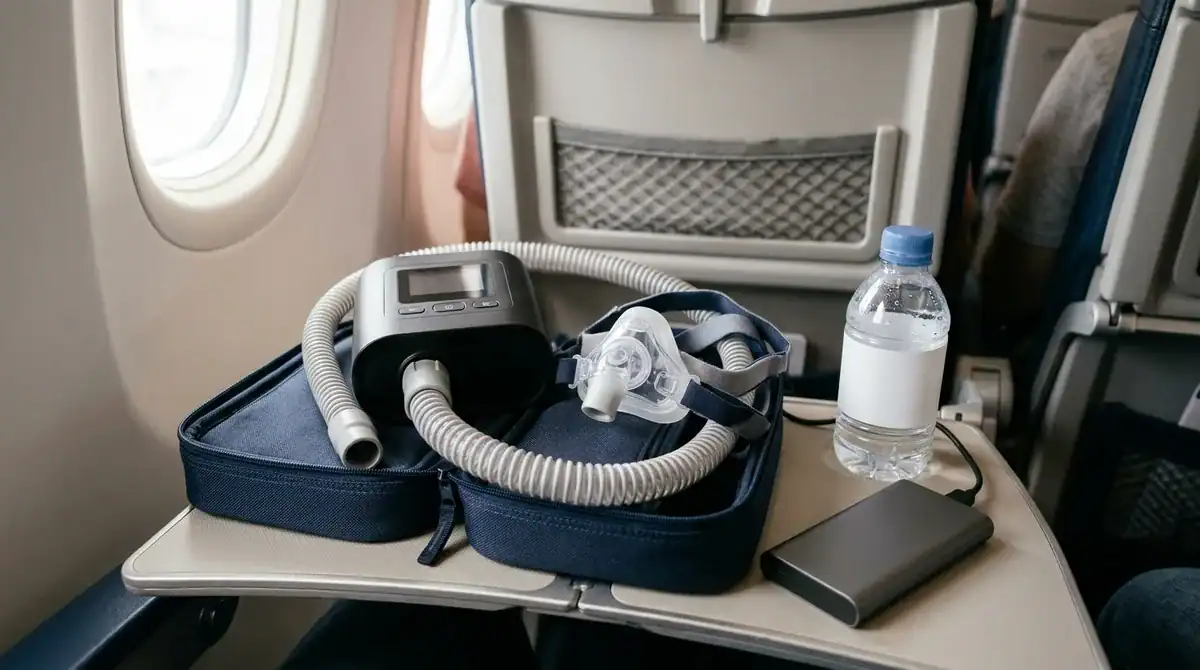
Traveling with a CPAP machine on a plane is generally allowed. The U.S. Department of Transportation treats CPAP machines as assistive devices that airlines must let you bring into the cabin, and they don’t count toward your carry-on limit. Bringing the machine on board and using it during the flight are separate questions, though. The second depends on airline rules and power.
Using it in the air can require up to 48 hours’ notice and check-in one hour before the usual time. The airline may also ask for batteries charged to at least 150% of your flight duration. For U.S. flights, spare lithium-ion batteries are limited to 100 watt-hours each unless the airline approves more, so start planning your power early.
Key Takeaways
- Contact the operating airline as soon as you book your flight so you have time to meet the notice window.
- Travelers should confirm their CPAP’s 100 to 240 volt range before buying a plug adapter for the destination’s outlet type.
- Keep a doctor’s note explaining your CPAP’s purpose with your boarding documents, so officers can answer questions quickly.
- Travelers who fly only a few times a year may never need a travel CPAP that costs around $900 at list price.
Can You Take a CPAP Machine on a Plane?
Yes, you can generally bring a CPAP machine into the cabin with you, because it is treated as an assistive device rather than an ordinary carry-on. Think of your trip as two separate decisions. The first is whether the machine can come aboard, and the answer is usually yes. The second is whether you can run it during the flight, which depends on the airline’s approval and the power you bring.
Before you book, read the operating airline’s rules on in-flight CPAP use. If your ticket includes a partner carrier, check that airline’s policy too. Don’t count on a seat outlet. Plan independent power from the start so the machine runs whether or not a plug is available.
Ask the airline whether it wants a manufacturer’s label showing the device meets FAA requirements for onboard use. Keep that paperwork in your carry-on, where you can reach it quickly at the gate. Checking these details early will save you from scrambling at the airport.
How Much Notice Does an Airline Need for In-Flight Use?
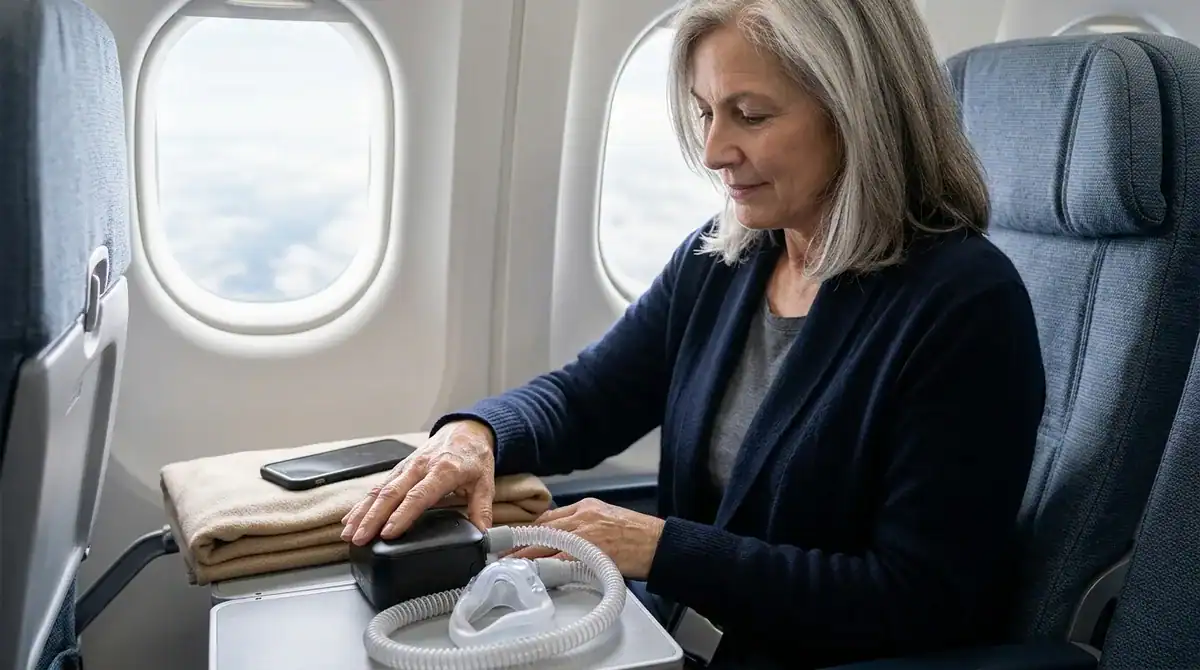
Under federal rules, an airline may require up to 48 hours’ advance notice before you use a CPAP onboard, and it may ask you to check in one hour before the general check-in time. Those requirements are set out in 14 CFR § 382.27. The same notice and early check-in rules can also apply when you ask for an aircraft electrical-power hookup, so treat the two requests as one conversation with the airline.
Contact the airline as soon as your flight is booked, so you have time to meet the notice window and sort out any questions. Use these steps:
- Contact the operating airline as soon as your flight is booked, and name your CPAP in the request.
- Ask for the exact notice period and check-in time that apply to your flight, and write both down.
- Ask whether you also need an aircraft power hookup, and request it in the same contact.
- Record the date, time, agent name, and reference number for every conversation.
- Save the written confirmation in your carry-on so you can show it at check-in and at the gate.
Battery Power and Lithium Rules for a Long Flight
Battery math is where many travelers get caught out. Airlines may require a CPAP battery that is fully charged and can run the machine for at least 150% of the flight’s length, as assistive device stowage guidance explains. On a 6-hour flight, that means at least 9 hours of battery capacity. A battery that runs for 6 hours covers the flight on paper but leaves no margin for delays or a gate change, so build in that buffer from the start.
DOT guidance names RTCA DO-160, Section 21, Category M as a standard used to show that a CPAP meets electromagnetic-interference requirements for onboard use. Review that documentation before you fly, and keep a copy with your battery records in your carry-on.
Spare batteries follow their own rules. On U.S. flights, each spare must be rated at 100 watt-hours or less. With airline approval, you may carry up to two spares rated over 100 and up to 160 watt-hours, under FAA lithium battery rules. Spares must travel in your carry-on bag, never in checked luggage. Cover each battery’s terminals with tape or keep it in its original case so nothing can short-circuit in your bag.
How Does TSA Screening Treat CPAP Equipment?
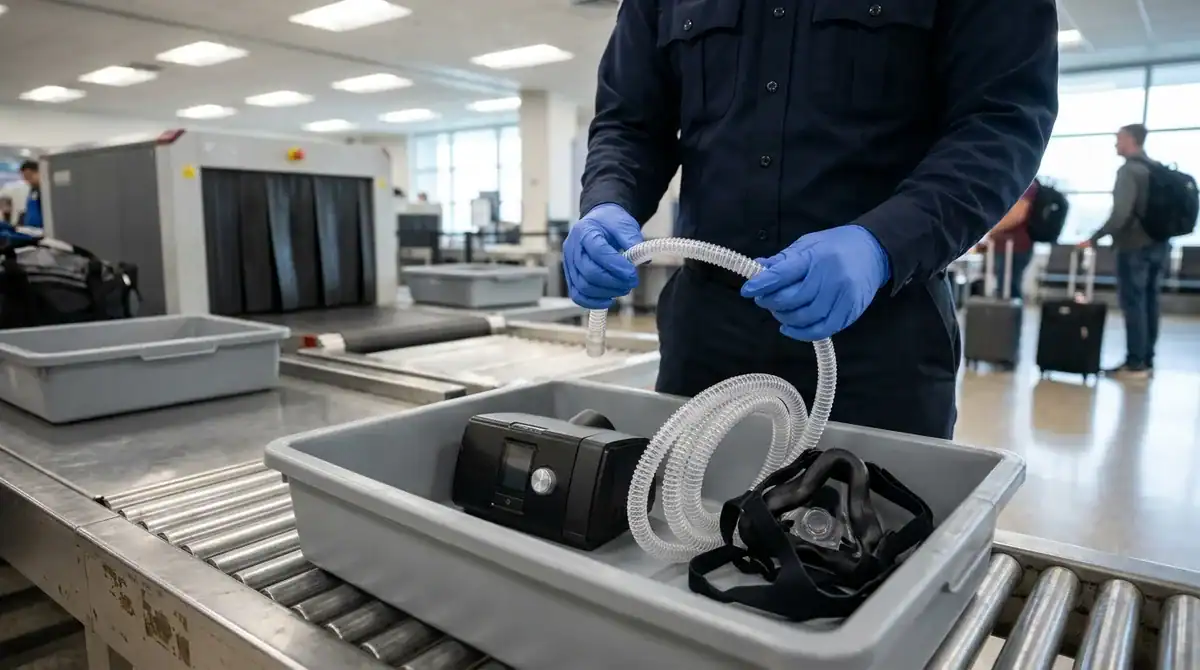
TSA allows a CPAP machine, its masks, and its tubing to stay in their carrying case during standard X-ray screening, but officers may still ask you to remove the machine from your carry-on. Plan for it to come out at the checkpoint, and pack it so you can lift it out and put it back quickly.
If you hold TSA PreCheck, the Transportation Security Administration says the machine and masks may stay in both the case and the carry-on. Know which screening lane you are in before you reach the belt so you aren’t caught off guard.
Protect the gear and your paperwork with a few simple habits:
- Label the machine, mask, and power cord with your name and a phone number, so a lost part can find its way back to you.
- Keep masks, tubing, and cords in a plastic bag or padded case to guard against damage and to stop small pieces from slipping into a bin.
- Carry a doctor’s note or prescription information that names the device and explains why you use it, and keep it with your boarding documents.
If an officer has questions, a short, plain-language note usually clears things up faster than a long explanation at the belt.
What Plug and Voltage Do You Need Abroad?
For most international trips, you need a plug adapter rather than a voltage converter, and mountain destinations add one more check. ResMed says its CPAP machines accept 100 to 240 volts at 50 to 60 hertz for international use, so many machines already handle foreign voltages. The adapter is still essential, because it only changes the plug shape to fit the destination’s outlet.
Before you pack, look up your machine’s voltage range in its manual or on its label. Then buy an adapter for the specific outlet type at your destination, not a general travel kit that may not fit.
Check the hotel or rental outlets as soon as you arrive. Find one you can reach from the bed without stretching the hose across the room or leaving a cord in a walkway. Ask whether an extension cord is allowed before you rely on one, since some properties have their own rules.
- Outlet: reachable from where you sleep
- Extension cord: confirmed as allowed before you arrive
- Adapter: matches the plug shape at your destination
Altitude matters if your trip includes high towns, ski resorts, or trailheads. ResMed’s travel guidance advises travelers going to 8,500 feet or higher to confirm with their equipment provider that the machine automatically compensates for altitude. Ask that question before you leave, and get the answer in writing so you know how the machine will behave once you arrive.
Packing Water, Spare Parts, and Gear for the Road
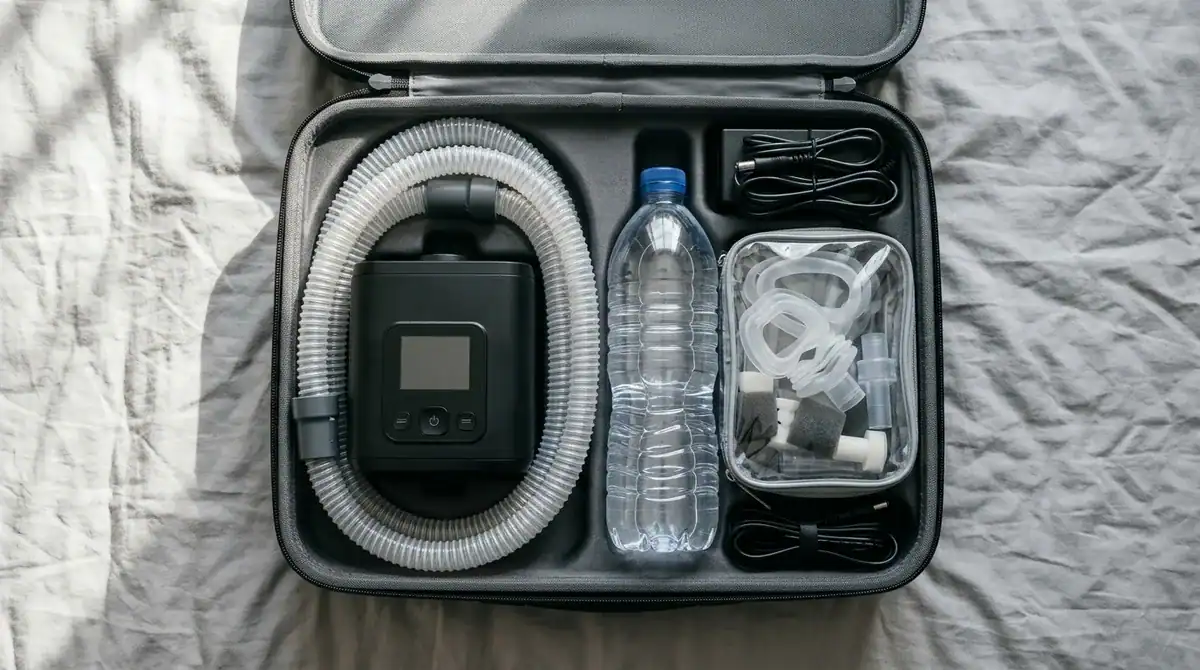
A CPAP has three basic parts: a flow generator, an air-pressure hose, and an interface such as a nasal mask, full-face mask, nasal pillows, or lip-seal mouthpiece. Keep all three together in one bag so nothing is left behind at the hotel or the gate.
For trips longer than a few nights, pack a backup mask or cushion and a length of spare tubing. A cracked cushion or a torn hose can ruin your sleep far from the nearest pharmacy, and a spare takes up very little room.
Bring distilled water for the humidifier, or check the destination’s water quality before you rely on the local tap. If you want to skip the water altogether, a waterless option such as ResMed’s AirMini with HumidX works with compatible masks. The AirMini has no built-in battery and must be plugged into power, so it still needs a reliable outlet.
Clean the mask and tubing each morning in warm water with a mild soap, rinse them well, and let them air dry away from direct sun. Make sure every piece is completely dry before it goes into the case, because trapped moisture can make a bag smell and encourage mold.
Hotel corridors, air conditioners, and cabin announcements can keep you awake, so pack a pair of soft earplugs and a padded eye mask in your carry-on. Keep them where you can reach them quickly once the lights go down.
- Flow generator, hose, and mask interface
- Backup mask or cushion
- Spare tubing
- Distilled water and humidifier chamber
- Mild soap and a drying towel
- Earplugs and eye mask
Do You Need a Travel-Sized CPAP?
A travel-sized CPAP is an optional cost, not a requirement, and many travelers do well with their regular machine in a well-padded bag. Travel units are often priced around $900 at list price, with some sales lower, so the real question is how often you will use one.
Compare that price with your actual trips. A traveler who takes one or two short trips a year to hotels with easy outlets may never need the upgrade. Someone who flies monthly, changes time zones often, or heads to remote lodges may find the extra cost easier to justify. Count your flights, trip lengths, and destinations before you decide.
Compact models such as the AirMini still need a plan for power. It has no battery of its own, so you need a dependable outlet at every stop. Its HumidX option provides waterless humidification for compatible masks, which can mean one less water container to pack and clean on the road.
If your current machine already accepts international voltage and you mostly stay where the outlets are easy to reach, a good bag and the right adapter may be all you need.
Building Your Pre-Trip CPAP Checklist
Start with one task today. Open your booking, note the operating airline’s name, and contact it about in-flight CPAP use. Write down the agent’s name, the date, and the reference number, then keep them in the same place as your battery specifications and your machine’s voltage range so everything you need sits in one spot.
Next, turn the earlier advice into a physical checklist and tape it inside your carry-on lid. List the flow generator, hose, primary mask, backup cushion, spare tubing, power cord, plug adapter, labeled bag, your doctor’s note, and the manufacturer’s label paperwork. Tick off each item the night before you leave, not at the airport, when a missing cord is much harder to fix.
Finally, message your hotel or rental host with two questions: how far the nearest outlet is from the bed, and whether an extension cord is allowed. Their answers will show you whether your power plan works before you pack the suitcase.