
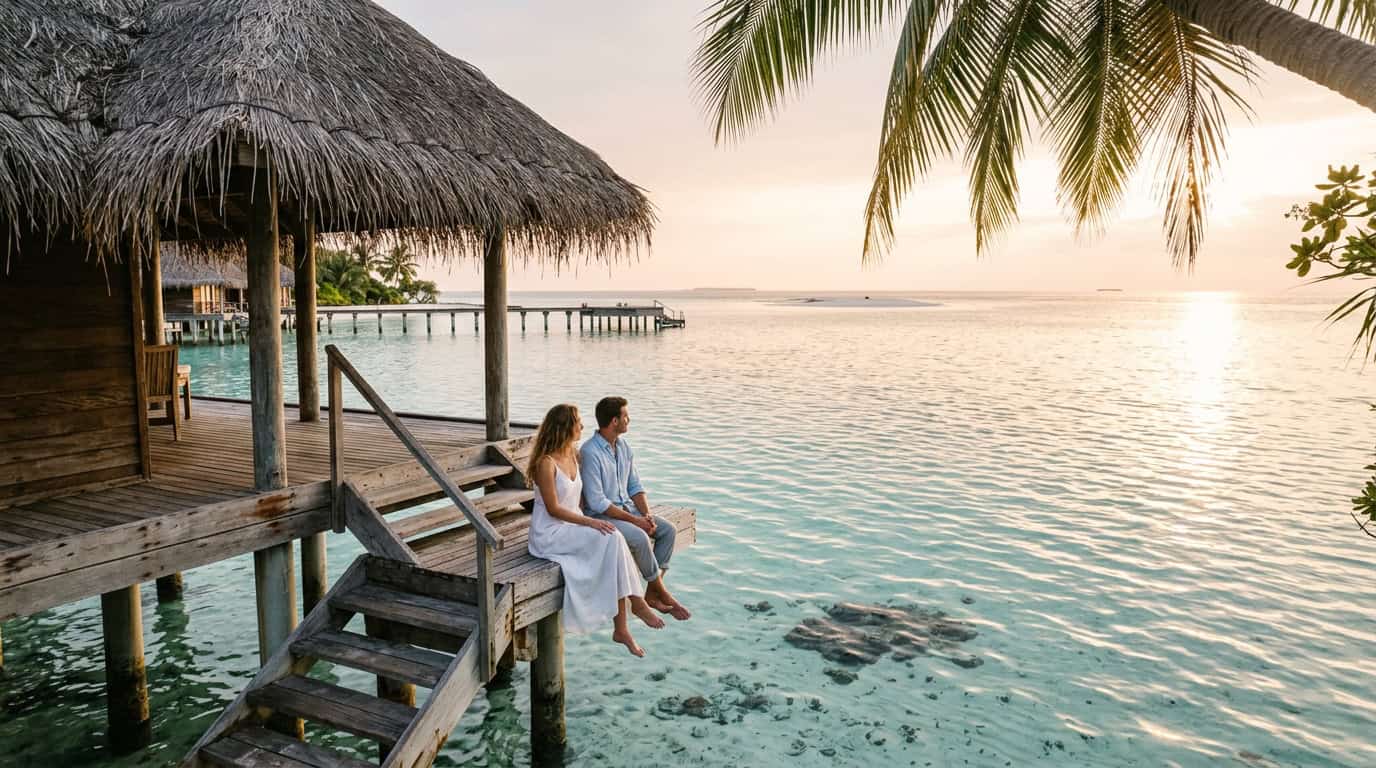
A Maldives honeymoon works well over about seven nights, with one overwater bungalow as your base, a house reef for snorkelling steps from your deck, and one sunset dinner you will remember for years. A week is also close to how long most visitors actually stay. Tourists stayed an average of 7.0 days in 2025, according to the Maldives Monetary Authority’s 2025 annual report, down slightly from 7.4 days in 2024. That makes a week a useful planning anchor, not an official rule. Stay on one island and seven days feels unhurried. Split the trip between a resort and a local-island guesthouse and you can add a few nights for a quieter, more local rhythm.
The paperwork and money deserve as much attention as the sunsets, so sort them early. Visas on arrival are available without pre-approval, subject to conditions such as a machine-readable passport valid for at least one month and a confirmed return ticket. Every arriving traveller, children included, must submit the free IMUGA Traveller Declaration within 96 hours before arrival. Budget for the Green Tax, which is USD 6 per person per day at small hotels and guesthouses on inhabited islands with 50 or fewer rooms, and USD 12 at most other establishments. Then price the transfer. Speedboat and seaplane rides from the airport can run from roughly USD 195 to USD 470 per adult. Seaplane timing has to match your flight connections, so confirm them with your accommodation before you book.
Key Takeaways
- We recommend a Maldives honeymoon of about seven nights on a single overwater bungalow, since visitors stayed an average of 7.0 days in 2025.
- Couples should submit the free IMUGA Traveller Declaration within 96 hours before arrival, and every traveller, children included, needs one to enter the Maldives.
- Couples should budget for transfers of roughly USD 195 per adult by speedboat or USD 470 per adult by seaplane, plus the Green Tax of USD 12 per person per day at most establishments and USD 6 at small guesthouses on inhabited islands with 50 or fewer rooms.
- Couples should confirm seaplane timing with their accommodation against their flight connections before booking, because seaplanes run on daylight schedules and a late arrival can leave them waiting for the next departure.
- We suggest that couples keep their Maldives honeymoon to two islands at most, since each extra island adds another transfer that costs time and money.
How Long Should a Maldives Honeymoon Last?
A Maldives honeymoon works best at about seven nights on a single island, or a few extra nights if you want to split the trip between a resort and a local-island guesthouse. Our short answer is a week for one stay, with extra nights only if you want a second island.
Visitors stayed an average of 7.0 days in 2025, down from 7.4 days in 2024. We treat that figure as a planning anchor, not an official recommendation for how long a honeymoon should last. It shows what a typical trip looks like, which makes it a sensible starting point when you decide how many nights to book.
A week suits a single island stay very well. You unpack once, learn the rhythm of the house reef and the sunset deck, and spend your mornings in the water rather than repacking bags. Seven nights in one overwater villa leaves room for slow breakfasts, a lazy afternoon on a sandbank and one sunset dinner you will remember for years.
A longer stay opens up a different kind of trip. Many couples start with several nights at a guesthouse on a local island, where evenings move at an unhurried pace and daily life around you is more visible. They then finish at a resort for private beaches and polished service. That combination gives you culture and luxury in one honeymoon.
Longer trips also change the budget. Government figures for 2022 put weighted average daily rates at about USD 1,050 at resorts and USD 470 at guesthouses, as reported in the Maldives’ 2024 Budget. A guesthouse block can stretch a fixed budget further. Remember to factor in the transfer between properties as well.
Keep the number of islands low, though. Each extra island adds another transfer, and every transfer costs time and money and depends on connections. Two islands is a comfortable plan for most couples, while three starts to eat into the days you came for.
Before you commit, count the hops before you count the nights. If a route needs two boats, a seaplane and an extra domestic flight, drop one stop and spend those nights where you already are.
What Does a Maldives Honeymoon Really Cost?
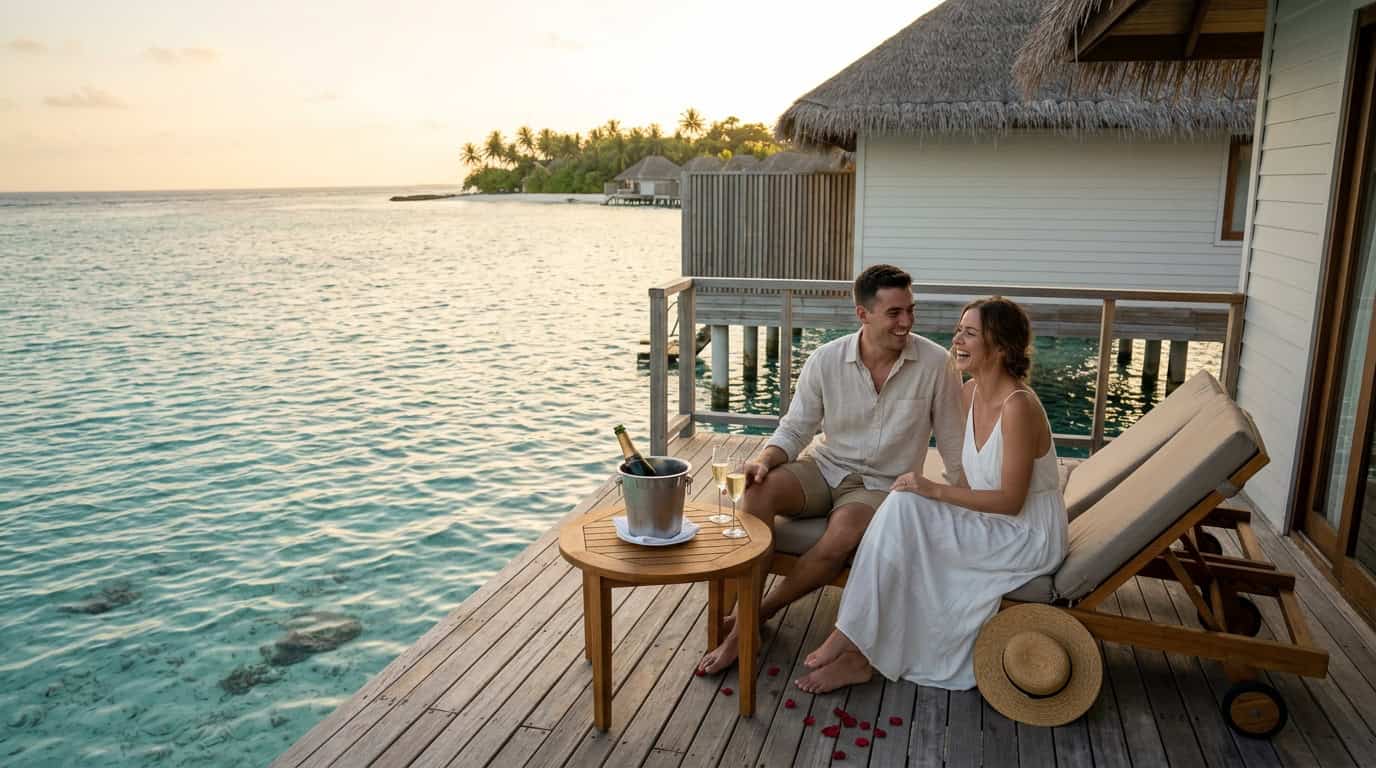
A Maldives honeymoon usually costs more than the nightly room rate suggests, because transfers, taxes, meals and flights are separate lines that many couples overlook. The room is still the biggest expense, and government figures give a useful sense of the gap between tiers. For 2022, weighted average daily rates were roughly USD 1,050 per night-equivalent at resorts and USD 470 at guesthouses. Those are historical numbers, so treat them as a guide to the difference between tiers rather than a quote, and check current pricing before you set your budget.
Across seven nights, the gap is large. At the 2022 resort average, the room alone costs far more than the same week at a guesthouse. A guesthouse block can therefore pay for a resort night, a sunset dinner or a day of diving.
The Green Tax is a smaller but fixed line. From 1 January 2025, it is USD 12 per person per day at most establishments and USD 6 per person per day at small guesthouses on inhabited islands with 50 or fewer rooms. Because it is charged per person, a couple pays double the figure each day, so multiply it across your nights before you compare properties.
Transfers are the line that surprises couples most. Round-trip speedboat rides from Velana International Airport typically run about USD 195 per adult, and seaplane rides about USD 470 per adult, so a couple pays for two seats each way before a single meal. If your route includes a second island, add another transfer to the total. Seaplane times also depend on your flight arrival, so ask your accommodation to confirm the connection before you pay.
Flights sit outside all of these numbers. Your international fare is a separate budget line, and it varies widely depending on where you live and when you travel. Meals can also grow quickly. Resort restaurants and bars price each dish and drink on its own, so a couple who orders freely can spend more on food and drink than on the room. A meal plan, such as half board, which covers breakfast and dinner, makes the daily cost easier to predict. Ask exactly what is included, since alcohol and speciality dinners often fall outside the plan.
Excursions are where you choose how much to spend. South Ari Marine Protected Area offers whale-shark encounters year-round, with August to November the peak sighting period. Hanifaru Bay has a seasonal manta experience from June to early October. Its protected-area rules limit visitor numbers and stay times, so book early. Snorkelling is allowed there, while scuba diving is prohibited. Decide which outings matter most to you, then build the rest of the budget around them.
How Do You Get from the Airport to Your Island?
Most couples reach their resort island from Velana International Airport by speedboat or seaplane, and the choice shapes how your first day feels. Both are far quicker than any alternative, but they differ in cost, scenery and how closely they follow the clock.
Transfer prices in the Maldives typically run about USD 195 per adult for a 45-minute speedboat ride, and a seaplane usually costs around USD 470 per adult for a 15-minute flight. Speedboat rates are often tied to a set date, so a quote valid only through 31 October 2026 may have lapsed by the time you book. Check the validity period before you plan around it.
Seaplanes are the dramatic choice. You rise over the lagoon and see the reef colours from above before you land beside your jetty. The trade-off is timing. Seaplanes run in daylight and on set schedules, so a late international arrival can leave you waiting for the next departure rather than heading straight to your bungalow. Build in a buffer, and check the departure times against your flight before you commit to that route.
That is why timing matters more than the price tag. Your arrival time, your baggage and your transfer need to line up. The simplest way to check is to ask your accommodation to confirm the connection before you book flights. Give them your full itinerary, including the airline and flight number, and ask how they handle delays.
The airport picture is also changing. The President’s Office announced the opening of Muli Airport in Meemu Atoll on 20 May 2025, giving that atoll an airport gateway of its own. If your heart is set on Meemu Atoll, ask your resort which airport its guests use, since a new gateway can change both the route and the transfer time.
Before you pay anything, put a few questions to the resort directly. Ask whether transfers are mandatory or optional, since some resorts require the resort’s own transfer for every guest. Ask whether the fee is included in your room rate or added on top, whether it is per adult or per child, and how much luggage is allowed. Then ask what happens if your flight is late. A clear answer now saves stress when you land in the heat with a honeymoon waiting on the other side of the water.
Seven-Day Maldives Honeymoon Itinerary: Arrival and Settling In
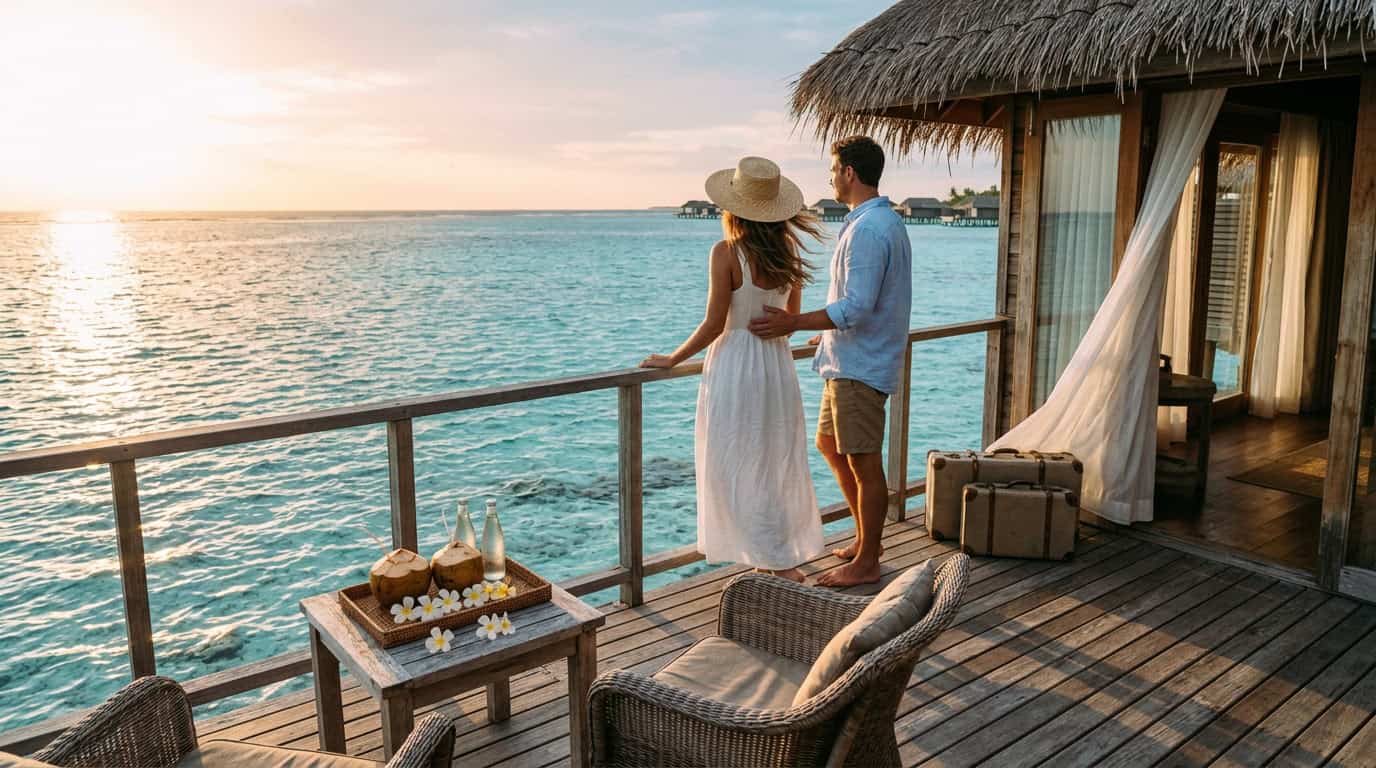
Your first day is about arriving slowly. After you clear immigration at Velana International Airport and collect your bags, your speedboat or seaplane will carry you across the lagoon to your island. Most resorts greet couples with a cold drink on arrival. Then you can walk out to your overwater bungalow, drop your bags and simply look at the water for a while.
Once you have unpacked, head to the beach for a swim as the sun drops. The water is usually calm and warm near the shore, and the sky turns gold and pink over the lagoon. Keep this first evening loose. A light supper on your deck or an early night is a perfectly good honeymoon plan.
Day two belongs to the house reef. Ask the dive centre or the water sports desk for a guided snorkel in the morning, when the light is clear and the reef is at its quietest. Parrotfish, damselfish and the occasional reef shark tend to appear around the coral heads close to shore. Afterwards, take a long, slow lunch at a beachfront restaurant, and leave the afternoon open for a spa treatment. Couples’ massages are popular, and a treatment booked for late afternoon lets you finish with a sunset dip.
Day three is built around the water after dark, in the best sense. Book a sunset cruise that looks for dolphins or heads out to a sandbank, where you can wade in shallow, bright turquoise water. Choose the option that suits your energy level, because both return you to the island in time for dinner. Then finish the evening with a private dinner set up on the sand, with a table, lanterns and your own waiter.
Booking ahead keeps these days running smoothly, so do the groundwork early. Spa slots and beach dinners fill quickly, especially on weekends and during the busiest months. Lock them in as soon as you have confirmed your arrival time, because a late seaplane connection can shorten your first afternoon.
Here is the order to work through once you check in:
- Ask the front desk for the resort’s full activity list, including sandbank and dolphin cruise departure times.
- Book your couples’ spa treatment for day two, choosing a late afternoon slot.
- Reserve the snorkel guide for the morning of day two, and ask for a briefing the evening before.
- Request a beach dinner table for day three, and confirm whether the set-up includes drinks and lighting.
- Check whether the sunset cruise on day three departs from your jetty or from the main pier.
Leave the rest of each day unplanned. A honeymoon week works best when mornings are for slow coffee, afternoons are for a nap on the deck, and the schedule gives way to whatever the lagoon is doing that day.
Seven-Day Maldives Honeymoon Itinerary: Exploring and Going Home
Day four is your rest day, and it works best when you keep it deliberately light. Choose between a slow beach morning with a book and a long lunch, or an island-hopping day trip that takes you to a second reef. Ask the water sports desk for the boat’s departure time and whether snorkel gear is included.
Day five is the day to step off the resort’s sandbars and see how people live. Book a half-day visit to a local island such as Maafushi, a short boat ride from Malé, where guesthouses, small shops and fishing boats line the lanes. Cover your shoulders and knees when you walk through the village, and carry a sarong for the mosque area. Buy fresh fruit at the market, then have a cold drink at a café where the locals gather.
Day six is your full-day adventure, built around a marine experience and a sandbank picnic. Pick the outing that suits you from the options in the next section, and ask the operator whether the boat will be shared or private. Ask them to pack a picnic of grilled fish, fruit, cold drinks and sun shades, and to set it up on a quiet sandbank away from the other boats. The marine life guides on Visit Maldives are a useful place to read up before you go.
Day seven is your farewell day, and it should feel unhurried from start to finish. Sleep in, have a late breakfast on your deck and spend the last swim of the trip in the shallows. Book a farewell dinner for your final evening, and ask for a table at the end of the jetty so you can watch the lights come on across the lagoon. Then plan an early start, because the morning ahead needs to be simple.
Your departure flight needs breathing room, so avoid a tight connection at all costs. Seaplanes run on daylight schedules, and a delay at the jetty can cost you your flight. Give yourself several hours between the transfer and your departure, and confirm the details with the resort in this order:
- Ask the front desk to confirm your departure transfer time in writing the evening before.
- Check the transfer time against your airline’s departure time and the schedule of the seaplane or speedboat.
- Ask whether the resort can move your transfer earlier if your flight changes.
- Confirm the luggage allowance and whether the transfer fee is charged per adult or per child.
- Request a final bill the night before, so checkout takes minutes rather than an hour.
Pack your passport and your confirmed return ticket in your hand luggage, and keep your sunscreen where you can reach it. A slow final morning feels far better when the logistics are already sorted.
Where Can Couples See Whale Sharks and Manta Rays?
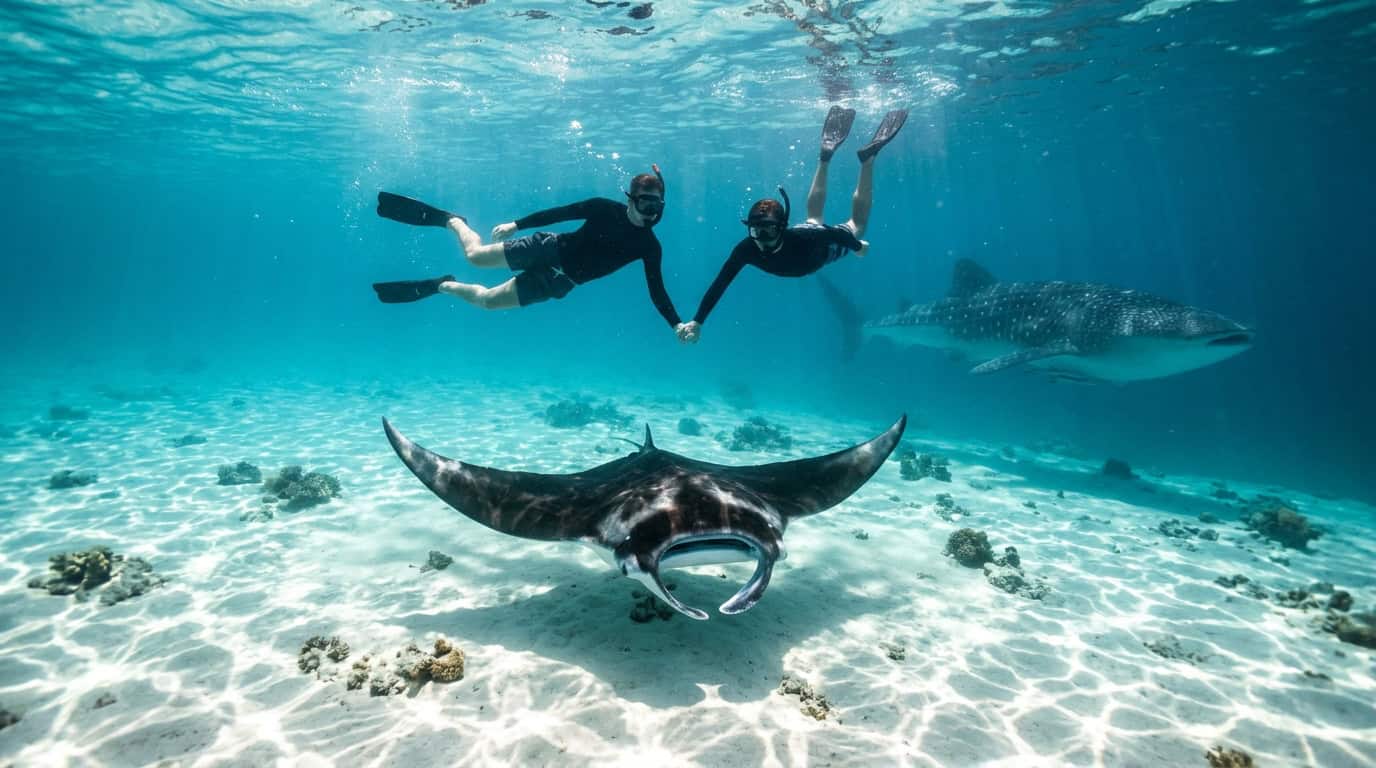
South Ari Marine Protected Area is the place to go if your dates fall anywhere in the year, and Hanifaru Bay is the choice for manta rays between June and early October. South Ari is a year-round whale-shark aggregation area, so you do not need to time your trip around a season to have a real chance of meeting one. The months from August through November are the peak sighting period, which makes them the strongest window for a honeymoon built around the sea.
Hanifaru Bay works differently, and it rewards couples who plan around the calendar. The best window for manta rays runs from June to early October. Swimming and snorkelling are allowed in the bay, but scuba diving is not, so you will watch the mantas from the surface with a mask and snorkel.
The rules at Hanifaru Bay shape the whole day, and they are stricter than many couples expect. The bay has been a Marine Protected Area since 2009. The Convention on the Conservation of Migratory Species of Wild Animals factsheet on the Maldives sets out its visitor limits, maximum tourist stay times, and bans on scuba diving and fishing. Expect a briefing before you enter the water, and expect the group to leave when its time is up.
Book with an operator that follows the visitor limits and stay-time rules. Ask how many people the boat takes into the bay and how long each group stays in the water. A reputable operator will answer those questions without hesitation, and the answers tell you whether the trip is built around the rules or around squeezing in as many guests as possible.
A few habits make both excursions more enjoyable:
- Bring snorkel gear that you have tried in the water at home, so the mask does not leak halfway through a manta run.
Pack a reef-safe sunscreen and apply it before you board, since you will be in the sun on the open water for hours. Choose an early departure for both trips. The water is usually calmer in the morning, the light is clearer for spotting shapes below the surface, and the boats are less crowded before the midday rush.
Choosing by date is simple once you lay out the calendar. If you are travelling in June or early July, Hanifaru Bay is at the start of its season, so you can plan a manta morning early in the trip and still keep South Ari as a backup. From August to early October, both sites are open, and South Ari’s peak falls in the same stretch, so you can book a whale-shark trip and a manta trip in the same week. From November to May, South Ari is your only option, and it still offers a dependable sea encounter for couples who want more than a sunset cruise.
What Paperwork Do Couples Need Before Flying?
Couples flying to the Maldives need a machine-readable passport, a confirmed return ticket, a prepaid booking at a registered facility and enough funds for their stay. With those in hand, they can receive a visa on arrival without arranging one in advance. Check each condition before you book flights.
The visa on arrival is the simplest route, but only if your paperwork is in order when you land. Your passport must be machine-readable and valid for at least one month, and you need proof of a confirmed onward or return ticket. The full conditions are set out by Maldives Immigration, so read them directly rather than relying on a summary from a third party.
- Passport: machine-readable and valid for at least one month
- Return ticket: confirmed and ready to show at check-in and immigration
- Accommodation: a prepaid booking at a registered facility
- Funds: enough money to cover your stay
- IMUGA Traveller Declaration: submitted within 96 hours before arrival
Every arriving traveller needs the IMUGA Traveller Declaration, and that includes children. It is free, so there is no reason to pay anyone for it. Each person completes their own declaration, so plan to do it for both partners and any children travelling with you during the same window.
Budget for the Green Tax as covered earlier in this guide. It is a per-person, per-day charge, so your total depends on how many nights you spend at each type of property. Add it to your spreadsheet before you compare room prices, because a figure left out at the start is easy to forget later.
Names are where many couples run into trouble. The name on your booking, your airline ticket and your transfer confirmation must match your passport exactly, including the spelling, the order of names and any middle names. A small difference can hold up check-in or a speedboat booking, and correcting it at the last minute is far harder than getting it right at the start.
Keep printed copies of your bookings and transfer confirmations in your hand luggage, separate from your phone. Mobile signal can be patchy on some islands, and a battery can fail at the worst moment. A folder with your passports, return ticket, accommodation confirmation, transfer details and the resort’s contact number gives you everything you need at the desk, in the boat queue or at the jetty.
Booking Your Maldives Honeymoon Week
Your next step is to fix your dates and choose your island before you search for flights. Decide whether you want one stay of about seven nights or a split trip, then write the number of nights beside each island on a single page.
Once the plan is on paper, email the resort and ask for a written quote that lists the transfer, the Green Tax and any meal plan. Ask them to confirm the seaplane or speedboat time against the flight you are considering, and file their reply with your booking folder.
Next, put the IMUGA Traveller Declaration on your calendar. You can submit it within 96 hours before arrival, so mark the window now rather than the night before you fly, when you will be tired and packing.
If whale sharks or manta rays are on your list, check the calendar before you choose excursions. South Ari is open all year, while Hanifaru Bay runs from June to early October, so your travel month may decide which outing you book first.
Start with the resort email this week. Once the transfer timing is confirmed in writing, you can book your flights with confidence and spend your energy on the honeymoon itself.