
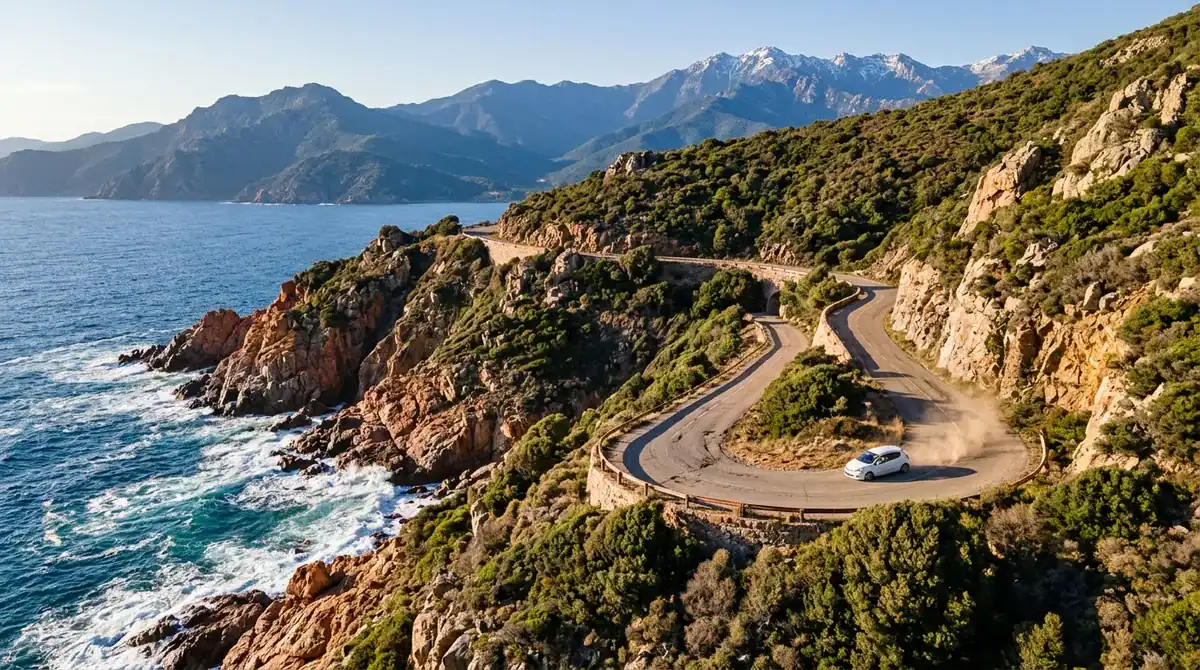
A Corsica road trip works best as a seven-day southern loop that starts and ends in Ajaccio, linking the Gulf of Ajaccio, the hilltop town of Sartène, two nights in Bonifacio and the mountain forests around Bavella. The official Corsica tourism itinerary follows this same shape and gives a realistic sense of pace. Expect about 1 hour 15 minutes from Ajaccio to Propriano, then roughly 20 more minutes on to Sartène, with a stop at the Baracci Baths along the way. Arrival is easy, too. Napoleon Bonaparte Airport is about 20 minutes from the city centre, so the sensible plan is to land, sleep in Ajaccio, and collect your car the next morning rather than driving straight from the terminal.
Give yourself a full week because Corsica has no toll motorway or continuous expressway linking its main towns, so the distances on the map understate the time behind the wheel. The regional travel guide recommends adding at least 30 minutes to every important drive, with more buffer in July and August. Trying to squeeze the whole island into three or four days backfires, because you end up spending your swimming time in the car. Instead, build in stops at Piantarella, Santa Giulia and Palombaggia, and book your car and beds early, since summer demand is high and prices shift with the calendar. Do that, and the coves, hill villages and mountain passes become the trip itself rather than a blur between destinations.
Key Takeaways
- We recommend a seven-day southern loop from Ajaccio through Propriano, Sartène, two nights in Bonifacio, Porto-Vecchio, the Ospedale forest and the Bavella pass, then back to Ajaccio for a first Corsica road trip.
- Plan every Corsica drive by minutes rather than kilometres, adding at least 30 minutes to each important leg and more in July and August, because the island has no toll motorway or continuous expressway linking its main towns.
- Book your car and beds early, securing the two Bonifacio nights first, since summer demand is high and Bonifacio and Porto-Vecchio fill fastest.
- Land at Napoleon Bonaparte Airport, which is about 20 minutes from Ajaccio’s city centre, and spend your first night in Ajaccio so you start the long first driving day rested.
- Follow French road rules on every leg of a Corsica road trip, which means seat belts for all occupants, approved child seats for children under 10, and no holding a phone while driving.
How Many Days Does a Corsica Road Trip Need?
Seven days is the right length for the southern loop, and it’s the trip we’d recommend for a first visit. The route runs from Ajaccio to Propriano and Sartène, then two nights in Bonifacio, on to Porto-Vecchio, through the Ospedale forest and over the Bavella pass, and back to Ajaccio. That gives each stop room to breathe without rushing the drives.
The distances on the map can be misleading. Corsica has no toll motorway or continuous expressway between its main towns, so roads wind through hills and villages, and a stretch that looks short on the map can take most of a morning. The final leg from Zonza back to Ajaccio runs about two hours on its own, so it’s worth planning that day as a travel day with only one swim stop. Plan each day around driving time rather than kilometres, and leave a gap between arrival and your first activity.
If you only have three to five days, choose either one coast or one mountain area. A coastal trip might centre on the Gulf of Ajaccio and Sartène, or on the beaches around Bonifacio, including Rondinara and Tamaricciu. A mountain trip could focus on the Ospedale forest and Bavella, based around Zonza, where you can hike without driving back to the sea each evening.
With two weeks, you can stop more often, linger in the coves and take in the northern side of the island. Bastia and Calvi are both a long way from the southern loop, so they need extra days of their own. Two weeks also leaves time for a boat trip out to the Lavezzi Islands from Bonifacio, which is easy to rush on a shorter itinerary.
Whatever length you choose, treat the seven-day loop as a foundation. Add beach days at Rondinara or Tamaricciu, or an extra night in Bonifacio, and the route itself stays the same.
How Do You Get From the Airport to Ajaccio?
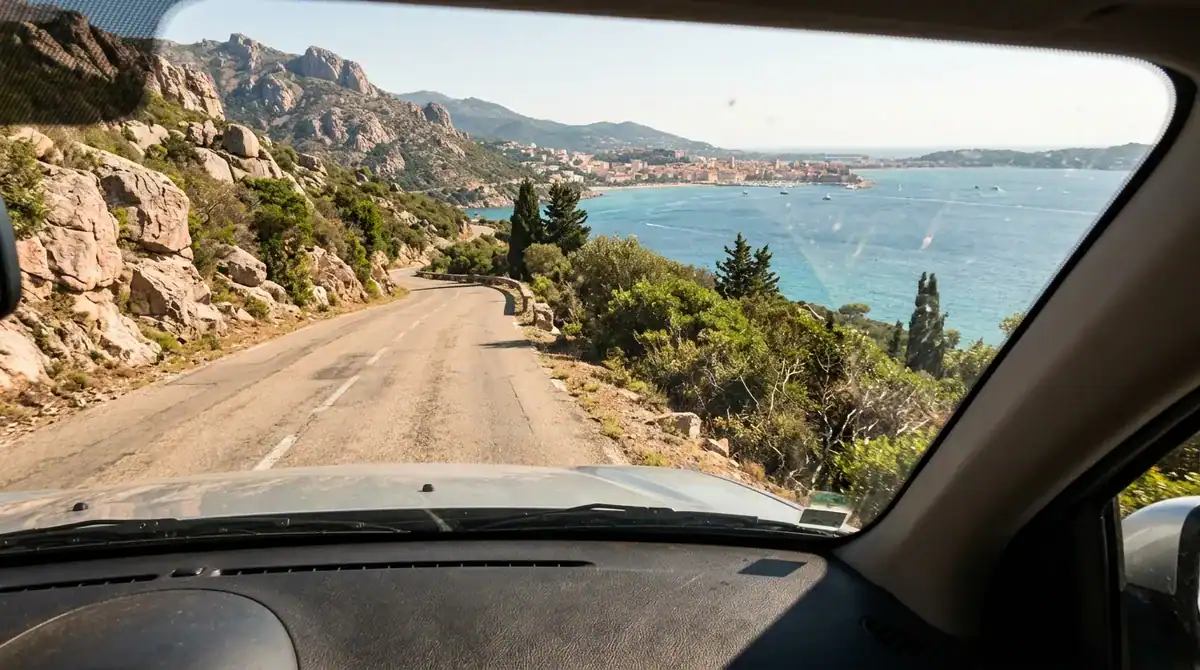
Napoleon Bonaparte Airport is about 20 minutes by road from Ajaccio’s city centre, so the transfer is the quickest part of the whole trip. The official Corsica itinerary treats the arrival day as a gentle start and recommends sleeping in Ajaccio before the driving begins.
If your flight lands early enough, pick up your car at the airport on arrival day. Drive straight into town, park near your accommodation, and leave the car where it is for the evening. That way you get the keys sorted without a rushed drive through unfamiliar streets after a long journey.
Then spend the evening on foot. Ajaccio’s old town climbs above the harbour in a tangle of narrow lanes, washing hangs between the shutters, and small squares fill with people in the early evening. Wander toward the water as the light fades, and you’ll see why the city makes such a good base. Napoleon was born here, and the town still feels like the start of something.
Staying the night in the city also gives you a clean start. The first real driving day of the loop is a long one, and beginning it rested, with the car already sorted and a good breakfast in you, makes the coastal roads far more enjoyable. You’ll also have a chance to buy supplies for the road, such as water, snacks and a picnic for the beach stops.
Flights to Ajaccio from the UK and elsewhere vary by season, so check routes and timetables carefully when you book. Some connections run only at certain times of year, and a late-afternoon arrival can leave you with little time at the rental desk before it closes. Match your flight times to the car pick-up hours, and choose a landing time that leaves room for the transfer and a relaxed evening.
Days One to Three: Ajaccio, Propriano and Sartène
Day one is deliberately light. Collect your car at Napoleon Bonaparte Airport if your flight lands early enough, or pick it up the next morning in Ajaccio, then spend the evening in the old town before the real driving starts. The first full day of the loop is the longest leg of these three, so start it early and rested.
Here is how the first three days can unfold:
- On day one, check into your Ajaccio accommodation, park the car near it, and walk down toward the harbour as the evening light softens the rooftops.
- On day two, leave Ajaccio after breakfast and drive south to Propriano, allowing about 1 hour 15 minutes of driving plus a buffer for the hill bends.
- Stop at the Baracci Baths on the way, where a short break gives you a chance to stretch your legs and swim if the water looks inviting.
- Continue to Propriano for a late lunch by the harbour, then take the roughly 20-minute drive inland to Sartène for the afternoon.
- On day three, drive to Piantarella Beach in the morning and swim while the sea is still calm and the sand is quiet.
- Eat a picnic lunch on the beach, then head back toward the hills for a second night in the southern countryside around Sartène.
Propriano makes a useful contrast to Ajaccio. Where the capital climbs steeply in tangled lanes above the water, Propriano sits on the flat shore of its gulf, and its harbour is wide open. Fishing boats and pleasure craft rock gently against the quay, and cafés spill onto the pavements in the warm afternoon. Give yourself twenty minutes or so at the waterfront to photograph the boats with the hills behind them. The light is best in the hour before sunset, when the water turns gold.
Sartène feels like a different country altogether. The old town is built almost entirely from grey granite, and its streets are narrow, steep and cool even at midday. Doorways are framed in stone, shutters are often the only splash of colour, and the quiet is striking after the coastal towns. Walk slowly and let yourself get a little lost. Early morning is the best time for photos here, before the tour groups arrive, and the stone catches the first sun beautifully on the upper streets.
Keep the afternoons loose on these days. Corsica’s roads reward patience, so a long lunch, an unplanned swim or an extra half hour in a village square won’t derail the plan. Build your timetable around the drives and the light, and the first three days will feel unhurried rather than rushed.
Days Four to Seven: Bonifacio, Porto-Vecchio and the Mountains
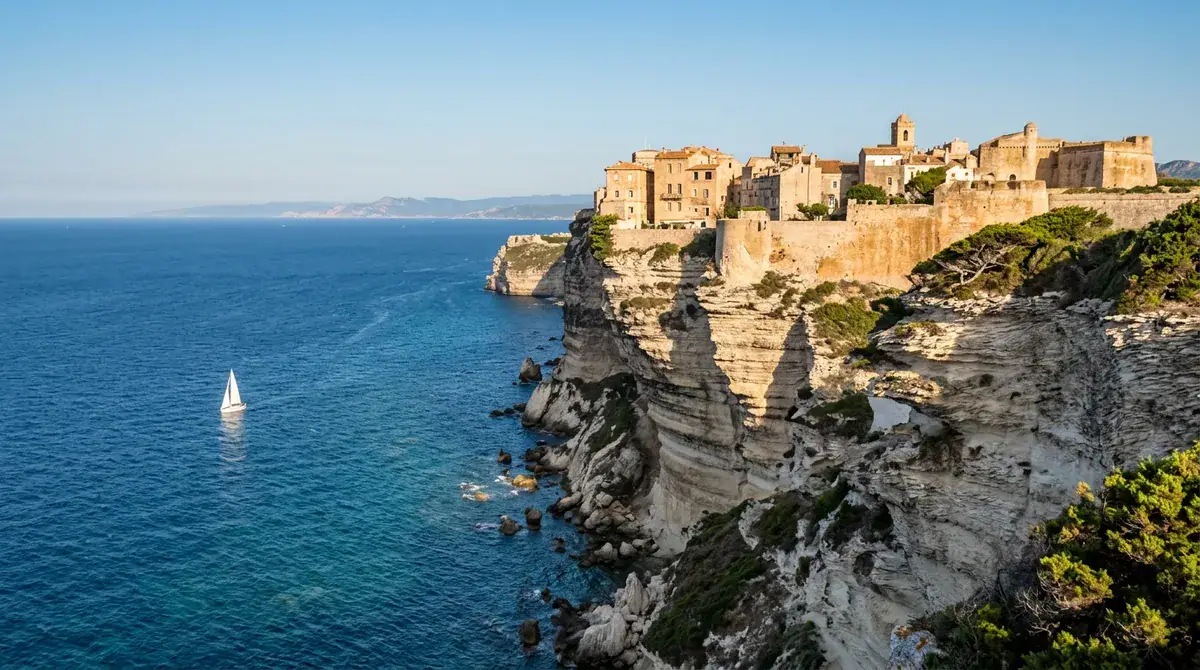
Bonifacio is where the loop turns dramatic. The old town sits on a limestone ridge at the southern tip of Corsica, with white cliffs falling to the sea on most sides. Walk the clifftop path at sunset, when the stone takes on a warm glow, and you can look down into the narrow inlet where the harbour sits in shadow beneath the walls. Give yourself two nights here so that one day can belong to the town and the next to the water.
Plan your first afternoon for the citadel lanes. The stairway down to the harbour is steep, and the cafés along the quay fill quickly in the evening, so arrive before the crowds if you want a table with a view. Bonifacio is also the best place to stop for a long dinner after a day of driving, because the harbour lights reflect in the water until late.
On day five, take a boat out to the Lavezzi Islands, a small group of granite islets just off the southern coast. The water around them is clear and turquoise, and the rocks are good for slow exploring with a mask and snorkel. Boat schedules change with the season, so check departure times at the harbour the day before, and pack water, sun cream and a towel, because there is little shade on the islands.
Porto-Vecchio is the natural base for beach hopping, and its gulf is lined with coves that each have their own character. Rondinara is a horseshoe bay of pale sand and shallow turquoise water, reached by a short walk from the car park. Santa Giulia is a long, sheltered beach with pine trees behind it, good for families and for a lazy afternoon in the shallows. Palombaggia is the postcard bay, with umbrella pines, pinkish granite boulders and sand that stretches out in a curve. Tamaricciu is smaller and quieter, a cove where you can swim and wander without feeling hemmed in.
Parking is the real challenge on these beaches. In summer, the car parks near Santa Giulia and Palombaggia fill early, and spaces can be gone long before the midday crowds arrive. Start your beach days early, drink your coffee on the road, and aim to be parked before the rush. Leaving the car at a distance and walking in is often easier than circling for a space near the sand.
The final day brings the mountains. The Ospedale forest is a dense stand of Laricio pines, where the air smells of resin and the trails stay cool even in July. Take a short walk among the trunks, then continue up to the Bavella pass, where the granite needles of the Aiguilles de Bavella rise sharply above the road. A short hike from the pass gives you wide views over the valleys, and the rock formations change colour as the sun moves across them.
Zonza is the staging point for the drive home. Spend your night in the village, then set off in the morning, leaving time for a final swim before the road to Ajaccio. Here is how the last three days can fit together:
- Drive from Sartène to Bonifacio after breakfast, and walk the clifftop path before dinner.
- Board a boat to the Lavezzi Islands in the morning, then spend the evening back in the old town.
- Head to Porto-Vecchio, and start early at Rondinara or Santa Giulia before the car parks fill.
- Swim at Palombaggia or Tamaricciu in the afternoon, then drive inland to Zonza for the night.
- Walk the Ospedale forest and the trails near the Bavella pass before the heat builds.
- Drive from Zonza back to Ajaccio, leaving the coast for the last swim of the trip.
How Long Does It Take to Drive Around Corsica?
Driving the southern loop takes about a week once you add swims, walks and meals, and the actual time behind the wheel usually falls between 30 minutes and two hours per leg. Corsica’s roads are slower than the map suggests, so plan by minutes rather than kilometres.
The reason is the terrain. Corsica has no toll motorway or continuous expressway linking its main towns, so most routes climb through hills, bend around headlands and pass through villages. A straight-looking line on the map can hide dozens of corners and a stretch behind a slow vehicle that you can’t pass for a while.
Some legs have clear estimates. The drive from Ajaccio to Propriano takes about 1 hour 15 minutes, and the onward run to Sartène adds roughly 20 minutes. The return from Zonza to Ajaccio runs about two hours. These are driving times only, so they leave out your stops at the Baracci Baths, lunch by the harbour or a swim.
For every important drive, add at least 30 minutes to the estimate, and allow more in July and August, when traffic and beach-side parking both slow everything down. The table below lists each leg with its estimated time and a suggested buffer.
| Leg | Estimated driving time | Suggested buffer |
|---|---|---|
| Ajaccio to Propriano | About 1 hour 15 minutes | At least 30 minutes, more in summer |
| Propriano to Sartène | About 20 minutes | At least 30 minutes |
| Sartène to Bonifacio | Roughly 30 minutes to 2 hours | Allow at least 30 minutes, with extra in midsummer |
| Bonifacio to Porto-Vecchio | Typically 30 minutes to 2 hours | Allow at least 30 minutes, more again in peak season |
| Porto-Vecchio to Zonza, via Ospedale and Bavella | Roughly 30 minutes to 2 hours, longer with stops | Add time for the forest walk and the pass |
| Zonza to Ajaccio | About 2 hours | Allow at least 30 minutes, extra in the July rush |
The buffer does most of its work in the morning. If you set off soon after breakfast, a delayed departure or a slow stretch of road won’t push your arrival into the heat of the afternoon. Keep a bottle of water and a snack in the car, because a long, bend-filled drive can make a short break feel like the best part of the day.
Leave a gap between arrival and your first plan, too. A village square, a bakery or a viewpoint you didn’t expect can take an hour without you noticing, and that’s the kind of detour that makes the trip memorable. Build the day around the drive, and the scenery will fill the rest.
When Should You Book Your Car and Accommodation?
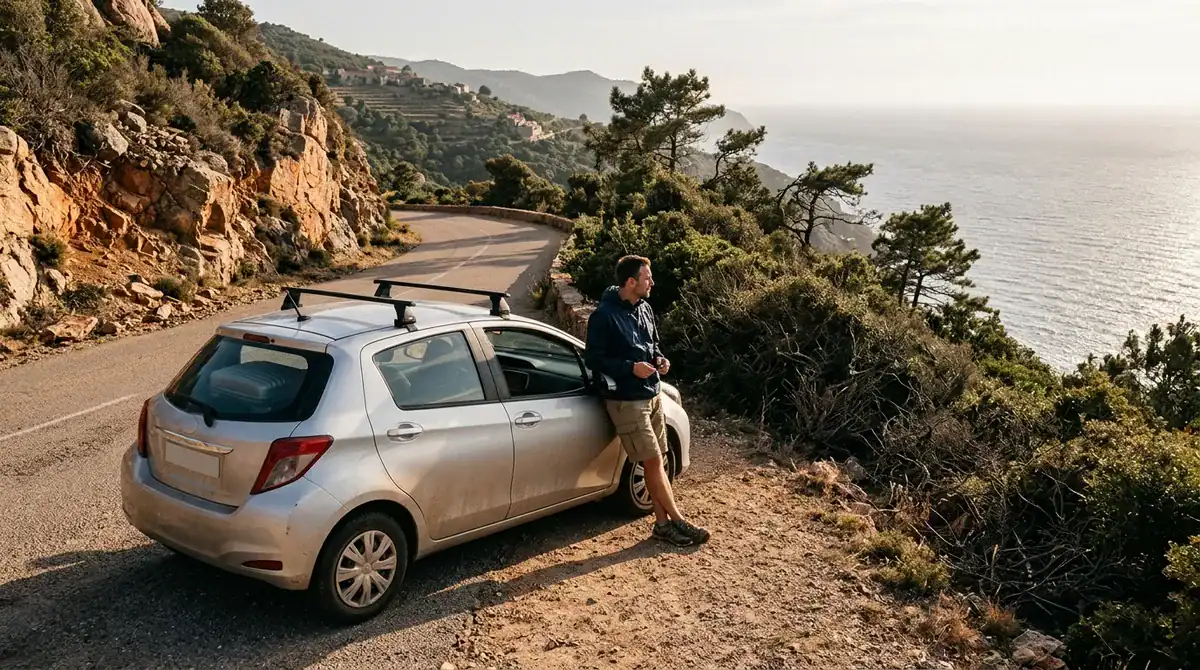
Book your car and beds as early as you can, well ahead for July and August, and give Bonifacio and Porto-Vecchio first call because they fill fastest. Corsica’s visitor numbers are high and still rising. Recent INSEE figures show 10.8 million overnight stays in hotels, campsites and other collective tourist accommodation in 2025, up 1.1% from 2024. The increase is small on paper, but in midsummer every extra visitor competes for the same rooms in the southern towns and the same narrow car parks near the beaches.
Car rental follows the calendar in much the same way. In the general market, booking about 23 days ahead may secure a below-average daily rate, though that depends on the date you travel. August average car-rental prices are around $64 per day, and deal examples across the market range from $26 to $128 per day. Treat any single price you see as a snapshot. A quote that looks high on Monday may drop by Thursday, and a weekend pick-up may cost more than a midweek one.
When you compare, keep the variables identical. Check the same dates, the same pick-up point and the same class of car. Ajaccio airport and a city-centre desk can quote very different totals, so note both. Pay attention to the fine print on insurance, mileage and additional drivers, because a cheap headline rate can grow once extras are added. A smaller car also makes life easier in Sartène’s granite lanes and the tight streets of Bonifacio’s old town, where parking spaces are scarce.
For beds, the order matters more than the price. Bonifacio’s old town is small, and its clifftop rooms are limited, so secure those two nights first. Porto-Vecchio has more choice, but the best-placed rooms near the gulf go quickly in summer. Zonza is a small village with fewer beds than the coast, so reserve it early too, especially if you plan to walk the Ospedale forest and reach the Bavella pass before the heat builds.
Once your accommodation is confirmed, you can work around the car. Choose a pick-up date that suits your arrival and your first night in Ajaccio, then check prices for a few days either side of it. Shifting your start by a day or two can change the total noticeably, and a short search across those dates is often enough to find a better deal.
What Are the Driving Rules for a Corsica Road Trip?
Under French road rules, seat belts are mandatory for every vehicle occupant, children under 10 must use an approved child seat suited to their size, and drivers may not hold a phone in their hand or by their ear. These rules apply on every leg of the loop, from the Ajaccio ring road to the bends above Bavella, so it’s worth knowing them before you leave the rental car park. The French National Interministerial Road Safety Observatory publishes the core rules in English.
The seat belt rule covers the back seats as well as the front, so check that everyone has buckled up before you pull away. Families should sort out child seats before the trip starts. Ask the rental desk whether a seat is available when you book, and check that it suits your child’s size. A seat that doesn’t fit properly will not meet the rule, and fitting it on a busy morning in Ajaccio is far easier than doing it at the roadside.
Phones are the rule drivers most often forget on a scenic route. A dashboard mount keeps the screen visible without you touching it, and it’s worth setting the navigation before you start the engine. On the descent from the Bavella pass, when the views pull your eyes away from the road, a fixed phone is a far better option than one balanced on your knee.
Who can drive depends on where the licence was issued. The main options are:
- A valid European Economic Area licence, for drivers aged 18 or older.
- A non-EEA licence, accepted for stays under 185 days, if it is valid and written in French or officially translated into French.
- A non-EEA licence accompanied by an international licence.
A seven-day loop sits comfortably inside the 185-day limit, so the question for most visitors is which of those documents they hold. If your licence is not in French, arrange a certified translation or an international licence before you travel, since there are few ways to sort it out once you have landed. Keep your licence and passport in the car, and check that every named driver on the rental agreement meets the age and licence conditions before you set off from Ajaccio.
Can You Bring Your Own Car to Corsica by Ferry?
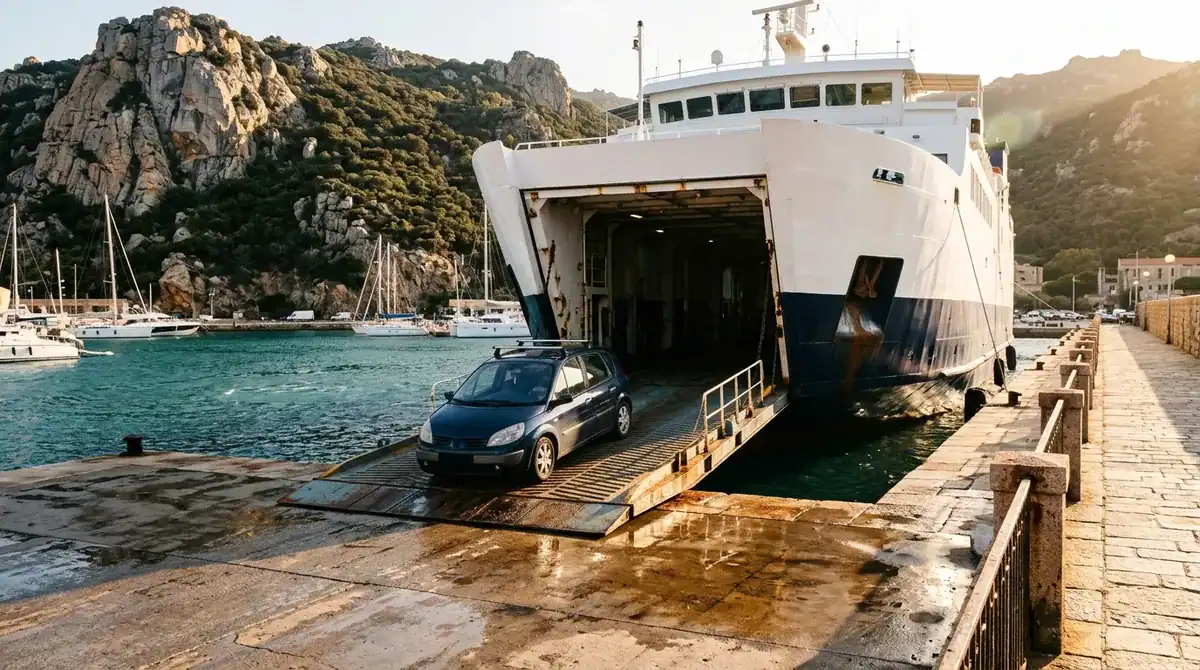
Yes, you can bring your own car to Corsica by ferry, but it takes more planning than collecting keys at a rental desk. When you travel with a vehicle, ferry operators generally ask you to arrive at least 1 hour before departure, so build that margin into your morning and don’t plan to reach the terminal at the last minute.
Vehicle size matters just as much as timing. Any vehicle over 5 metres long, 1.90 metres high or 2 metres wide must be declared when you book. Measure your car before you enter anything online, and include a roof box or bike rack, since these can push a vehicle over the height limit without you noticing. An undeclared oversized vehicle can lead to a surcharge at the port or a delay while the booking is corrected, and either can eat into the first day of your holiday.
Check the dimensions against the manufacturer’s figures rather than memory, and check them again if you plan to carry extra equipment for the whole trip. Doing this before you book avoids the most common surprises at the terminal.
For most visitors, a rental car is the simpler option. The rental company already knows the vehicle’s size, so you skip the declaration step, the early check-in and the risk of a surcharge. You can pick up the car at Napoleon Bonaparte Airport or in Ajaccio and begin the loop the next morning. The trade-off is cost and choice. Hire prices move with the season, so compare the full ferry fare, fuel and any car hire total for your exact dates before you decide.
Your Corsica Road Trip Booking Plan
Here is the whole plan in one sentence: a seven-day southern loop from Ajaccio through Propriano, Sartène, Bonifacio, Porto-Vecchio, the Ospedale forest and Bavella, then back to Ajaccio.
Start with the bookings. Reserve your car and beds first, since Bonifacio and Porto-Vecchio fill fastest in summer. Once your nights are fixed, plan your swim stops around them, so Rondinara, Santa Giulia and Palombaggia become a matter of timing rather than luck.
Set your transfer buffers before you set your alarm. Add at least 30 minutes to every important drive, and more in July and August, so a slow bend or a full car park doesn’t cost you a swim.
Packing is where the sea and the mountains meet. Bring a swimsuit, water shoes for the granite rocks, sun cream and a towel for the coves. Then add a warm layer for the Bavella pass, where the air can feel far cooler than on the coast. A reusable water bottle and a picnic bag will save you a stop at a café on the road.
Before you leave, check the official Corsica tourism itinerary again, since boat times and opening hours change with the season. If you have mapped a variation of your own, send your route to Trvrsl. We would love to see how you have shaped the loop around your own pace.
Booking Checklist for Your Loop
Start by choosing your arrival date in Ajaccio, then count the nights backward. If that date falls in July or August, give yourself the larger buffers from the start.
Book the two nights in Bonifacio first. Its old town is small and its clifftop rooms are limited, so hold those beds before you look at anything else. Once they are confirmed, compare car hire for the same dates, with pick-up at Napoleon Bonaparte Airport and at a city-centre desk in Ajaccio. Check the total cost, not just the daily rate, and include insurance and any additional driver fees.
Then write your own day sheet. List each drive with its estimated time, add at least 30 minutes to every important leg, and mark the Zonza to Ajaccio run as a travel day with only one swim stop. Keep Rondinara, Santa Giulia, Palombaggia and Tamaricciu as options rather than fixed appointments, so the water and the weather can decide how long you stay.
Finally, check your licence before you pay for anything. If it was issued outside the European Economic Area, confirm that it is written in French or officially translated, or carry an international licence alongside it. Make sure every named driver is at least 18 for a car, and keep your licence and passport in the vehicle.
Pack the swimsuit and water shoes, print the day sheet, and send the first booking confirmation to yourself so the plan lives in one place. Then the road is yours.