
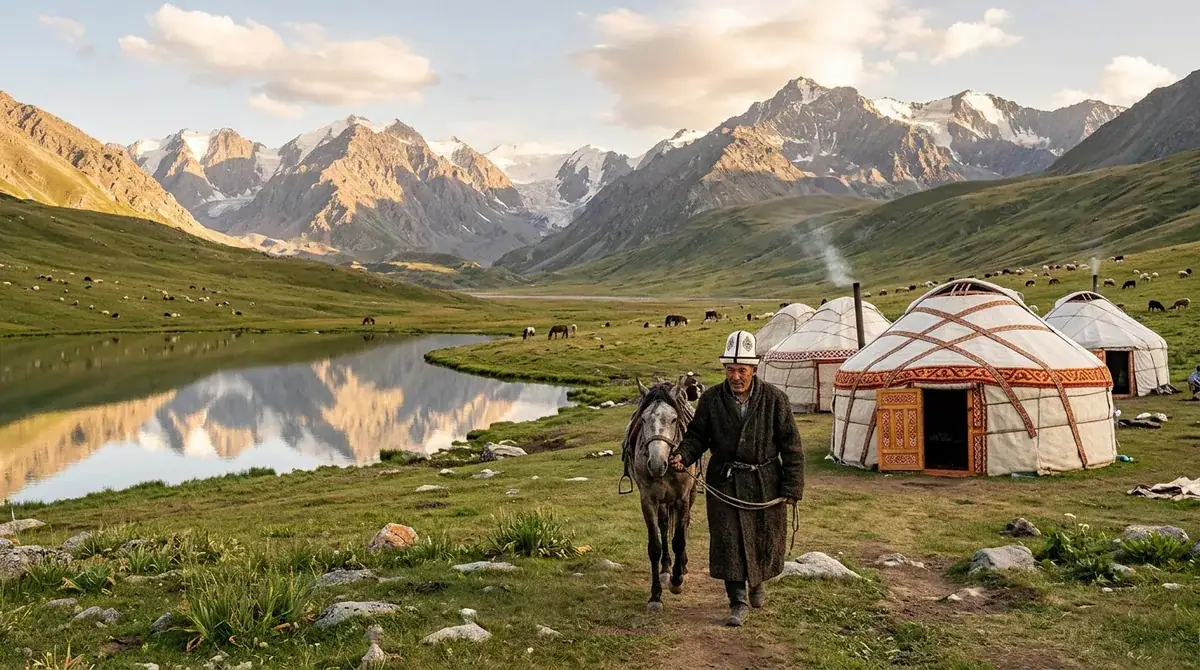
A Kyrgyzstan travel guide starts in Bishkek, the capital, where most journeys begin before they climb toward the mountains and the Issyk-Kul lakeshore. The road east forms the backbone of many itineraries. The drive from Bishkek to Karakol covers about 400 kilometres and takes roughly six to seven hours by bus, minibus or shared taxi, so treat it as a full travel day rather than a quick hop. Build in a rest night along the way and you will arrive with energy for the trails. Think of the country as a series of slow chapters: city streets in the morning, lakeside evenings, and high valleys where herders still move their animals with the seasons.
Entry is straightforward for many visitors, but the details matter. U.S. citizens need no tourist visa for stays of 30 days or less, while longer stays require one, so check your plans against that limit before you book. Roads demand patience. Mountain routes can be narrow, lack guardrails and close suddenly because of snow, ice or falling rock, and the U.S. State Department’s advisory currently sits at Level 1, “Exercise normal precautions.” Leave buffer days in your schedule, ask locals about conditions, and let the mountains set the pace. The reward for that patience is a country that feels wonderfully unhurried.
Key Takeaways
- Plan the Bishkek to Karakol drive of about 400 kilometres as a full travel day, since the trip takes roughly six to seven hours by bus, minibus or shared taxi, and add a rest night along the way.
- U.S. citizens can visit Kyrgyzstan without a tourist visa for stays of 30 days or less, so travelers planning longer trips should check the visa requirement before they book.
- Travelers should leave buffer days in their Kyrgyzstan schedule, because mountain passes can close suddenly from snow, ice or falling rock, and the U.S. State Department advisory currently sits at Level 1, “Exercise normal precautions.”
- The two-week route from Bishkek to Talas works best when travelers move in one direction, spending four nights in Bishkek, two or three in Cholpon-Ata, one or two on the south shore, two or three in Karakol and two in Talas.
- Plan to reach Talas by daylight, since mountain roads are harder to manage after dark.
Two Weeks in Kyrgyzstan: A Route from Bishkek to Talas
A two-week loop works best when you move in one direction and let each leg set up the next. Start in Bishkek, head east along the lake, and finish in Talas, the western valley that few visitors reach. Here is the order we suggest for a full fortnight, with the nights to plan for each stop.
1. Spend the first four nights in Bishkek to adjust to the altitude, shop at the markets, eat well and take a day trip to Ala Archa, which sits about 40 km from the city. 2. Travel east to the north shore of Issyk-Kul and stay two or three nights in Cholpon-Ata, where the beaches and petroglyphs make a gentle start to the lake. 3. Drive around the lake to the south shore for one or two nights of quiet scenery and short hikes through villages and red canyons. 4. Continue to Karakol for two or three nights, using it as a base for the Tian Shan valleys, the animal market and the Dungan district. 5. Take one buffer day in Karakol before the long drive, since mountain passes can close suddenly because of snow, ice or falling rock. 6. Travel to Talas by daytime, and plan two nights there, since driving on mountain roads is harder to manage after dark.
Song-Kul is the one leg you can only add in summer. Its [yurt camps](https://www.visitkyrgyzstan.org/where-to-stay-song-kul/) run seasonally, generally from mid-June to mid-September, and the lake at 3,016 metres has no conventional hotels. A typical community yurt stay is listed at $15 to $25 per night, though prices and availability should be checked directly with the camp before you go. If your dates fall in that window, two nights at Song-Kul make a memorable addition to the middle of the trip, with cold, starry evenings and the sound of horses on the grass.
The one-week version keeps the core of the route and trims the extras. Spend two or three nights in Bishkek, make the Ala Archa day trip, then go straight to Cholpon-Ata for two nights and continue to Karakol for two nights. Skip the south shore, Talas and Song-Kul, and you still get the lake, the mountains and a taste of the nomadic landscape. To extend a one-week plan, add the south shore first, since it fits naturally on the way to Karakol, then consider Song-Kul if the season allows.
Talas is the wildest part of the route, so treat it as a finale rather than a rushed stop. Arrive in daylight, leave the same way, and keep your schedule flexible enough to absorb a delay.
Getting Around Kyrgyzstan: Transport, Entry Rules and Mountain Roads
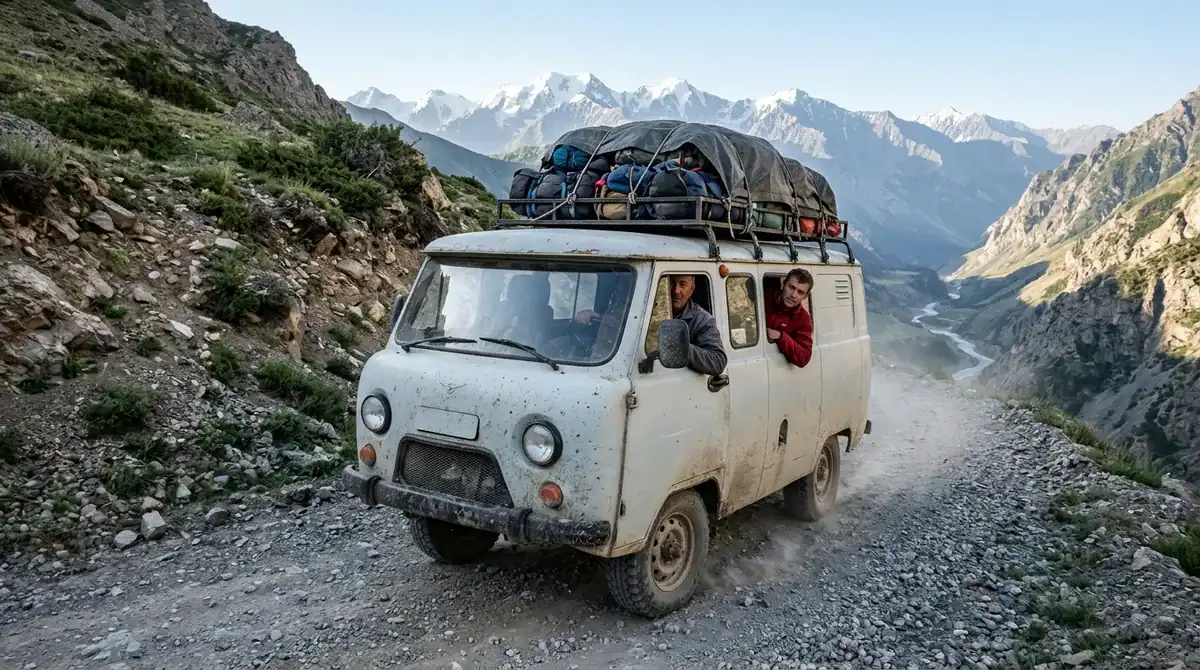
Most travelers move between cities by bus, marshrutka (minibus) or shared taxi. These options are inexpensive and run frequently along the main Bishkek to Issyk-Kul and Karakol corridors. Marshrutkas are the budget choice, while shared taxis cost more but leave when they fill, so they can go quickly or make you wait. Keep a spare hour in your day for the wait.
Winter slows things down. Snow on the passes can make departures less predictable, so if you plan to ski or trek from Karakol in the cold months, add extra planning days. Arrive a day early for any booked lesson or trek so a delayed bus does not cost you the first morning.
Guides and drivers are essential for remote valleys, Song-Kul and the high passes, where roads are rough and phone signal disappears. Arrange one through a reputable operator or through your accommodation. Before you pay, ask for the vehicle make, the driver’s name and the planned route in writing, and confirm the pick-up time, stops and what happens if a pass is closed.
Border plans need a recheck. Kyrgyzstan and Tajikistan agreed to resume cross-border movement in March 2025, but crossing status can change at short notice. If you are considering a route through the border, confirm the current situation with your accommodation and the latest travel advisory before you commit to it.
If you are traveling alone, stick to daylight hours for every journey and download offline maps before you leave Bishkek, since coverage fades quickly in the valleys. Save the contact details for your hotel or host in each town, along with a reliable contact in Bishkek. Share your itinerary with someone at home so that a missed bus or closed road can be noticed early.
Homestays, Local Food and Cultural Etiquette in Kyrgyzstan
Staying with a family or herding household is one of the best ways to understand Kyrgyzstan. Community-based stays and yurt camps let you share meals, watch daily chores and hear stories that no guidebook can tell. On Song-Kul, a typical community yurt stay is listed at $15 to $25 per night. The lake sits at 3,016 metres and its camps run only in summer, so confirm prices and availability directly with the camp before you go.
Plan your meals around the bazaars and cafes. Lagman, a hearty dish of hand-pulled noodles with vegetables and meat, appears on almost every menu. Plov, a rice dish cooked with carrots and lamb, is the centrepiece of many family gatherings. Samsa, flaky pastry filled with meat or pumpkin, comes hot from tandoor ovens, and in summer you will smell shashlyk grilling outdoors. For a salty snack on the road, try kurut, a dried cheese that is a favourite with herders.
Drinks are part of the welcome. Kumis, fermented mare’s milk with a tangy, slightly fizzy bite, is a traditional herder’s drink, so take a small cup and see how you like it. Black tea arrives with bread and sweets at most tables, and in Bishkek cafes you will also find Turkish-style tea.
Good manners go a long way. Remove your shoes at the threshold of any home or yurt, and accept tea or food when it is offered, even if you only take a sip. Pass cups, food and money with your right hand, and ask before photographing people or families. A smile and a gesture toward your camera usually lead to a yes.
Yurt-making is a central part of nomadic life, and a recent UNESCO inscription recognises the tradition. Some lakeside communities offer demonstrations, so ask your host whether a nearby family can show how felt is pressed and how the wooden lattice walls go together.
For budgeting, local cafes and bazaars keep meals cheap, while homestays and guided trips cost more. Add those lines to your daily budget before you leave Bishkek. In the capital, evenings are relaxed, but opening times vary from venue to venue, so check before you head out.
Bishkek: Tree-Lined Boulevards, Soviet Streets and Mountain Views
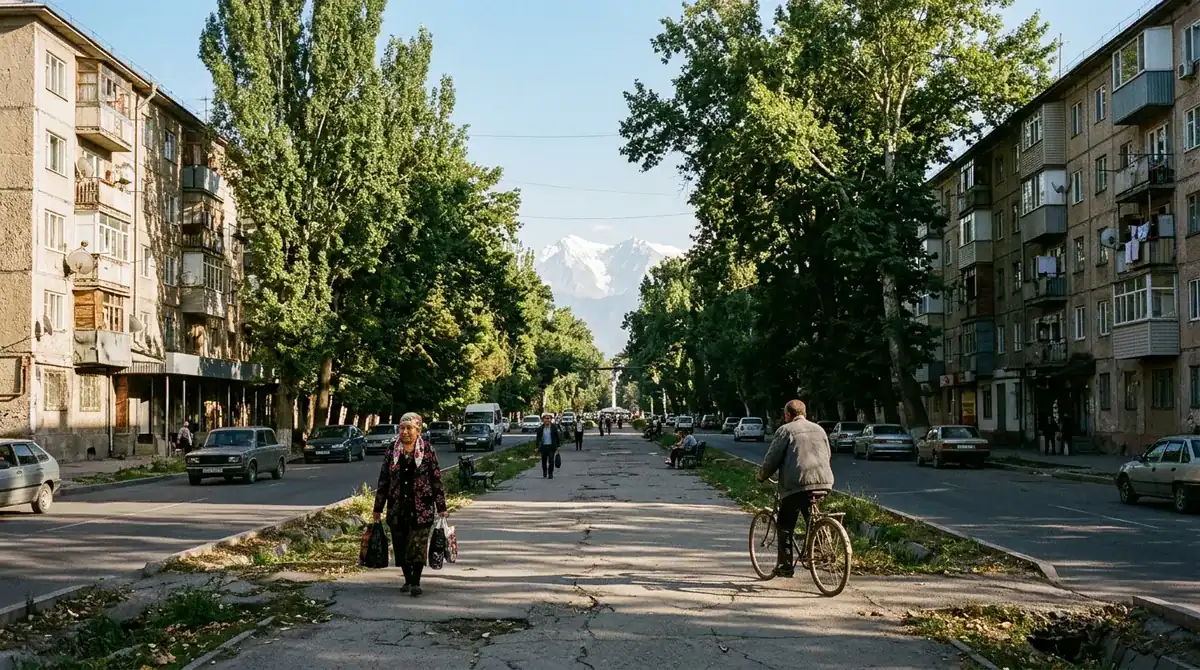
Bishkek sits at about 800 metres on the northern edge of the Tian Shan, and it feels green and open from the moment you arrive. Tree-lined boulevards shade the wide pavements, parks offer shady walks, and the central area packs in museums, galleries, cafés and restaurants within easy reach of one another.
The city grew around Silk Road routes linking the Chuy Valley with China and the central Tian Shan, and that history shows in its streets. Soviet-era buildings stand beside Kyrgyz cultural sites, and the bazaars reveal everyday life and regional food. Families will appreciate how easy it is to walk between sights, while food lovers can spend an afternoon sampling dishes and tea. Adventure travelers use the city to buy supplies, book guides and arrange transport before heading into the mountains.
Plan three or four nights in total. Give the city itself one or two full days, then use the remaining time for a day trip to Ala Archa and a visit to the nearby museums. April to June and September to October are the most pleasant months to be out walking. For current details on venues and events, see the official Bishkek city website.
At a glance
- Best for: Culture and food lovers, families wanting easy city walks, and adventure travelers preparing for mountain trips
- Season: April to June and September to October are the most pleasant periods
- Time Needed: One or two days for the city, within a three- to four-night stay
- Location: About 800 metres elevation on the northern edge of the Tian Shan
- Cost: Bishkek is a city rather than a ticketed attraction, so there is no single admission price
Ala Archa: A Mountain Escape Just Outside the City
Ala-Archa State Natural Park sits in the Tian Shan about 40 km from Bishkek, in Kashka-Suu village, and the drive to the checkpoint takes roughly 40 to 50 minutes. Spruce forest, a mountain river, waterfalls and peaks reaching 4,895 metres make the valley feel distinctly alpine, even though the capital is so close. The park was established in 1976 to protect rare plants and endangered animal species, which gives the hillsides a wild, untouched character.
The marked walks are the easiest way in. The 1.2 km route to Broken Heart rock and the 1.8 to 2 km route to Tepshi plateau suit families and casual visitors. Hikers can head for Ak-Sai Waterfall, a moderate climb that takes about four to six hours round trip.
Start early, because afternoon weather in the mountains can change quickly, and pack layers for the walk home. A first visit can fit into half a day, but a longer hike deserves a full day to feel comfortable. Ala-Archa works well as a day trip from Bishkek either before or after the Issyk-Kul leg of your journey, and its adult entry fee is 250 som, as listed on the park’s official website.
At a glance
- Best for: Nature lovers, families, casual visitors and hikers seeking alpine scenery near Bishkek
- Cost: 250 som for adults, 180 som for children aged 7 to 14, free for children under 7
- Time Needed: Half a day for a first visit, most of a day for longer hikes
- Location: Kashka-Suu village, Alamudun district, Chuy region, about 40 km from Bishkek
Karakol: Winter Ski Base and Gateway to the Tian Shan
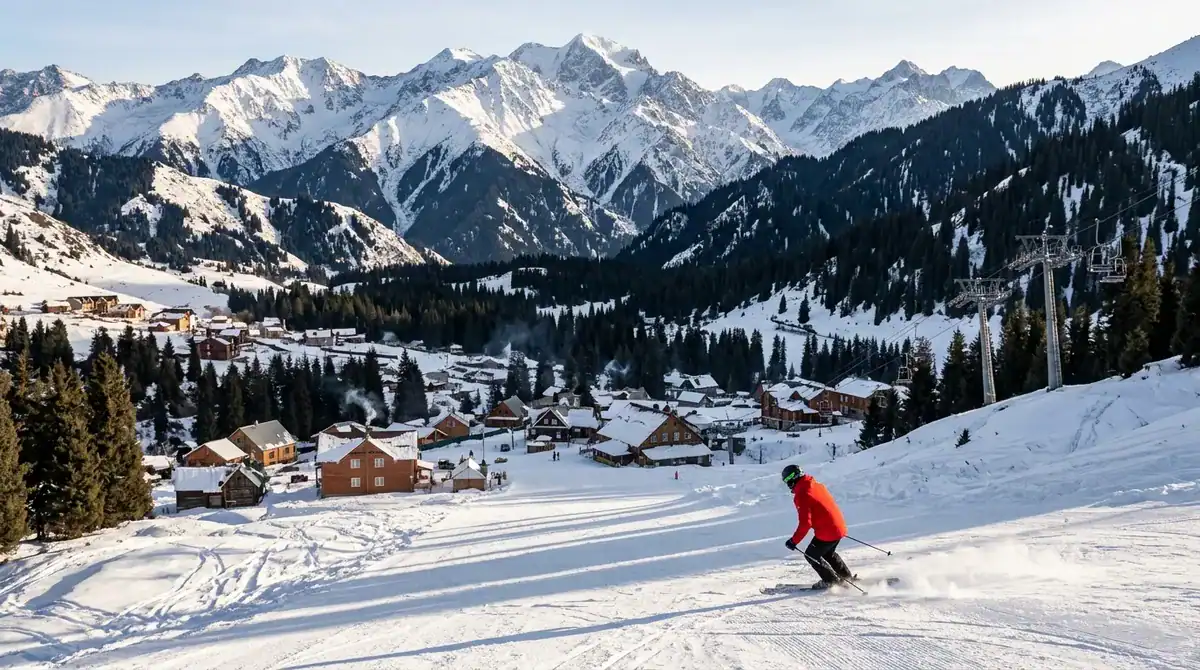
The town also has a lively old-world character, with the Dungan Mosque, built by Chinese craftsmen for the local Dungan community between 1907 and 1910, and its wooden sections were fitted together without nails. Visit Holy Trinity Cathedral nearby, then wander through the animal market, where the buzz of bargaining is half the fun. In summer, hikers set out toward Ala-Kul and Altyn Arashan, while the Karakol Ski Base, about 7 km from town, runs its season from November through April.
Dungan cooking is the highlight for food lovers. Try ashlan-fu, a cold noodle dish, and then head to the Karakol branch of Sierra Coffee, where you can pair Dungan dishes with a good cup of coffee. Museum prices are modest, with the History Museum at 70 KGS for foreign visitors and the Przhevalsky Museum from 100 KGS per person.
Karakol suits adventure travelers, skiers and culture-minded visitors. Families will enjoy the town’s parks and shorter outings, while demanding treks are best left to fit hikers. Allow a few nights for a focused stop. If you want more time in the valleys, a regional guide recommends several days, which makes Karakol a substantial anchor for a one- or two-week trip through eastern Kyrgyzstan.
At a glance
- Best for: Adventure travelers, skiers and culture-minded food lovers
- Hours or Season: Ski season runs November through April
- Time Needed: 2 to 3 nights
- Location: Eastern Issyk-Kul, about 400 km by road from Bishkek
Karakol Zoo: Bugu-Ene Refuge for Wildlife
Bugu-Ene Zoo is a small zoological park on Parkovaya Street in Karakol, founded in 1987 and described as the only zoo in Kyrgyzstan. You stroll among enclosures holding local wildlife and animals from other regions. Its quieter role matters just as much. The zoo takes in injured animals and creatures that were kept illegally, and some are treated and released back into the wild when possible. It reopened on July 1, 2025, after about a year of renovation.
Families will enjoy the easy pace, and wildlife or conservation-minded travelers will appreciate seeing the rescue work behind the fences. Kabar reported an entrance fee of 250 som for adults and 150 som for children aged 5 to 12 and pensioners with ID, with children under 5 admitted free. Fees change, so confirm the current figure before you visit.
Time is the easy part. A visit takes about 30 minutes to an hour, according to Nomad’s Land, so the zoo slips neatly between longer lake or mountain days. Try it on a morning around the bazaar or a late-afternoon stroll toward the cathedral, when the light softens and the animals tend to be more active.
At a glance
- Best for: Families, and wildlife or conservation-minded travelers
- Hours or Season: Listed as 09:00 to 17:00 daily, though an outdated notice says the zoo is temporarily closed, so confirm before visiting
- Cost: 250 som for adults, 150 som for children aged 5 to 12 and pensioners with ID, free for children under 5
- Time Needed: 30 minutes to 1 hour
- Location: Parkovaya Street, Karakol
Cholpon-Ata: Lakeside Beaches and Ancient Petroglyphs
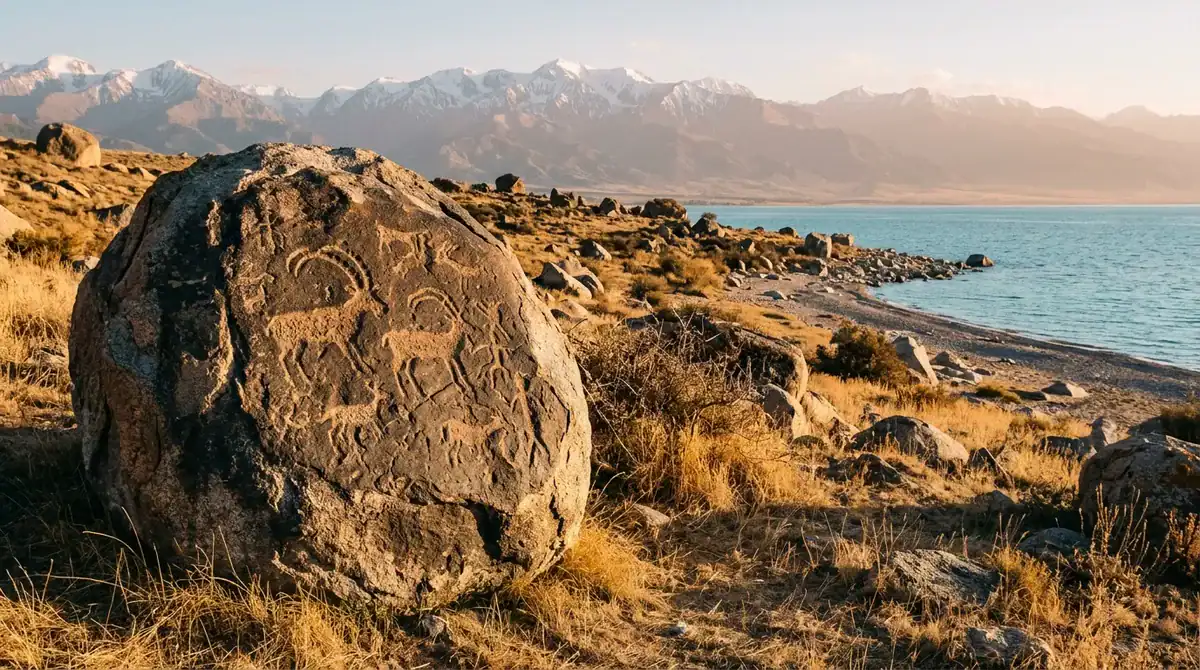
Cholpon-Ata is a resort town on the northern shore of Lake Issyk-Kul, and after several days on mountain roads, its beaches and lakeside walks feel like a welcome exhale. Restaurants along the water serve regional dishes, and in summer the afternoons slip by with a swim and a long look across the lake.
The town’s open-air petroglyph museum is the main draw. Ancient carvings sit on glacial boulders among stone circles, tombs and sculptures, and the field offers little shade, so go in the morning. Allow one to two hours there, then head to Ruh Ordo, a cultural complex named after the writer Chingiz Aitmatov. It has five religious temples or chapels and exhibits on Kyrgyz culture.
Families and travelers who want a relaxed lake break will find the pace easy. Plan two or three nights, with the carvings and Ruh Ordo taking up a morning or a day and the rest given to the beach. July and August bring the biggest crowds and the highest prices, so summer and autumn are the best seasons for swimming, while shoulder months suit quieter walks along the shore. On the north-shore leg of a one- or two-week trip, it is easy to pair the town with a Hippodrom visit on event days.
At a glance
- Best for: Families and travelers wanting a relaxed lake break after mountain days
- Hours or Season: Summer and autumn are the suggested seasons, and July and August are the busiest and most expensive months
- Time Needed: Two to three nights, with about a day for the petroglyphs and a swim
- Location: Northern shore of Lake Issyk-Kul
Panorama: A Sunrise Hilltop Above Issyk-Kul
Shatyly Panorama is a natural viewpoint in the Boz-Salkyn Valley, near Bokonbaevo on Issyk-Kul’s south shore. The route leads through a spruce-forested valley to a hilltop with views of the lake, the surrounding foothills and distant ranges, including the Mars Canyons and the Kungey Ala-Too range.
Sunrise is the moment to aim for. Early light falls at a low angle, and Asia Hikes describes how it sets the rugged hills glowing against the water. The round trip covers about 3.5 km with 177 metres of climbing, and the walk itself takes about an hour, including a photo stop. There is no entrance fee, but public transport does not use the mountain road to the trailhead, which lies about 11.5 km from Bokonbaevo, so you will need a taxi or another arranged ride. Asia Hikes gave an approximate round-trip taxi estimate of 1,500 som, including waiting time.
This stop suits hikers and landscape photographers who want a brief nature break rather than a developed attraction. Bring water and warm layers. Allow roughly one to two and a half hours for the outing, plus transport. A travel guide reports that the hike with transfers from Bokonbaevo takes about two to two and a half hours in total, so plan it as a morning outing from a south-shore base during your Issyk-Kul leg.
At a glance
- Best for: Hikers and landscape photographers seeking a brief nature stop
- Time Needed: About 1 to 2.5 hours, plus transport
- Cost: No entrance fee; round-trip taxi estimated at about 1,500 som
- Location: Boz-Salkyn Valley, about 11.5 km from Bokonbaevo on Issyk-Kul’s south shore
The South Shore of Lake Issyk Kul: Quiet Villages and Red Canyons
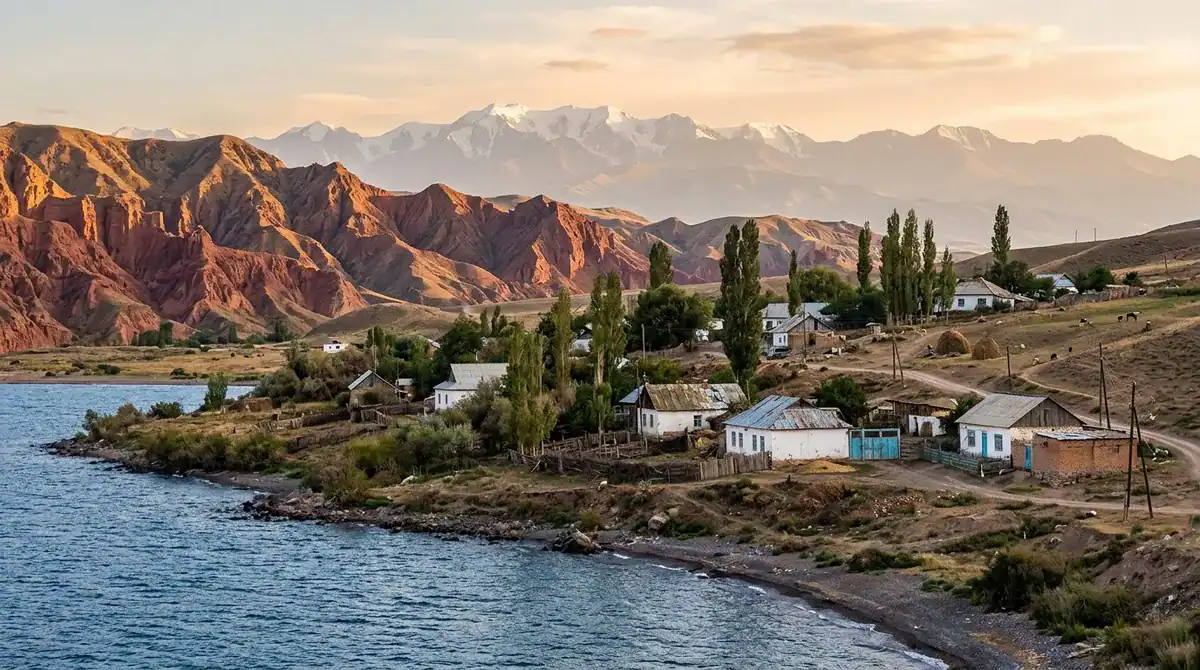
The south shore of Lake Issyk-Kul feels worlds away from the busier north. Villages such as Tamga, Barskoon and Tosor serve as bases, with homestays, canyon day trips and trekking toward the Terskei Alatoo mountains. Your mornings might start with a horse trek to an alpine lake or a bike ride along the pebbly shore, where the beaches are undeveloped rather than resort-style.
Set aside time for Skazka Canyon, where red rock rises in dramatic folds above the water. Then head to the lower valley of Barskoon Gorge for its waterfalls, a half-day outing according to Borboru Travel. No general entry fee for the gorge was confirmed, but cafés and yurts there charge separately, so bring cash. For culture, look for yurt-making and Salbuurun demonstrations, with Taigan dogs and golden eagles, and book them through Bokonbaevo, the contact point listed in a South Shore brochure.
This stretch suits campers, cyclists, horse riders and culture-curious travelers. Resort-focused visitors will find it quiet to the point of frustrating, and families should plan transport and services well ahead. Arrange transport between villages before you leave, because public links are limited. Give the shore one or two nights, and add a sunrise hike to Panorama before you leave. A full loop that includes Karakol takes three or four days, so the south shore slots neatly into a one- or two-week Kyrgyzstan trip.
At a glance
- Best for: Campers, cyclists, horse riders and culture-curious travelers
- Hours or Season: Spring, summer and autumn for Barskoon Gorge
- Cost: No general entry fee for Barskoon Gorge was confirmed; cafés and yurts are paid separately
- Time Needed: One or two days for the shore; three to four days for a loop including Karakol
- Location: Southern shore of Lake Issyk-Kul
Hippodrom: Kok Boru Matches in Baktuu-Dolonotu
The Hippodrom is a 10,000-seat equestrian venue in Baktuu-Dolonotu village, a short hop from Cholpon-Ata on the northern shore of Issyk-Kul. Spectators fill the stands to watch horse races and traditional contests such as kok boru, the fast, physical game played on horseback, along with endurance riding, flat racing and er enish. The noise of hooves and the crowd’s cheers make it feel like a true Kyrgyz sporting day.
Think of the Hippodrom as an event-day stop rather than a daily attraction. The official venue listing gives the address and event programme, but it does not publish regular opening hours, a general admission price or a standard visit length. Plan around the competition schedule instead. The Echo of the Nomads festival, held here from 1 to 4 September 2026, is a strong reason to make the trip, and the Ministry of Culture’s ticketing page listed tickets from 500 KGS, with prices varying by session and seating row.
This venue suits travelers who love horses, sport and Kyrgyz culture, and it rewards anyone who wants to see nomadic traditions in action rather than in a museum display. On a one- or two-week trip, it fits neatly into the Issyk-Kul leg. If your two nights in Cholpon-Ata coincide with a race day or festival, the Hippodrom becomes the highlight of that stay, and the lakeside beaches can fill the quieter hours.
At a glance
- Best for: Travelers interested in horses, sport and Kyrgyz culture
- Cost: Tickets from 500 KGS for the Echo of the Nomads festival (1 to 4 September 2026), varying by session and seating row
- Location: 2a Kyrgyz Street, Baktuu-Dolonotu village, near Cholpon-Ata
Kumtor Gold Mine: The Industry Behind the Mountains
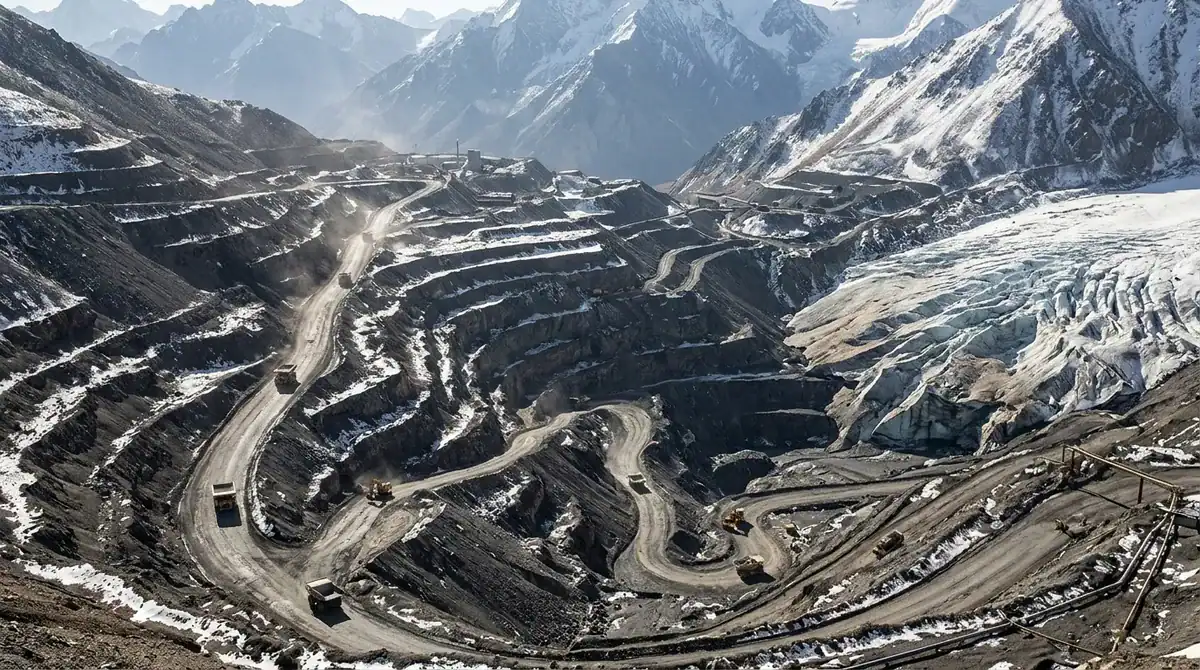
Kumtor is a working gold mine about 350 kilometres from Bishkek, sitting at roughly 4,000 metres in the Tien Shan. The company describes an open-pit operation where ore is crushed, milled and processed to extract gold. It is not a regular tourist attraction, and the company’s official site lists no public visiting hours, admission prices or tours.
Access is the real limit. A current Kyrgyzstan travel guide describes controlled access, with no route up the Barskoon valley to the pit itself. The same guide advises against photographing the mine or its checkpoints, because the site is treated as a secured strategic asset.
The realistic stop is the lower Barskoon valley, where waterfalls tumble beside the road and heavy mine traffic shares the same route. Watching trucks climb the gorge gives a sense of the operation’s scale without setting foot on mine property. It is a good place to think about the trade-offs of a mountain economy, where gold brings jobs and income, but also remote roads and environmental pressure.
This viewpoint suits travelers curious about industrial landscapes rather than those seeking a mine tour. Treat it as part of a Karakol or Barskoon day, not a separate excursion, and pair it with the waterfalls and the south-shore villages on a one- or two-week trip.
At a glance
- Best for: Travelers curious about industrial landscapes and the trade-offs behind Kyrgyzstan’s mountain economy
- Time Needed: Part of a Karakol or Barskoon day
- Location: Southern Central Tien Shan, about 4,000 metres above sea level; the lower Barskoon valley is the accessible viewpoint
Talas: The Wild West of Kyrgyzstan
Talas is a remote valley and regional centre in the northwest of Kyrgyzstan, far off the lakeside route most visitors follow. A visit here pairs the Manas Ordo heritage complex with mountain scenery, and walks and hikes around Besh-Tash open up the valley’s wilder side. It is a place where the open air and the old stories feel close together.
The valley is associated with the Battle of Talas, and the area is known for its Kyrgyz epic tradition, so history and storytelling shape the day. Few visitors reach it, which gives the valley a quieter, less-visited feel than the lake. Make time for local gulchetai, a regional dish that is well worth trying at a local table.
Talas suits culture seekers and outdoor travelers. Easier nature outings sit alongside more demanding trekking, so you can choose a gentle walk or a longer climb. Plan a few nights, and treat the valley as a planned side trip rather than a quick stop. Allow time for the region, plus travel. Plan to travel to and from Talas in daylight, since mountain roads are harder to manage after dark. A Besh-Tash itinerary from Community Based Tourism Kyrgyzstan sets aside three days from Bishkek, covering the journey, Manas Ordo, the Besh-Tash trek and the return.
At a glance
- Best for: Culture seekers and outdoor travelers who want a quieter mountain region
- Hours or Season: Trekking season runs late May through late August
- Time Needed: A few nights, with time in the region plus travel
- Location: Remote northwestern Kyrgyzstan
Manas Ordo: Medieval Mausoleum and the Manas Epic
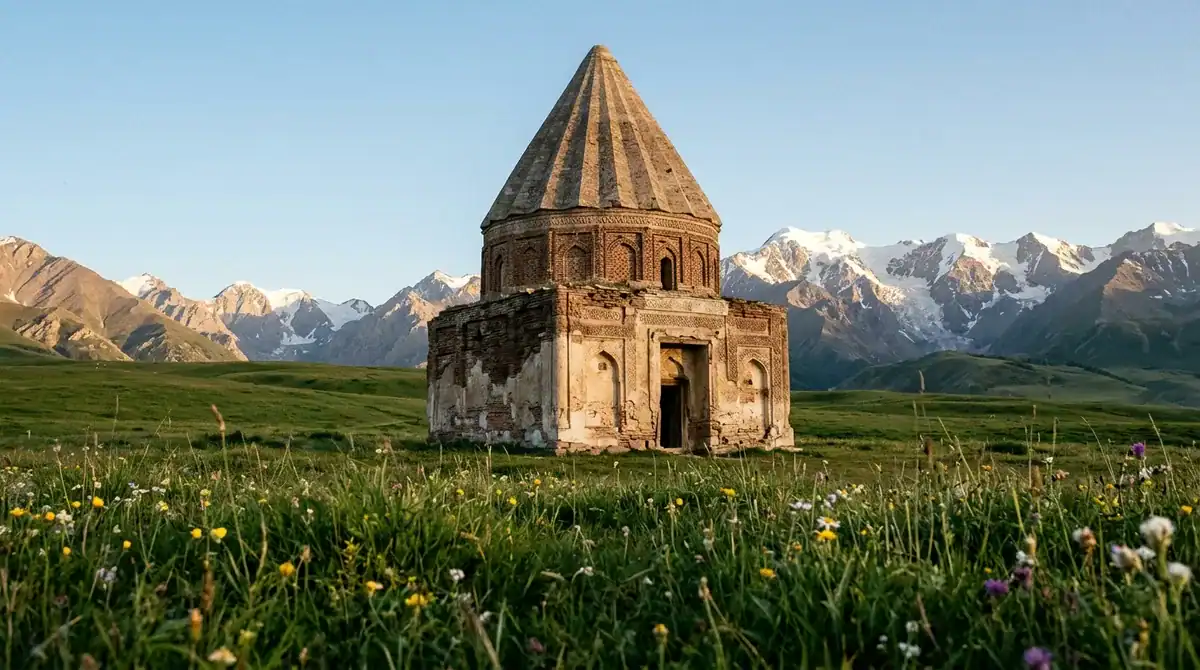
Manas Ordo is a cultural and historical complex about 15 km east of Talas, near Tash-Aryk, centred on a medieval mausoleum that legend links to Manas, the hero of the Kyrgyz epic. A taxi or minibus from Talas bus station will get you there. The complex reopened after renovation on September 11, 2026, with updated museum displays, and a new Rest Point opened the day before with an information centre, showers, toilets and a coffee shop.
Start at the gumbez, the domed mausoleum that anchors the site, then explore the museum and the grounds. Those grounds hold rock paintings, stone statues, burial mounds, petroglyphs and runic-writing monuments, so you can wander from one era to the next. Climb the lookout hill next, a stairway trek of about 15 minutes that rewards you with views over the park, the Talas Valley and the surrounding mountains.
Manas Ordo suits travelers curious about Kyrgyz history and culture, and families will enjoy the open grounds. It is not an adventure activity or a food-focused stop. Allow roughly half a day for a quiet visit, or treat it as an overnight stop in Talas. Ticket prices and regular opening hours were not listed after the reopening, so check current details locally before you set out.
In a one- or two-week loop, Manas Ordo fits naturally into the two nights planned for Talas. Pair it with a walk through the Talas Valley for a full day, and keep your travel to and from the valley in daylight.
At a glance
- Best for: Travelers interested in Kyrgyz history and culture, and families who enjoy open grounds
- Time Needed: Roughly half a day, or an overnight stop with a Talas valley walk
- Location: About 15 km east of Talas, near Tash-Aryk
National History Museum: Kyrgyz Story on Ala-Too Square
The National Historical Museum on Ala-Too Square, at 112 Chui Avenue, is the best indoor stop for understanding Kyrgyz history before you head for the mountains. Its archaeological, ethnographic and historical collections hold more than 90,000 exhibits, and they move from ancient objects and traditional crafts to more recent history. By the time you leave, the nomadic landscapes you see later will carry much more meaning.
The museum is also a welcome counterpoint on a rainy day in Bishkek, when a mountain walk is off the table. History lovers can linger over the displays, and families will find the mix of objects and crafts easy to follow. Plan one to two hours inside. A Bishkek travel guide recommends a one-day central itinerary that pairs it with Ala-Too Square, so the square and the nearby White House make natural companions for the same walk.
Visit early in your Bishkek stay so the museum’s story frames everything that follows. Adult entry is 200 som, students and pensioners pay 190 som, and schoolchildren pay 110 som. The museum is open Tuesday to Sunday, 09:00 to 18:00, with the ticket office closing at 17:30, and it is closed on Mondays and the last Friday of each month for sanitation. For current prices and hours, the official site is the best source.
At a glance
- Best for: History lovers, families and travelers who want context before the mountains
- Hours or Season: Tuesday to Sunday, 09:00 to 18:00, with the ticket office closing at 17:30
- Cost: 200 som for adults, 190 som for students and pensioners, 110 som for schoolchildren
- Time Needed: 1.5 to 2 hours
- Location: 112 Chui Avenue, Ala-Too Square, central Bishkek
Ala Too Square: Bishkek’s Civic Heart
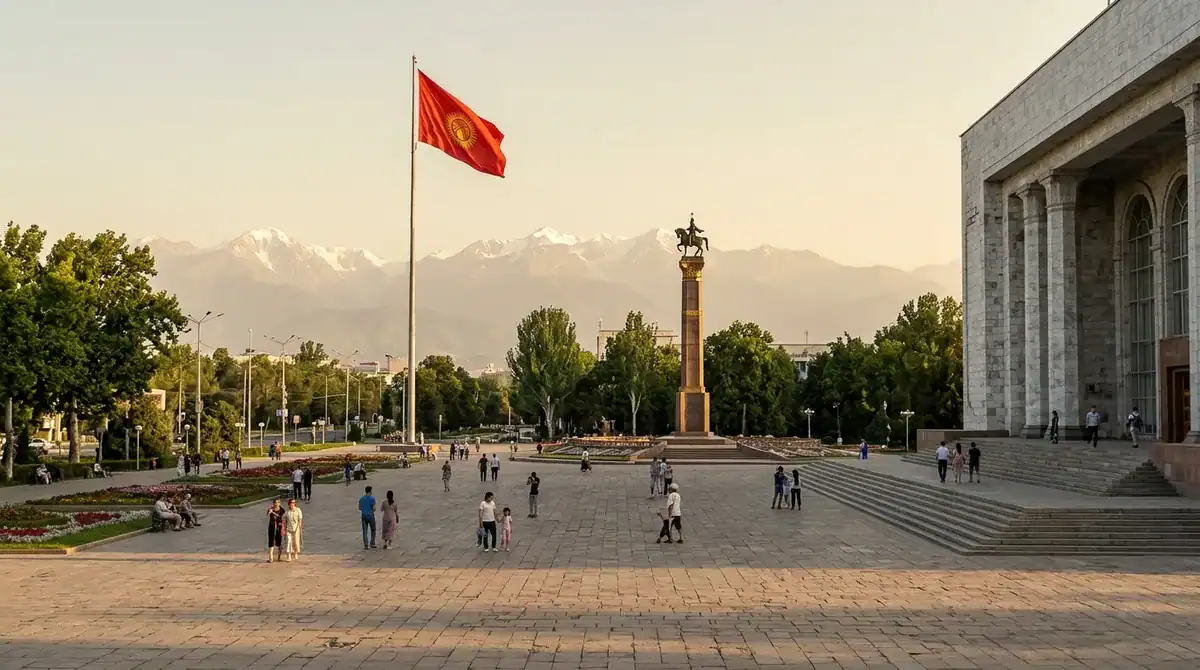
Ala-Too Square is Bishkek’s central public square, and it makes a short, easy stop between other sights. Stroll the plaza to see the Manas monument, several memorials, the national flag and the civic buildings that frame the open space. Reports describe an honour guard at the flagpole changing every hour, so if a ceremony is under way when you arrive, pause and watch, though confirm the schedule locally before planning around it.
Most visitors need about 30 minutes for the square itself, which makes it easy to fold into a full day of exploring Bishkek. The nearby National Historical Museum and Oak Park are natural additions, and the Fine Arts Museum can join the same walk. The square suits travelers who love city life, history and public spaces, and families will enjoy the open ground. It is not a food or adventure stop, but it gives you useful orientation in the capital.
On a one- or two-week Kyrgyzstan trip, the square fits neatly at the start or end of your time in the capital. An independent visitor guide lists it as open 24 hours but does not confirm access for ceremonies, fountains or the museum. Bishkek City Hall also warned in April 2024 that nearby pedestrian areas and public spaces would be temporarily closed during reconstruction work.
At a glance
- Best for: City life, history and public-space fans, including families
- Hours or Season: Listed as open 24 hours, though access for ceremonies, fountains and the museum is not confirmed
- Time Needed: About 30 minutes for the square itself
- Location: Central Bishkek
White House: Marble Soviet-Era Landmark
Bishkek’s White House stands at Prospect Chuy 205, a seven-story, marble-clad government building in a Stalinist-inspired style. It was commissioned as the headquarters of the Communist Party Central Committee and completed in 1985, and its pale stone façade still gives the avenue a formal, monumental presence. Most visitors admire it from the pavement.
Its place in recent history is what gives it weight. The building has been a focal point of Kyrgyzstan’s 2005, 2010 and 2020 revolutions, so it appeals to architecture fans and to anyone curious about the country’s politics. Koryo Tours describes it as a calm-looking building best viewed from a distance and advises against lingering nearby, so keep a steady pace.
The parliament announced in September 2026 plans to welcome foreign tourists once a week, with access to its museum and meeting halls. No finalised schedule has been published, and entry requires a pass ticket. Current arrangements are listed on the parliament’s official site.
Treat the White House as a brief city-walk stop. Ala-Too Square and the National History Museum are a short stroll away, and Panfilov Park, the State Flag and the State Historical Museum sit nearby too. One guide suggests one or two days for Bishkek, so fold this stop into your capital time rather than planning a separate day.
At a glance
- Best for: Architecture fans and travelers interested in Kyrgyzstan’s political history
- Hours or Season: Weekly foreign-tourist visits announced in September 2026, with no finalised schedule published
- Cost: Entry requires a pass ticket; no public admission price has been published
- Time Needed: A brief stop within a one- or two-day Bishkek visit
- Location: Prospect Chuy 205, Bishkek
Parliament: Jogorku Kenesh and Civic History
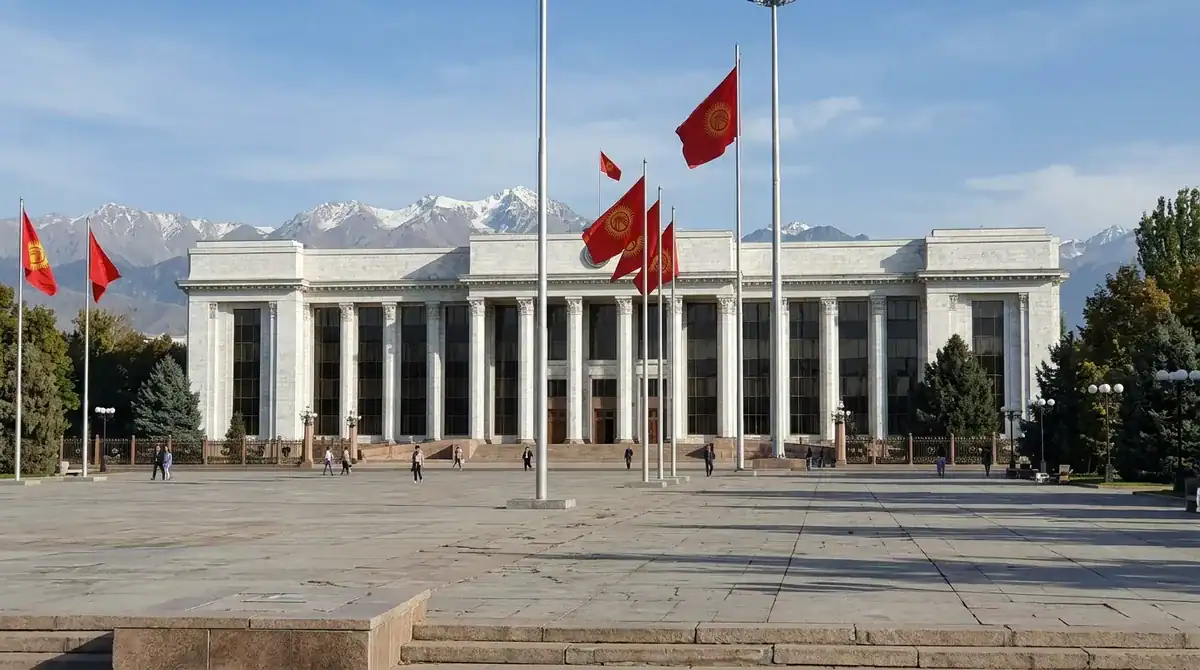
The Jogorku Kenesh, Kyrgyzstan’s parliament, sits inside Bishkek’s White House at Prospect Chuy 205. The seven-storey building is faced in marble and fronted by a large bed of red flowers, and its neoclassical lines carry a Stalinist-era grandeur. Most visitors begin with a slow walk around the exterior, pausing to admire the flowerbed and the building’s sheer scale.
Going inside is a newer story. On September 28, 2026, the parliament’s press service said officials were working out weekly introductory visits for foreign tourists, which could include the parliament museum and session halls, with security procedures to be followed. The announcement gives no start date, opening hours, ticket price or visit length, and entry is subject to a pass ticket, so read the latest details on the official parliament site before you plan around them.
This is a good stop for architecture and civic-history enthusiasts, and it works well on a walking day. The building is near Panfilov Park and close to the National History Museum, so you can visit the museum first and then cross to the White House for a fuller picture of Kyrgyz politics.
At a glance
- Best for: Architecture and civic-history enthusiasts
- Hours or Season: Weekly introductory visits for foreign tourists were being planned in September 2026, with no start date given
- Cost: Entry is subject to a pass ticket, and no price has been published
- Location: Prospect Chuy 205, Bishkek, near Panfilov Park
Victory Square: Eternal Flame and Memorial Design
Victory Square is a public memorial in central Bishkek dedicated to those who died in the Second World War. Walk across the open square to see the eternal flame, the sculptural groups and the memorial inscriptions, including carved date stones and inscribed marble slabs. The city administration says the memorial complex took shape in the mid-1980s, when a monument with an eternal flame was installed in 1984. The square is open to visitors around the clock, with no gates or ticket office, as Kyrgyz Seasons describes it.
The design is the reason to pause. Three curved arches symbolize a yurt, framing a mother figure beside the eternal flame, a quiet image of a family waiting for its loved ones to return. Take your time under the arches and watch how the light moves across the stone.
This is a reflective, short stop rather than an adventure or food attraction. It suits history and architecture fans, and anyone who wants a calm break on a central walk. Allow about 20 minutes on its own. For a memorial-themed morning, pair it with Panfilov Park, and in a one- or two-week trip, the square fits neatly into your Bishkek days. A 5.1-kilometre central walking loop that includes monument stops takes about two to three hours, so you can add Victory Square without rushing the rest of the city.
At a glance
- Best for: History and architecture fans, and travelers who want a reflective stop on a central walk
- Hours or Season: Open 24 hours
- Cost: No gates or ticket office
- Time Needed: About 20 minutes
- Location: Central Bishkek, about 42.8794° N, 74.6162° E
Panfilov Park: Leafy Paths, a Ferris Wheel and Local Life
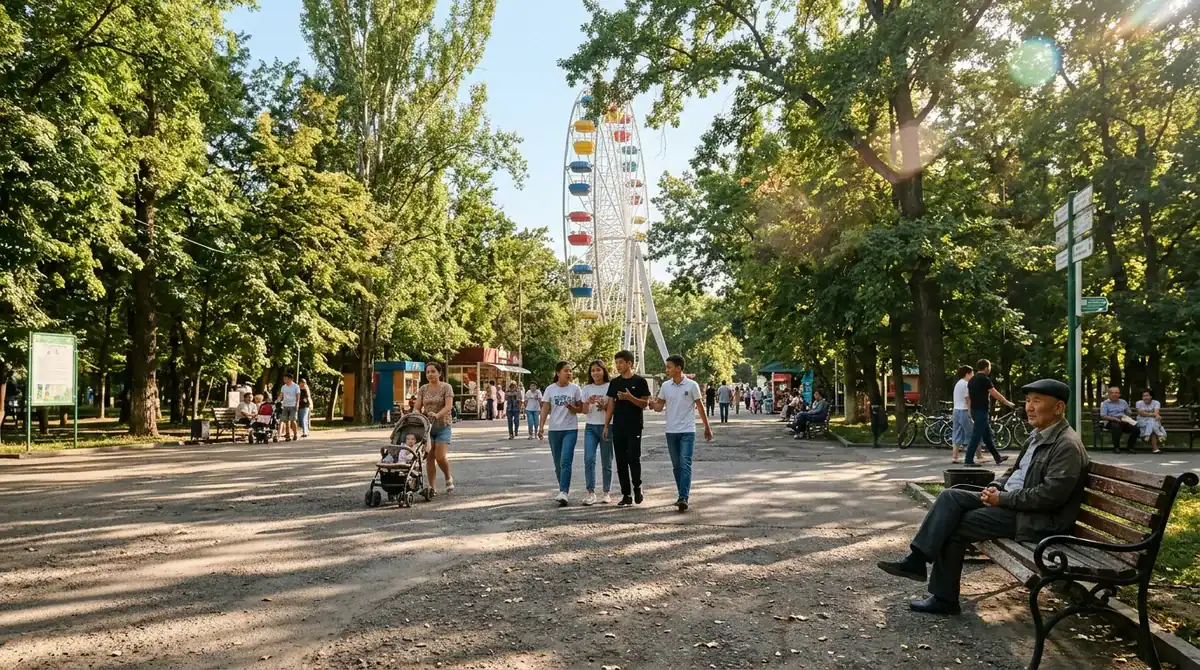
Panfilov Park is a leafy, easy-paced stop in central Bishkek. It began in 1924 as Zvezda (Star) Park near Old Square, and today its tree-shaded paths lead past a memorial to General Ivan Panfilov. Take a slow lap, stop at the monument, then sit back and watch local life unfold around you.
The small amusement area adds a playful side to the park. It has included a Ferris wheel, bumper cars and children’s rides, and the carousel runs until midnight when the rides are operating. In February 2026, child ride tickets were 120 som and adult tickets 150 som, while Ferris wheel tickets were 120 som for children and 200 som for adults. Rides can pause during very heavy rain. When the park is open, cafés and vendors line the paths, so a snack break comes easily. On Fridays and Saturdays, concerts run at the park’s new amphitheater from 17:00 to 18:00.
The park suits families with children and travelers interested in Bishkek’s Soviet-era legacy. Allow about 45 minutes to an hour, which makes it an easy addition to a Bishkek walking day alongside nearby Ala-Too Square. On a one- or two-week trip, it works well as a relaxed city break at either end of your time in the capital. Prices and ride schedules change often, so the park’s official Facebook page is the best place for current details.
At a glance
- Best for: Families and travelers interested in Bishkek’s Soviet-era legacy
- Hours or Season: Operates daily in season; carousel rides run until midnight (park administration posts, 2026)
- Cost: Ride tickets 120 som for children and 150 som for adults; Ferris wheel tickets 120 som for children and 200 som for adults (February 2026)
- Time Needed: About 45 minutes to 1 hour
- Location: Central Bishkek, near Old Square
Southgate Park: Victory Park and Quiet Green Space
Southgate Park, also known as Victory Park, South Gate or Yuzhnye Vorota, is a leafy memorial park on Bishkek’s southern edge. It is named after Dair Asanov, and the city’s [tourism department](https://tourism.meria.kg/parksGarden/7) describes a central Victory memorial complex here, along with monuments to Kyrgyz heroes.
Take your time among the memorials. You will find a monument to the heroes of the Batken events, an alley dedicated to Kyrgyz border guards and emergency-services employees, and a monument to victims of the Leningrad Blockade. The park covers more than 35 hectares of tree cover, benches and a bicycle path, so a slow stroll or an easy ride makes a pleasant change from the city’s busier streets. Be aware that in August 2026, visitors reported cracked asphalt and sunken paving, which makes walking harder with children. In July 2026, the mayor visited the park, and reconstruction was expected to begin soon.
This is a quiet green break and a place of local remembrance rather than a major adventure or food stop. It suits city strollers, gentle walkers and history-minded travelers. Come in daylight, and pair your walk with a cafe stop nearby. On a one- or two-week trip, it works well as a brief pause within your Bishkek days.
At a glance
- Best for: City strollers, gentle walkers and history-minded travelers
- Time Needed: A brief stop within the Bishkek portion of a 1–2 week trip
- Location: 28/9 Absamat Masaliev Avenue, Bishkek
Erkindik Boulevard: Bishkek’s Leafy Historic Promenade
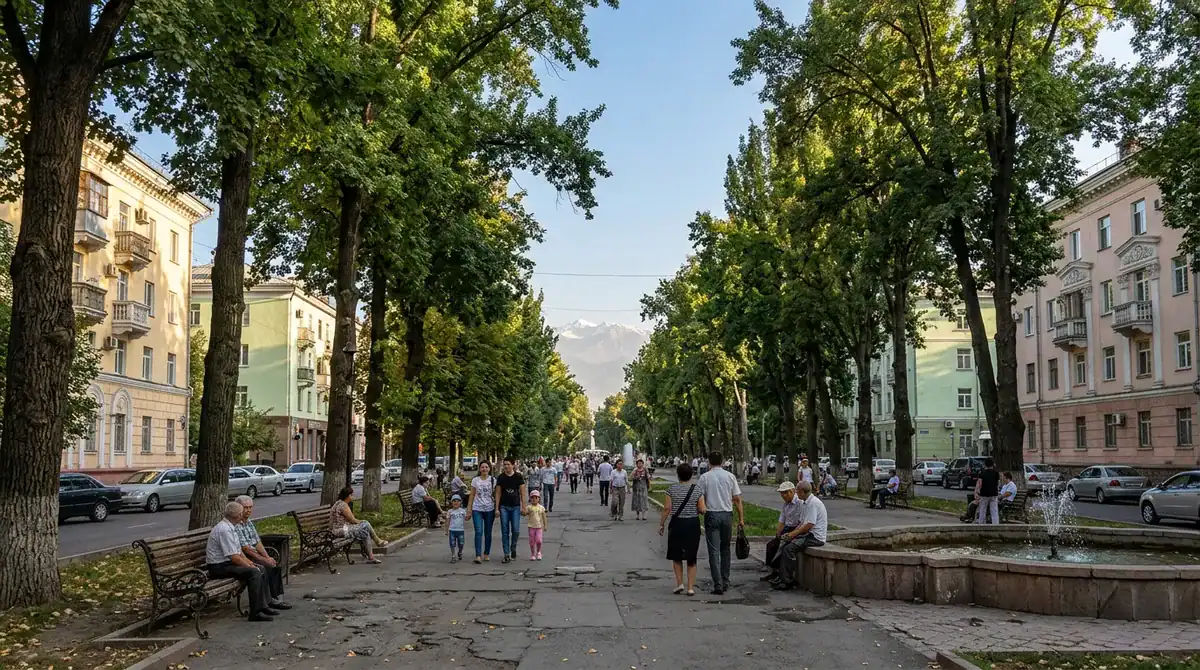
Erkindik Boulevard is the leafy spine of central Bishkek, a green promenade about 2.3 kilometres long that runs from the area beside Bishkek II railway station to Jibek Jolu Avenue. The State Tourism Department lists it as municipal property, so it belongs to everyone who walks it. Start at the station end and let the route unfold. Flowerbeds line the path, monuments stand at intervals, and the mix of older and newer buildings tells the city’s story one façade at a time.
The walk is as much about the everyday as the history. Locals stroll, exercise and linger on benches, so you will see grandparents chatting, joggers pacing the pavement and families out for a slow afternoon. Expect road crossings and traffic along the way, and take them carefully. The name adds a nice touch: Erkindik means “freedom,” and the boulevard grew out of a square planted in 1902.
This is an easy stop for casual walkers and anyone curious about urban history. Treat it as a short stroll or as one part of a wider Bishkek walking day. For a full city morning, start on the boulevard, then drop into a cafe and continue to Osh Bazaar. On a one- or two-week Kyrgyzstan trip, it fits naturally into your days in the capital, before or after the mountain legs.
At a glance
- Best for: Casual walkers and travelers interested in urban history
- Hours or Season: Flower displays are colourful from early spring to late autumn, according to Bishkek City Hall guidance
- Cost: No admission price is listed on the reviewed official city or tourism pages
- Time Needed: A short stop, or part of a wider Bishkek walking day
- Location: Central Bishkek, between Bishkek II railway station and Jibek Jolu Avenue
Chyngyz Aitmatov Museum: The Writer’s Lived-In Home
The Chyngyz Aitmatov Museum is a house museum in Chong-Aryk, Bishkek, set in the home where the writer lived. Its preserved rooms include the living room, the study and the library, and you can see his personal belongings, awards, documents, photographs and clothing. Notes for his unfinished work “Oimo” are also on display, so you get a close view of how he worked.
What makes the museum special is its intimacy. Rather than walking past glass cases in a gallery, you step into rooms where one of Kyrgyzstan’s best-known writers read, wrote and lived. Visits are by appointment, entry to the residence grounds is regulated, and groups are limited to 15 visitors at a time, so the atmosphere stays quiet and personal. The [University of Central Asia’s 2024 guide](https://ucentralasia.org/media/d2wbcmpu/museums-bishkek-eng-2024.pdf) covers the current arrangements in detail.
The museum suits culturally curious travelers and readers more than adventure seekers or food-focused visitors. Allow 60 to 90 minutes inside, and roughly half a day once travel from central Bishkek is included. To get there, take bus 8 or minibus 265 to Chong-Aryk, then walk a short distance. Pair it with the National History Museum on Ala-Too Square for a culture-heavy day, which fits neatly into the Bishkek portion of a one- or two-week trip.
At a glance
- Best for: Culturally curious travelers and readers, rather than adventure or food-focused visitors
- Hours or Season: Monday to Saturday, 10:00 to 17:00, by appointment
- Cost: 200 som including the excursion, as listed in 2024
- Time Needed: 60 to 90 minutes inside, about half a day with travel from central Bishkek
- Location: 305 Chyngyz Aitmatov Avenue, Chong-Aryk, Bishkek
Osh Bazaar: Bishkek’s Working Market for Food and Crafts
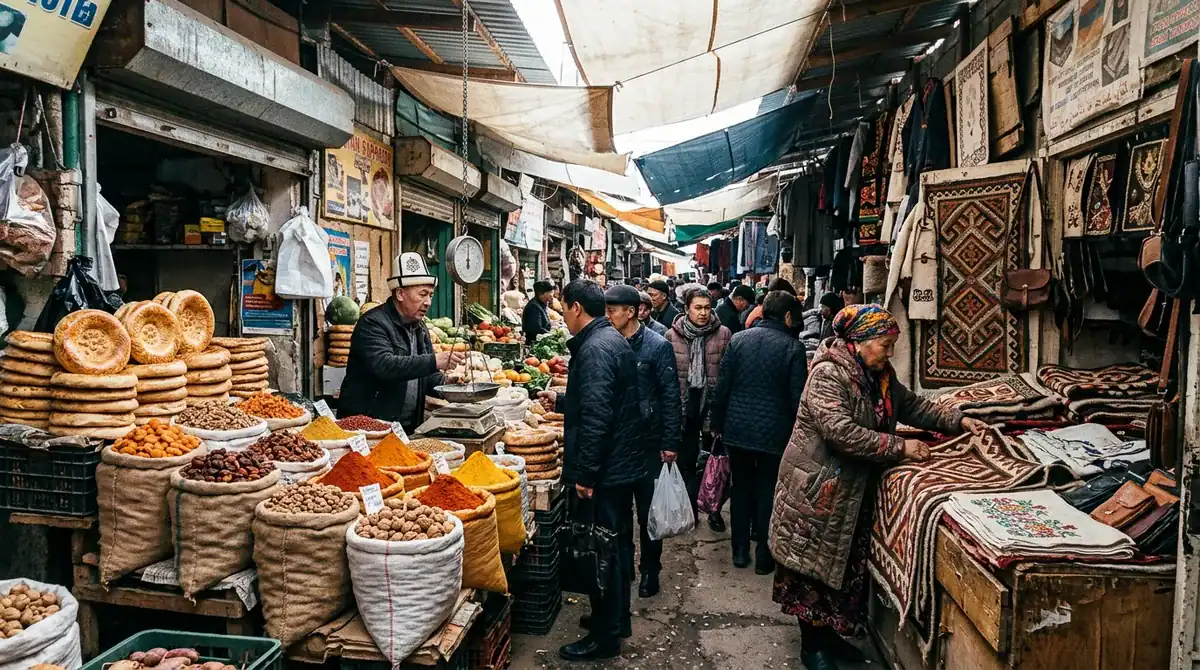
Osh Bazaar is a busy working market in western Bishkek, and despite its name it has nothing to do with the city of Osh in the south. Locals come here to shop, so you will walk past piles of produce, dried fruit, nuts, spices and fresh bread, with clothing and souvenirs filling the rows in between. Look for felt kalpaks, the traditional hats, among the stalls.
Eating is the real draw. Tandoor-baked samsa comes hot from the oven, and you can sample lagman, the hand-pulled noodle dish, and plov, the rice dish with carrots and meat. For a salty snack to take with you, try kurut, a dried cheese.
Go in the morning, when the stalls are at their busiest. Allow one to two hours for a first visit, or longer if you plan to shop and eat. Monday is a sanitation-cleaning day, when some sections may be closed or less active. The market suits food lovers and travelers curious about everyday life more than adventure seekers, and it makes an easy city stop within a one- or two-week trip. Keep in mind that the bazaar is due to move: Bishkek’s mayor’s office reported activity at the market on October 14, 2026, and Kabar reported on October 26, 2026 that the new Osh Bazaar was expected to open in March to April 2027.
At a glance
- Best for: Food lovers and travelers curious about local life
- Time Needed: 1 to 2 hours for a first visit, longer if shopping and eating
- Cost: Free open-air access; purchases and food are separate expenses
- Location: Western Bishkek
Jalalabad Cafe: Fresh Lagman in Central Bishkek
Jalalabad Cafe is a casual national-cuisine restaurant in central Bishkek, on Togolok Moldo Street near the Kievskaya intersection. Despite the name, it has nothing to do with the city of Jalal-Abad, so think of it as a place to eat rather than a sight to see. The American University of Central Asia’s dining guide singles out the fresh lagman as the dish to order. The cafe is especially appealing in summer, when shashlyk cooks grill outside and guests sit at Eastern-style tables.
A bowl of lagman and a plate of grilled meat is a simple way to taste regional cooking without spending much. Jalalabad is one of the cheaper places to eat in central Bishkek, though that is a general marker rather than a current menu price, so look at the prices when you sit down. Expect an informal room with no ceremony, where a quick lunch and a slow meal feel equally at home.
Food lovers on a budget will get the most from a stop here, especially those who want a real taste of regional cooking between days of exploring. Plan it as a meal rather than a sightseeing stop, and fit it into a Bishkek stay within a one- or two-week trip. It pairs well with a stroll along Erkindik Boulevard, followed by a wander through Osh Bazaar.
At a glance
- Best for: Food lovers seeking an inexpensive, informal taste of regional dishes
- Hours or Season: Listed as 08:00 to 00:00 by Asia Expeditions; summer is when the outdoor shashlyk grill is most appealing
- Cost: Among the cheaper places to eat in central Bishkek
- Location: 54/a Togolok Moldo Street, central Bishkek, near the Kievskaya intersection
Sierra Coffee: Local Roasts and a Flexible Meeting Spot
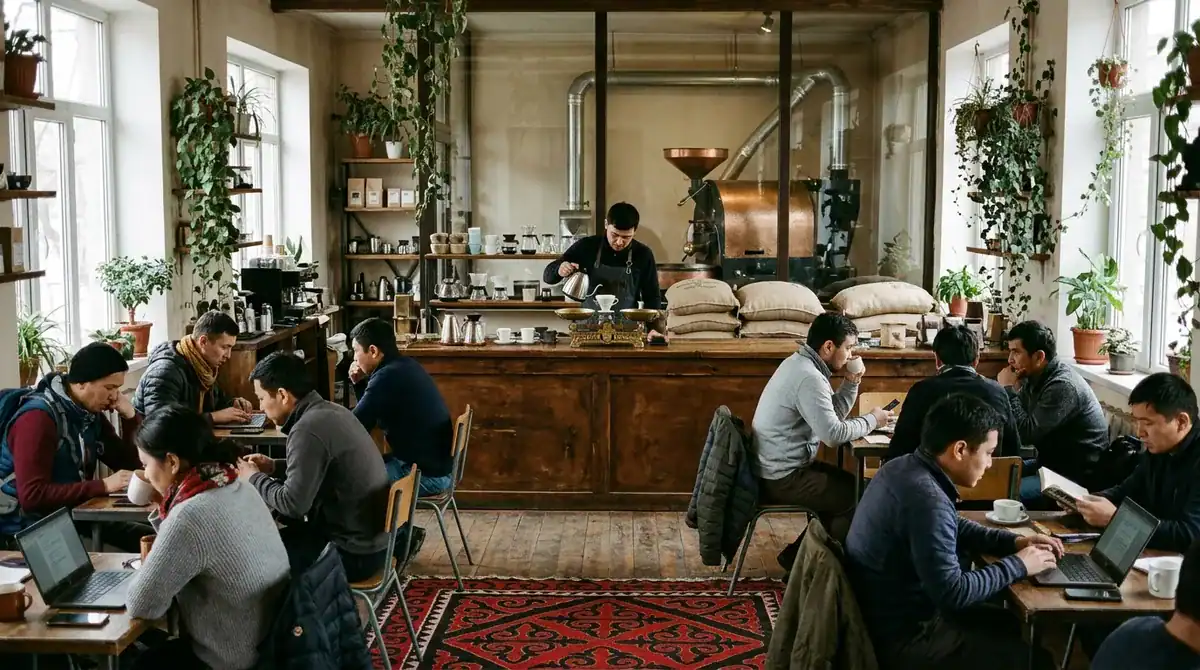
Sierra Coffee is a Kyrgyz café brand rather than a sightseeing stop, and that is part of its appeal. The company opened its cafés in 2012, after founder Bradley Brenneman had first set up Bishkek Coffee Roasters. Its beans come from Brazil, Colombia, Guatemala and Ethiopia and are roasted in Bishkek, so your cup has a local story behind it.
The Karakol branch is the place to linger if you want a full meal. Alongside its coffee, it serves European coffee-shop fare, a small Tex-Mex menu and Dungan dishes, with vegetarian options and Wi-Fi. The Bishkek café on Manas Avenue has high chairs and outdoor seating, which makes it handy for families, and guests often mention the nachos, tacos and burritos. A 2021 Bishkek listing gave an average check starting at 350 som and hours of 7:30 a.m. to 11 p.m., though those details change often, so see the official Sierra Coffee website for current information. That site currently says it is under construction, so check locations before you set out.
Coffee and food lovers will get the most from a stop here. It also works well as a meeting spot, a place to regroup between a morning bus and an afternoon walk. There is no separate excursion to plan, and no set visit length is published, so treat it as a coffee or meal break. On a one- or two-week trip, it slots easily into your days in Bishkek or Karakol.
At a glance
- Best for: Coffee and food lovers, families and travelers who want a flexible break
- Hours or Season: 7:30 a.m. to 11 p.m. at the Bishkek branch (2021 listing, changes often)
- Cost: Average check from 350 som at the Bishkek branch (2021 listing)
- Time Needed: Plan around a coffee or a meal
- Location: Bishkek (57/1 Manas Avenue) and Karakol
Promzona: Live Music and Evening Concerts in Bishkek
PROMZONA is a live-music club and concert venue in Bishkek, and it works best as an evening stop rather than a daytime sightseeing attraction. Visitors come for concerts, club nights and performances by resident bands. The stage, dance floor and seating areas fill up once the music starts, and a bar and menu keep the night going. The club opened in Bishkek with an official presentation in October 2005.
Expect a lively, late-night atmosphere. An event listing states that the venue is 18+ and has a dress code, so it is not a family attraction. Resident bands Green Light and Cool Band appear on the club’s weekly program, though the repertoire changes often, so check the event schedule before you go.
Entrance prices on the [official PROMZONA site](https://promzona.kg/) are 300 soms on Thursday and Sunday and 800 soms on Friday and Saturday. Holiday prices are set separately by the club, and drinks and food at a live-music venue can cost more than at a neighbourhood cafe, so plan your budget accordingly.
Treat PROMZONA as one evening during your time in Bishkek on a one- or two-week trip. Spend the afternoon on a walk through Panfilov Park or Ala-Too Square, then head to Cholponatinskaya Street after dark.
At a glance
- Best for: Adults interested in live music, concerts and nightlife
- Cost: 300 soms on Thursday and Sunday, 800 soms on Friday and Saturday
- Time Needed: An evening stop during your time in Bishkek
- Location: 16 Cholponatinskaya Street, Bishkek
Booking Your First Kyrgyzstan Trip
Start with your calendar, because the season shapes everything else. Song-Kul’s yurt camps generally run from mid-June to mid-September, so if that lake is on your list, pick dates inside that window first. Bishkek is most pleasant from April to June and from September to October. Then count your nights. U.S. citizens need no tourist visa for stays of 30 days or less, but a longer trip requires a visa, so check the options on the Kyrgyz Republic e-Visa Portal before you book flights.
Next, book the long road day. Reserve a morning departure from Bishkek for the 400-kilometre trip to Karakol, which takes six to seven hours by bus, minibus or shared taxi. An early start gives you daylight for the mountain sections, and it leaves room for a rest night on the way.
Then request written confirmations. Ask your Song-Kul camp for the current nightly rate and its opening dates, and ask your driver for the vehicle make, the route and the pick-up time. If your plans include crossing into Tajikistan, confirm the border situation with your accommodation before you pay any deposit.
The country’s tourism push is worth watching too. The [National Statistical Committee](https://stat.gov.kg/ru/opendata/category/130/) reported that tourism made up 3.8% of GDP in 2024, and the government’s [Sustainable Tourism Development Program](https://www.trade.gov/country-commercial-guides/kyrgyz-republic-travel-and-tourism) for 2025 to 2030 aims to lift that share to 7% by 2030. Expect more services in the coming years, but plan today around the routes and dates you can confirm now.