
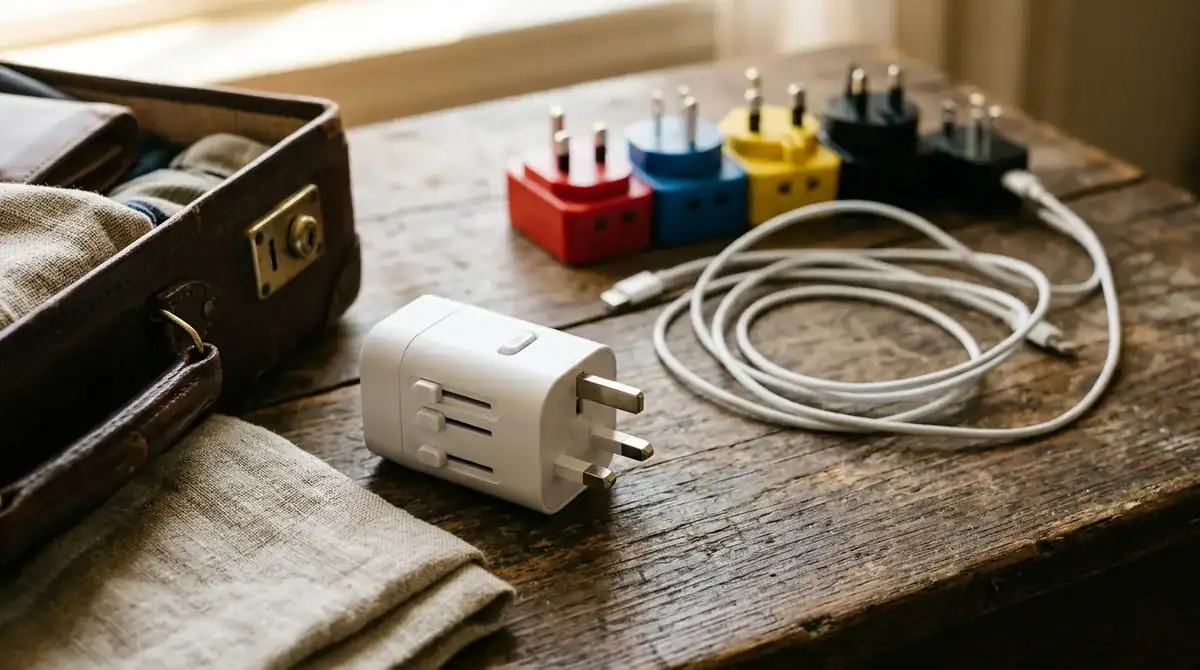
Travel plug adapters change only the shape of your plug so it fits a foreign wall socket. They do not convert voltage or frequency, so an adapter alone does not make an appliance safe to use abroad. Electricity supplies around the world range from 100 V to 240 V, and Electrical Safety First advises checking the rating plate on each device before you plug it in abroad. Start there, and the rest of your packing list gets much simpler.
Look for the input line on the label. A phone charger or laptop marked “INPUT: 110-240V” can usually handle most supplies you will meet, so a plain adapter is enough. A single-voltage hair dryer or older appliance is different and needs a converter. U.S. outlets deliver 110-120 V at 60 Hz, while many other countries use 220-240 V at 50 Hz. Frequency changes how some devices run too: a 50 Hz clock may run fast on 60 Hz power. Safety matters as much as fit. Adapters are tested against standards such as IEC 60884-2-5, which covers travel adapters rated up to 250 V and 20 A. In January 2026, UK safety regulators reported a US-to-UK adapter whose plug did not meet British size rules, creating a fire risk. Choose adapters that name recognized standards on the packaging.
Key Takeaways
- Travel plug adapters only change the shape of your plug, so every travel plug adapter leaves voltage and frequency unchanged and you must check each device’s INPUT rating before plugging it in abroad.
- A phone charger or laptop marked “INPUT: 110-240V” can usually run on a plain plug adapter, while a single-voltage hair dryer needs a voltage converter sized to its printed wattage.
- Travelers should match their plug adapter to each destination’s socket type, since the International Electrotechnical Commission documents the standardized plug-and-socket systems in IEC/TR 60083.
- Travelers should choose adapters that name recognized standards such as IEC 60884-2-5 on the packaging, and avoid unbranded adapters whose plugs wobble or have thin, bendy pins.
- Travelers using three-pin appliances in earthed sockets should pair them only with adapters that carry an earth connection, and UK visitors using certain non-UK domestic equipment must follow Regulation 35 and use a fuse that conforms to BS 1362.
Matching Your Plug, Voltage and Frequency to Each Country
Start with the plug shape. Your adapter has to match the socket you will meet at your destination. The International Electrotechnical Commission documents the standardized plug-and-socket systems used around the world in IEC/TR 60083. Look up the socket type for each country on your route, because one adapter rarely fits every stop.
Next, check the supply voltage. The U.S. Department of Energy describes American power as 110-120 V at 60 Hz, while many other countries use 220-240 V at 50 Hz. A device built for one of those systems can behave very differently on the other.
Then read the label on each device. Picture two items in your bag. The first is a laptop charger marked “INPUT: 110-240V,” which accepts any supply in that range. In a country running on 220-240 V, a plain plug adapter is all it needs. The second is a hair dryer marked for one voltage only. Plugging it into a supply it was not built for can damage it, so it needs a voltage converter, not just a new plug shape.
Frequency is the detail many travelers miss. A device can accept the right voltage and still run poorly. A 50 Hz clock may run fast on a 60 Hz supply, so a matching voltage alone does not guarantee normal operation. If a label lists only one frequency, treat that as a limit to respect.
If you are heading to the UK with appliances that have non-UK plugs, the rules are stricter. Under UK electrical safety regulations, certain domestic equipment must use a compatible conversion plug and a fuse that conforms to BS 1362, rated according to the manufacturer’s instructions.
Before you pack, run through this quick checklist for every device:
- Plug type: Does the adapter match the socket shape in each country on your route?
- Voltage range: Does the INPUT line cover the local supply, which worldwide can run from 100 V to 240 V?
- Frequency: Is the device rated for 50 Hz, 60 Hz, or both?
- USB-only: Can the device charge from a USB cable alone, so it needs no wall outlet conversion at all?
Adapter or Converter: Which Electronics Need What
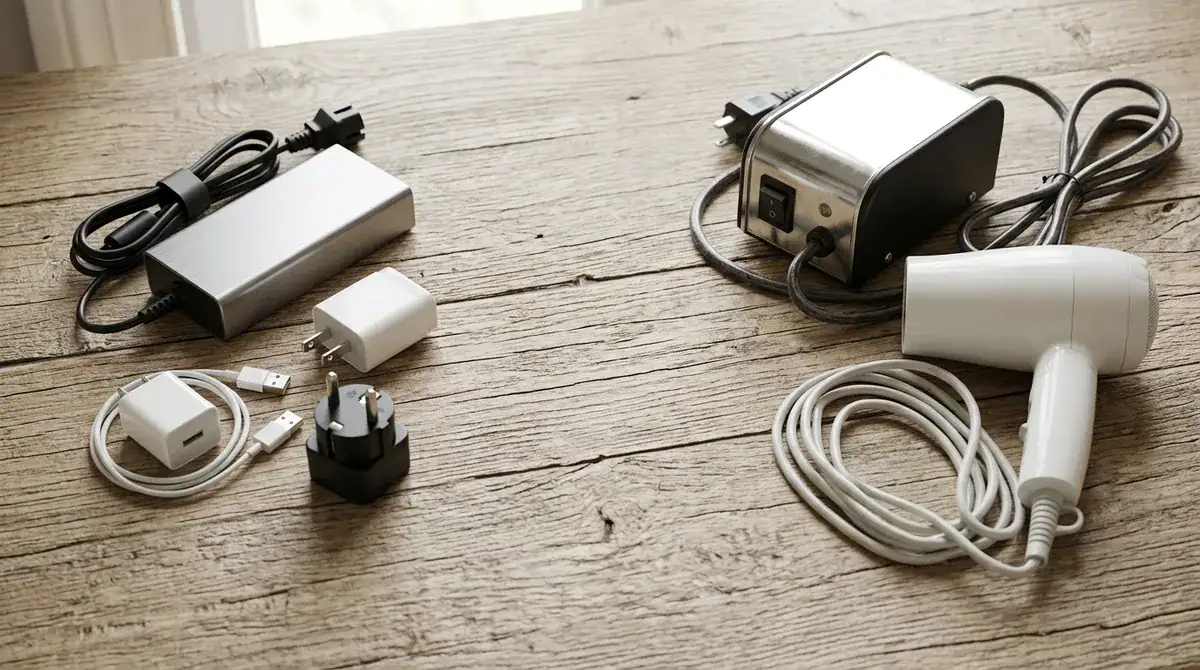
A plug adapter changes the shape of your plug so it fits a foreign socket. A voltage converter changes the electrical supply itself, and you need one only when a device cannot handle the local voltage on its own.
Most everyday gear falls into the first group. Phone, tablet, laptop, and camera chargers are often built with wide-range power bricks, so one charger can work on supplies anywhere from 100 V to 240 V. For these, a plain adapter in the right shape is usually all you need. Check the input line, and you have answered most of the question.
The second group includes heating tools and older single-voltage appliances. Many hair dryers, straighteners, and curling irons are rated for one voltage only. A standard adapter will not protect them from a mismatched supply, so they need a converter sized to the wattage printed on the device. Before you pack one, ask whether you really need it. Many hotels provide hair dryers, and a good hotel dryer saves you from carrying a heavy converter.
Read the label on the power brick, not just the device body. The brick is the small block on the charging cable, and it often carries the INPUT rating even when the phone or laptop itself shows different details or none at all. Compare both labels. If they disagree, plan around the stricter rating.
USB ports on an adapter are handy. They let you charge a phone or tablet straight from the wall with a standard USB cable, so you can skip carrying a separate brick for that device. Those ports do not change what your device needs, though. The adapter delivers power to the cable, but a laptop or hair tool plugged into a different outlet still has to match the local supply on its own rating.
Keep a short list of your devices with their input ratings written on a card or saved in your phone. When you reach a new country, you can sort each item into “plug adapter only” or “needs a converter” in a moment.
Safety Standards and Fuses Before You Plug In
Safety is where a cheap adapter can cost you the most. An adapter that fits the socket is not automatically built to carry current safely, and the difference only shows when something goes wrong. The International Electrotechnical Commission’s IEC 60884-2-5 covers travel adapters, with a scope above 50 V, which is why packaging that names it is worth looking for.
The broader IEC 60884-1 standard covers household plugs and socket-outlets rated above 50 V up to 440 V and up to 32 A. A plug built to that family of standards is designed for loads closer to what a wall outlet actually delivers.
Pay attention to the plug itself. A plug that is slightly oversized or undersized can wobble in a socket, make poor contact, and heat up. Avoid unbranded adapters with loose-fitting plugs. Push the plug gently into a socket before you trust it. If it rocks, or the metal pins feel thin and bendy, leave it on the shelf.
If you are buying in the UK, the rules are stricter. Adapters sold with a UK plug or socket section must meet BS 8546, and the UK plug must match the size rules in BS 1363. In January 2026, a US-to-UK adapter sold through Amazon was found to have a UK plug that missed those dimensions. The import was rejected and destroyed, because a plug of the wrong size is a real fire risk.
Under Regulation 35 of the UK Electrical Equipment (Safety) Regulations 2016, certain domestic equipment with a non-UK plug must use a compatible conversion plug and a fuse that conforms to BS 1362, rated according to the manufacturer’s instructions. If you plan to use a foreign hair straightener or kettle in a UK rental, check its fuse rating before you assume a plain adapter is enough.
Look for a built-in fuse in the product specifications. A fuse inside the adapter cuts the circuit if the current climbs too high, which protects the adapter, the cable and the socket. If the listing says nothing about fuses, ask the seller or choose a different product.
Grounding matters too. Many countries use earthed sockets, and a three-pin appliance plug relies on its earth pin for protection. An adapter must carry that earth connection through to the appliance. A two-pin adapter cannot provide an earth, so pair three-pin devices only with adapters that show an earth connection in their specifications.
Targus World Power Travel Adapter: Simple Plug Shapes for Light Packers
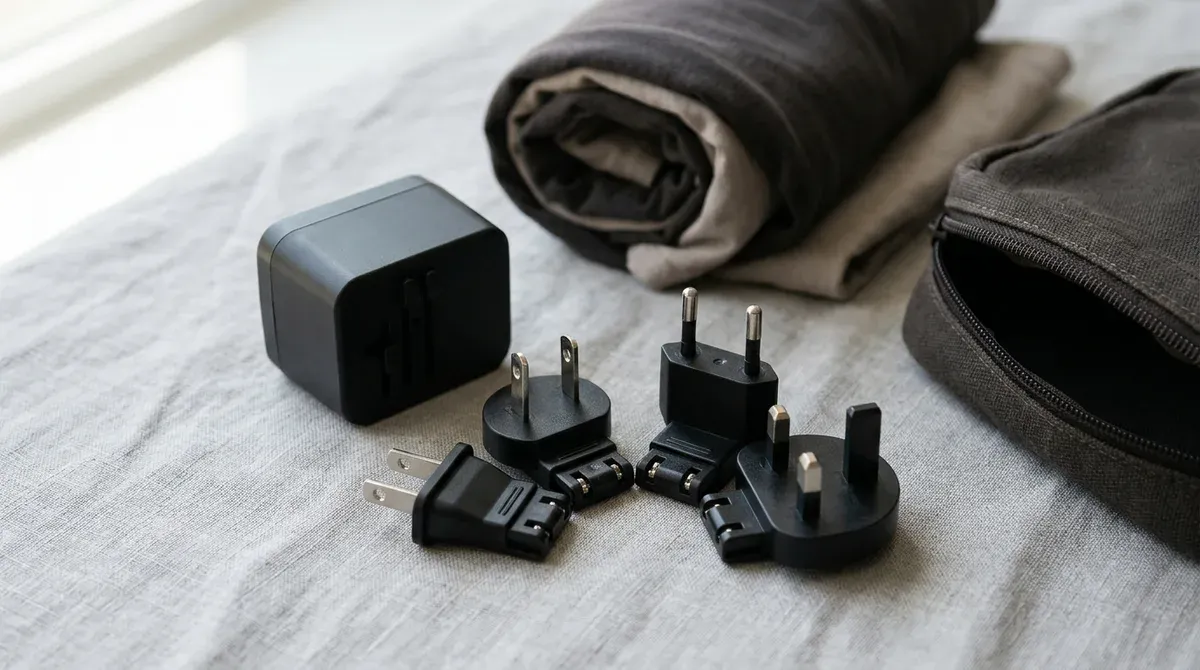
The Targus World Power Travel Adapter (APK01US1) suits travelers who only need the right prongs. The kit includes three interchangeable plug adapters, including UK, European, and adjustable US and Australian configurations, which can be used singly or combined. It changes plug shape only. It has no USB ports and does not convert voltage, so you will need a charger you already own.
The pieces combine into different plug configurations, so you can use one plug or several together. The body is high-impact polycarbonate with red safety shutters. The design is non-grounded, and the manual says not to use it with grounded devices, so keep it for two-pin gear.
This adapter fits travelers who already carry a USB charger or a laptop brick with a wide input range. It is less suited to anyone who wants a compact all-in-one hub, since it has no USB ports. The manual says to use it only with devices rated for the local voltage and drawing no more than 10 amps.
At a glance
- Best for: travelers who need plug compatibility and already carry a separate charger
- Price: $37.99 as shown on the Targus product page, which changes often
- Sockets and USB Ports: three interchangeable plug adapters, no USB ports
- Countries Covered: Africa, Asia, the Caribbean, Central America, Europe, the Middle East, and North America, plus UK and Australian plug configurations
- Size and Weight: 2.00 × 3.50 × 2.00 inches, 0.24 pounds
Anker Nano Travel Adapter: Slim Charging for Phones and Small Gear
The Anker Nano Travel Adapter combines a plug-shape adapter with one AC outlet, two USB-A ports and two USB-C ports, so up to five devices can charge from a single wall socket. Anker says the USB-C1 port supports up to 20W, while simultaneous multi-port USB use is limited to 15W shared. It changes only the shape of your plug and is not a voltage converter.
The design suits a phone-and-tablet traveler moving through several countries. The body measures 3.39 × 1.97 × 0.98 inches and weighs 3.77 ounces, so it stays small in a daypack. Its retractable regional plugs cover plug types A, C, G and I, and the adapter is compatible with 146 countries. Reviewers found it stable in wall outlets.
Keep a few trade-offs in mind. The adapter has no ground prong, so it cannot provide the earth connection that three-pin devices rely on. Reviewers also note that the retractable prongs must be locked firmly into place before each use. The 20W USB-C output handles small electronics well but is not enough to replace a dedicated laptop charger. Anker lists the US price at $25.99 on its
The CARD CA4-Pro is a card-shaped travel adapter from CARD that combines one universal AC socket with four USB ports: three USB-A and one USB-C. Its folding pins fit UK, US, EU and Australian plug formats, and the maker describes the adapter as universal for more than 150 countries. It measures 86 × 55 × 32 mm and weighs 155 g. It does not convert mains voltage, so every device you plug in must already suit the local supply.
The USB-C port supports Power Delivery with output up to 20V/2.25A (45W), which is enough for phones and some laptops. The USB-A ports share 5V/3A of output. A replaceable 6.3A fuse protects the adapter, and a spare fuse is stored in the back cover so you can swap it on the road.
Pack Hacker describes the CA4-Pro as relatively heavy and says it may fall out of some outlets. The same review notes that changing plug configurations between countries takes more fiddling than on some alternatives, although the adapter sits flush against a wall socket and supports fast charging through USB-C.
At a glance
- Best for: minimalist packers who charge a few devices in a limited set of regions
- Price: US$92 in a retailer listing, discounted from US$105 when checked; see the maker’s official site for current pricing
- Sockets and USB Ports: one universal AC socket, three USB-A ports and one USB-C port
- Countries Covered: UK, US, EU and Australian plug formats
- Size and Weight: 86 × 55 × 32 mm, 155 g
- Safety Features: replaceable 6.3A fuse with a spare stored in the back cover
MINGTONG Universal Travel Adapter: Retractable Plugs for Multi-Region Trips
The MINGTONG TA-MT-007, sold on Newegg, combines four retractable plug types with one universal AC socket. It also has one USB-C and one USB-A port, so you can charge up to three devices without carrying separate USB wall chargers. Like any travel adapter, it changes plug shape only and does not convert voltage, so each device’s input rating still decides whether it can plug in.
The plug types are A, C, G and I. The listing says they cover more than 200 countries, including the United States, much of Europe, the United Kingdom, Australia and Japan. That makes it a good fit for trips that move between several of those regions. To use it, slide out the regional pin you need with the side slider, then plug in your device.
The adapter has an 8A fuse, safety shutters, an LED power indicator and fire-resistant material. It also offers over-current, over-voltage, short-circuit and surge protection. At 3 × 1.9 × 1.5 inches, it stays small enough for a crowded day bag.
Its built-in plugs do not cover every socket standard, so a destination outside those four types will need another adapter. The product page also gives two weights, 3.3 ounces and 3.2 ounces, so expect a figure close to that range. Sliding pins in and out takes a little more handling than a fixed plug.
At a glance
- Best for: travelers visiting several regions covered by plug types A, C, G and I
- Price: $31.99 on Newegg when checked; listing prices change often
- Sockets and USB Ports: four retractable plug types, one universal AC socket, one USB-C port and one USB-A port
- Countries Covered: more than 200, according to the product listing
- Size and Weight: 3 × 1.9 × 1.5 inches; 3.3 ounces
- Safety Features: 8A fuse, safety shutters, LED power indicator, over-current, over-voltage, short-circuit and surge protection
EPICKA Universal Travel Adapter: A Budget Hub for Many Countries
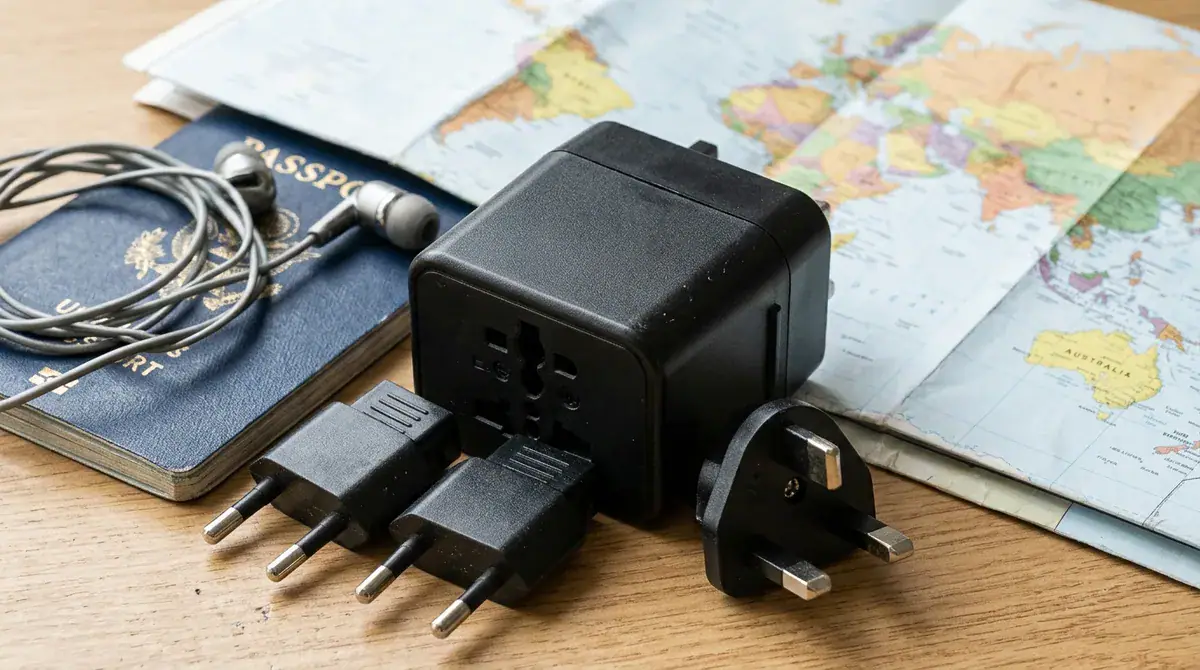
The EPICKA TA-105 Pro is an all-in-one travel plug adapter and multiport USB charger. Many adapters only change plug shape, but this one also charges your devices. Its primary USB-C port delivers up to 70W, and the unit adds two more USB-C ports, two USB-A ports and one universal AC socket. Its built-in plugs are advertised for more than 200 countries and regions.
It suits frequent travelers who move through several countries and want one charging hub instead of a separate charger for each phone, tablet and laptop. Safety features include a built-in 10A fuse, safety shutters and a plug-lock system, and the package includes two spare fuses.
Some limits matter before you pack it. It does not fit Type D sockets in India and Nepal or Type M sockets in South Africa, Swaziland and Lesotho, so those stops need another adapter. It does not convert voltage, and the manual warns against using appliances that require a ground wire. The adapter weighs 8.32 ounces (236 grams). The manufacturer lists it at $49.99 USD, and you can find current details on the EPICKA official product page.
At a glance
- Best for: frequent multi-country travelers who want one charging hub
- Price: US$49.99 listed by the manufacturer
- Sockets and USB Ports: one universal AC socket, three USB-C ports and two USB-A ports
- Countries Covered: built-in plugs advertised for more than 200 countries and regions
- Size and Weight: 8.32 ounces (236 grams)
- Safety Features: built-in 10A fuse, safety shutters, plug-lock system and two spare fuses
UGREEN 65W Nexode GaN USB C 3-Port Travel Charger: A Laptop-Ready Splurge
The UGREEN 65W Nexode GaN USB C 3-Port Travel Charger is a wall charger first and a plug adapter second. Its removable plug system lets you swap in US, UK or EU plug heads with a press-and-slide motion. It also delivers real charging power: two USB-C ports and one USB-A port, with up to 65W from a USB-C port and 22.5W from USB-A.
The UGREEN charger suits travelers who carry a laptop and want one block for the wall. Up to 65W from a single USB-C port is enough to charge a laptop, which goes well beyond the 20W USB-C port on the Anker Nano Travel Adapter. It is not a universal adapter, though. The US head covers the USA, Mexico and Canada, the UK head covers the UK and Ireland, and the EU head covers Germany and France. Anywhere else, you will need a second adapter.
The body is the trade-off. At 12 ounces and 2.56 × 2.56 × 1.28 inches, it feels boxy in a daypack. A Windows Central review found it can occupy two spaces on some US power strips and may fall from certain wall sockets because of its weight. Digital Camera World noted that with all three ports in use, it may not keep a laptop running while the laptop is actively in use, although it charged several devices well when left alone to charge.
UGREEN lists the charger at $49.99, and its official product page showed a discounted $42.99 when we accessed it.
At a glance
- Best for: travelers carrying a laptop who want one wall charger covering US, UK and EU plug types
- Price: $49.99 listed, with a discounted $42.99 displayed on the official site when accessed
- Sockets and USB Ports: interchangeable US, UK and EU plug heads; two USB-C ports and one USB-A port
- Countries Covered: US plug for the USA, Mexico and Canada; UK plug for the UK and Ireland; EU plug for Germany and France
- Size and Weight: 2.56 × 2.56 × 1.28 inches, 12 ounces
- Safety Features: input 100–240V, 50/60Hz; short-circuit, over-voltage, overheating, over-current and overcharge protection
MOGICS Super Bagel: A Power Hub for Desks and Hotel Beds

The MOGICS Super Bagel is a circular travel power hub with five AC outlets, four universal and one US, plus one USB-A and one USB-C port, so up to seven devices can charge at once. Its removable MA1 adapter swaps plug shapes for each destination. A built-in 92 cm cable retracts into the body, which helps when you need to reach a desk or bed. The round layout also leaves room around bulky plugs so they don’t block neighboring sockets.
This suits travelers who move through several countries and want one device to cover most of them. The MA1 adapter supports plug types A, B, C, E, F, G, I, J, L and N, which the retailer says covers 187 countries. Types G and I cover the UK and Australia, while C, E and F cover much of Europe, so the set handles the main routes.
Weigh a few drawbacks before you buy. The Bagel does not convert voltage and has no grounding function, and its manual warns against some grounded appliances and devices that exceed its power limits. Both USB ports share up to 20 W when used together. Pack Hacker found the center adapter clunky to remove at first, and its adapter did not fit South Korean outlets during testing. Handle the removable plug carefully, and practice the swap before your trip.
At a glance
- Best for: travelers who want one outlet hub that handles several plug types and charges USB devices from a desk or bed
- Price: US$88 on the Red Dot Design Museum shop page when checked; see the official MOGICS site for current details
- Sockets and USB Ports: five AC outlets (four universal, one US), one USB-A port and one USB-C port, for up to seven devices at once
- Countries Covered: plug types A, B, C, E, F, G, I, J, L and N, which the retailer says covers 187 countries
- Size and Weight: 4 × 9.1 × 9.1 cm, 117.9 g
- Safety Features: auto-reset 6.3 A fuse that cuts power during an overload and restores it after a few minutes
MOMAX 1-World²+ 100W International Adapter: All-in-One for Several Countries
The MOMAX 1-World²⁺ 100W International Adapter does far more than reshape your plug. It is a 100W USB charger with two AC outlets, two USB-C ports and one USB-A port, plus a built-in retractable USB-C cable. Its USB-C output is rated up to 100W, which leaves room for demanding gear. It is not a voltage converter, though, so its 100–240V, 50/60Hz input only helps if your devices accept that same range.
This design suits frequent travelers who move through several regions with more than one device. Its plug formats cover CN/TW/US, UK, EU and AU, which MOMAX says work in more than 180 countries. The two AC outlets let two devices charge from one socket, and the retractable cable, about 65 cm long, means you can charge a phone without packing a separate cable. Travelers who stay in one region may find a simpler plug enough.
The trade-offs are weight and fit. At 322 g, the body is substantial for a plug, and a reviewer who tested it in Hong Kong, Singapore, South Korea and Germany called it relatively heavy. That same reviewer reported that it could slip from loose wall sockets, so press it firmly into the socket before you leave a laptop charging. Its overload-fuse protection and CE, FCC and RoHS certifications offer reassurance, and the 205W model below suits heavier loads.
At a glance
- Best for: frequent multi-country travelers who want one universal adapter for several devices
- Price: listed at US$84.99 on the MOMAX product page
- Sockets and USB Ports: two AC outlets, two USB-C ports, one USB-A port and a built-in retractable USB-C cable
- Countries Covered: CN/TW/US, UK, EU and AU plug formats, which MOMAX says work in more than 180 countries
- Size and Weight: 95.2 × 59 × 54.3 mm, 322 g
- Safety Features: overload-fuse protection, CE, FCC and RoHS certifications
MOMAX 1-World² 205W All-in-One Travel Adapter: High Output for Laptops
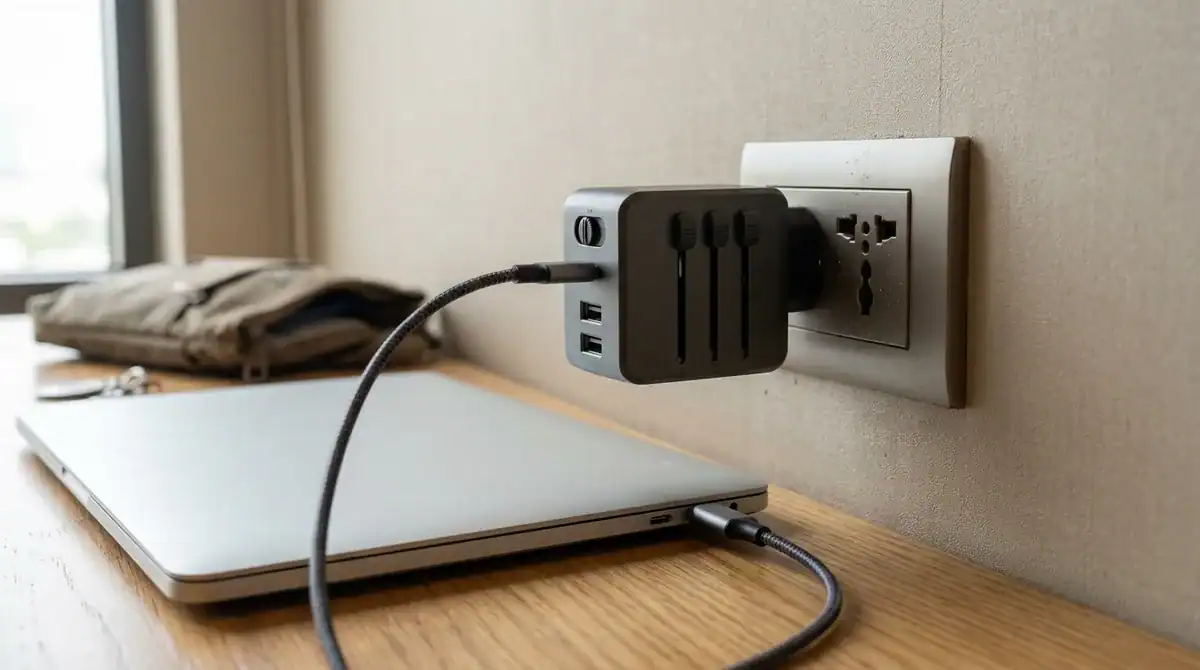
The MOMAX 1-World² 205W is a universal plug adapter paired with a high-output GaN USB charger. It changes your plug compatibility and charges your devices, rather than only reshaping the plug. Built-in plug sliders set the plug configuration, and the unit offers two AC outlets, six USB-C ports and one USB-A port.
It suits travelers moving through several countries with a laptop and a pile of gadgets. The adapter delivers up to 205 W total USB output, and up to 140 W from either of its two high-power USB-C ports. Its protections include short-circuit, over-voltage, over-power and overload-fuse protection, and the casing is fire-resistant PC.
The trade-off is weight. The body measures 98.8 × 54.7 × 54.3 mm and weighs 314 g, which is heavy for a plug. USB output is shared according to the devices and port combination you connect, so charging speed can drop when several devices draw power at once. The adapter also does not convert voltage, so check that each AC appliance supports the destination’s voltage before you plug it in.
At a glance
- Best for: multi-country travelers charging a compatible laptop plus several devices from one adapter
- Price: listed at USD $129.99 on the official product page, where current pricing is shown
- Sockets and USB Ports: two AC outlets, six USB-C ports and one USB-A port
- Countries Covered: CN, TW, US, JP, UK, EU and AU plug standards, advertised for use in more than 180 countries
- Size and Weight: 98.8 × 54.7 × 54.3 mm, 314 g
- Safety Features: short-circuit, over-voltage, over-power and overload-fuse protection; fire-resistant PC casing
Packing Tips, Airport Buying and Extension Cords
Start with a device inventory before you shop. List every phone, laptop, camera, tablet and single-voltage appliance you plan to bring, and note the INPUT rating on each power brick. A list shows you which items can share one adapter and which need a converter, so you don’t pack three adapters when one will do.
Next, compare power needs with the adapter’s output. A phone and tablet can charge comfortably from the 20W USB-C port on the Anker Nano Travel Adapter, but that port will not keep a laptop charging at full speed. Check the wattage on your laptop’s power brick, then look for an all-in-one unit that meets it. The UGREEN 65W charger and the MOMAX 205W adapter offer much more headroom for laptops, though both are heavier than a plain plug.
Deciding between bulk and convenience comes down to how you travel. A multi-port hub saves you from carrying several chargers, but it costs more and takes up more room in a daypack. A simple plug set is light and cheap, and it works well if you already carry a charger that accepts a wide voltage range.
Buy before you leave whenever you can. Prices for universal adapters vary widely, so a few minutes comparing listings at home can save real money. Airport shops usually stock fewer plug types and charge more for them. If you forget something, buy only the plug you need for your first stop, not a full kit.
Awkward outlets call for a short extension cord or a power hub with a cable you can reach from a desk or nightstand. Recessed sockets behind a headboard or a bulky plug blocking the next socket are common in older hotels, and a little extra reach solves both problems.
Keep loose plug pieces in a zip pouch or storage sleeve so they don’t disappear in a hotel room. Many USB-A ports are now dated, since most newer phones and laptops use USB-C. Prioritize USB-C ports and pack USB-C cables, and keep an older USB-A charger only for older gear.
Building Your Own Travel Power Kit
Start with a single sheet of paper. List every device you plan to bring, then copy the INPUT line from each power brick next to it. A laptop charger marked “INPUT: 110-240V” can usually handle most supplies you will meet, while a hair straightener rated for one voltage needs a converter or a hotel appliance. Sort your list into two columns: devices that need only a new plug shape, and devices that need a converter or should be left at home.
Next, map your route and check each socket type before you buy. The EPICKA TA-105 Pro does not fit Type D sockets in India and Nepal or Type M sockets in South Africa, so a trip through those countries needs a second adapter. A route through the United States, the United Kingdom, Germany or France is simpler, since the UGREEN 65W charger carries US, UK and EU plug heads and delivers up to 65W from one USB-C port.
Then match the adapter to your gear. Phone and tablet travelers can carry the Anker Nano Travel Adapter, which weighs 3.77 ounces. Laptop owners should check the wattage on the laptop’s power brick and choose a USB-C port that meets it.
Finish by packing one USB-C cable for each device and a zip pouch for loose plug pieces. Your kit is ready when every device on your list has a matching plug and a confirmed input rating.