
A few days is enough to see Copenhagen’s highlights on a first visit, and the city is compact enough to explore on foot and by bike. Copenhagen Airport sits about 8 kilometres from the centre, and direct metro and train journeys take around 15 minutes. The city recorded 11.7 million overnight stays in 2024, according to Wonderful Copenhagen, so popular sights can feel busy at peak times.
The historic centre puts Strøget and the royal palaces within easy walking distance, while Vesterbro blends family life, nightlife and fashion, and Nørrebro is the city’s most culturally diverse neighbourhood. Waterfront Christianshavn, with its canals and coloured houses, feels like a different city again, and Refshaleøen, the former industrial area, has become a hub for creativity, festivals and food. Stay near a metro line and most of these areas are simple to reach. Fares are priced by zone, with adult single tickets at DKK 24 for 2 zones and DKK 30 for 3, and the metro runs 24 hours a day, all year round.
Key Takeaways
- Plan on a few days to see Copenhagen’s highlights on a first visit, since the compact city is easy to explore on foot and by bike.
- Copenhagen Metro fares are set by zone, with adult single tickets at DKK 24 for 2 zones and DKK 30 for 3 zones, and the metro runs 24 hours a day, all year round.
- Bicycles may not be taken onto the Copenhagen Metro on weekdays from 7:00 to 9:00 a.m. and 3:30 to 5:30 p.m., and Nørreport Station has an extra rush-hour ban on bikes boarding or alighting.
- Rosenborg Castle entry runs by timed slot in ten-minute intervals, so travellers should reserve their visit before leaving home because slots can sell out in peak season.
- The Botanical Garden in Copenhagen is free to enter, while the Palm House costs 70 DKK for adults and 40 DKK for children under 18.
Copenhagen Travel Guide: Choosing Your Base and Neighbourhoods
A first visit works well over a few days, and the historic centre is the easiest base for sightseeing. From there, Strøget, Tivoli Gardens and the main museums are all within walking distance, so you can start the day at your first stop before the crowds build.
Vesterbro suits travellers who want a livelier evening. Its streets mix family life with nightlife and fashion, and Kødbyen, the old meat-packing area, is close by. Here, former warehouses now hold restaurants, galleries and bars, so an evening can start with dinner and end with a late drink somewhere nearby.
Nørrebro is the place we would head for if food and street life matter most. Visit Copenhagen describes it as the city’s most culturally diverse neighbourhood, and you can feel that in its cafés, bakeries and small shops. Superkilen, the colourful urban park, and Jægersborggade, lined with independent boutiques, are both easy to reach on foot.
Christianshavn feels like a different city. Canals, cobbled lanes and coloured houses line the water, and the area is quieter in the evenings than Nørrebro or Vesterbro. It makes a relaxed base for a couple of nights, especially if you love waking up near the water.
Refshaleøen is the outlier. This former industrial district has become a hub for creativity, alternative urban development, festivals and food, and its venues are worth the trip for an event or a long lunch. Check your way back before you set out, because late nights here need a plan for getting home.
Hotels and holiday apartments each have their trade-offs. Hotels usually offer a front desk, a set check-in time and daily cleaning, but rooms rarely include a kitchen. Apartments give you space and a kitchen for simple breakfasts, which can save money on eating out. Check-in often involves a key code or a handover, though, and noise levels vary a lot from street to street. If you book an apartment in a busy nightlife area, ask about window glazing before you arrive.
Whichever base you choose, pack comfortable shoes. The old streets are charming, but the cobblestones are uneven, and heels or thin soles grow tiring after a day of walking between Strøget, Nyhavn and the museums.
Getting Around Copenhagen by Metro, Train and Bike
Getting around Copenhagen is easier than most first-time visitors expect. The metro is the backbone of the network, and because fares are set by zone, it pays to check which zones your journey crosses before you tap in. Trips out toward the airport or north to the coast often cross more zones than a ride between the centre and Vesterbro.
The metro also keeps the city flexible. Because it runs through the night, a late dinner in Vesterbro doesn’t have to end in a taxi queue, and an early flight out of the airport is just as easy to reach.
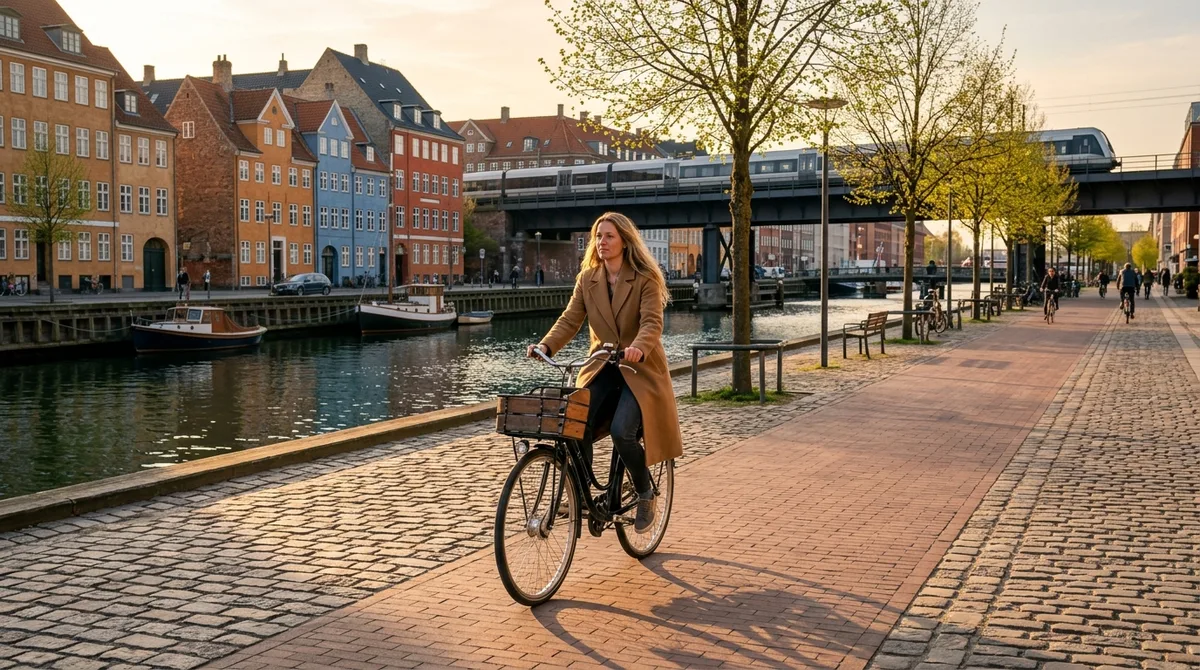
Cycling is how many locals get around, and it’s the most enjoyable way to see the canals and the waterfront. Use the bike lanes wherever they exist, and switch on your front and rear lights once it gets dark. At intersections, don’t turn left directly. Instead, go straight across the junction first, then turn left from the far side. It feels odd the first time, but it keeps traffic moving and protects everyone on the road.
Bikes have their own timing rules on the metro. On weekdays from 7:00 to 9:00 a.m. and from 3:30 to 5:30 p.m., bicycles may not be taken onto the train. Nørreport Station has an extra restriction: bikes cannot board or alight there during those rush-hour periods. If you plan to combine a ride with the train, schedule it outside those windows or ride the whole way.
Cashless payment is the norm. Cards and phone wallets are widely accepted on public transport, in cafés, restaurants and shops, so you rarely need cash. CopenPay, a payment option that launched on June 22, 2026, runs year-round, so it’s worth checking whether it suits your plans before you arrive.
A city pass can save money, but only if it matches your itinerary. Start by listing the sights you’re certain to visit, such as Rosenborg Castle or the Round Tower, and note how many days you’ll spend mostly on public transport. Many city passes include transport, so compare the pass with the number of single journeys you expect to take. If you plan a packed sightseeing day with several paid entries, a pass may make sense. If you’ll mostly walk and visit only a few places, pay as you go.
Copenhagen by Season: Festivals, Harbour Swims and Free Days
Copenhagen changes character with the seasons, and the 11.7 million overnight stays recorded in 2024 mean the most popular spots fill fastest in summer. Plan around the weather and you’ll discover a different city each month.
Spring brings outdoor dining back to the squares and pavements, so cafés that spent the winter indoors suddenly have tables on the street. Weekend flea markets open too, making them a good place to browse for secondhand Danish design. Once the grass dries out, Kongens Have, the King’s Garden, is an easy spot for a picnic.
Summer evenings and warm days bring people to the water, so arrive early if you want a spot by the water. Before you jump in, check the bathing-water quality and swim only where it is permitted, as the SvømKBH guidance for municipal bathing zones advises. Families should note the rule at municipal harbour baths: children under 7 must be accompanied by someone at least 15 years old.
Autumn is the time to focus on museums. Rain is common, and the sights in this guide suit a grey afternoon, from the National Museum of Denmark to Designmuseum Danmark. Pick a museum for the wet hours and save the open-air walks for the days when the sky clears.
Winter offers a different kind of charm. Ice swimming draws hardy locals to the water, and Christmas markets fill the squares with lights, warm food and mulled wine. Daylight is short, so schedule outdoor sights for the middle of the day and keep your evenings for the markets.
Several of the city’s best experiences cost nothing. Walk through the Botanical Garden for free, though the Palm House charges extra. You can also wander Freetown Christiania, the alternative community with its own distinctive character, and stroll the yellow houses of Nyboder, the old naval quarter where people still live. Christiansborg tower is free to visit, and Tippen, the wild greenery on the former landfill known locally as Sydhavnstippen, makes a quiet walk for a free afternoon.
Peak season has one real booking pressure point. Timed slots at Rosenborg Castle can sell out in summer, so reserve your entry before you leave home.
Tivoli Gardens: Copenhagen’s Classic Amusement Park
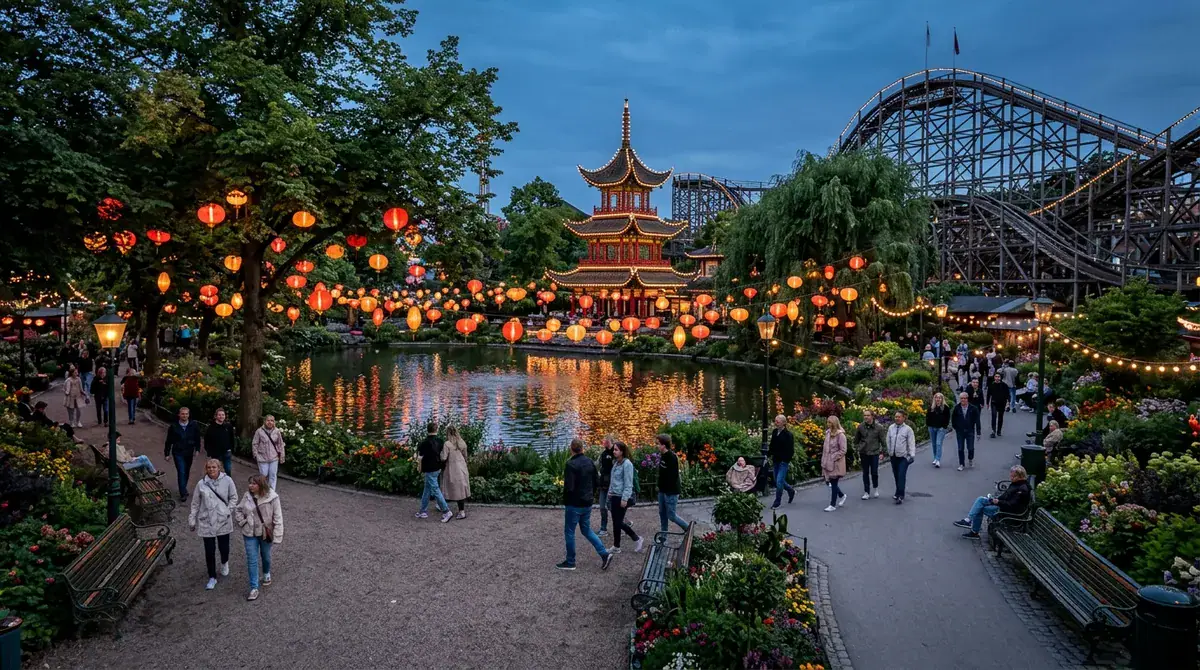
Tivoli Gardens sits right next to Copenhagen Central Station, which makes it one of the easiest sights to fit into a first day. Wander the landscaped gardens and winding lanes, then decide whether to ride something or simply sit with a coffee and watch the crowds go by. A stroll is enjoyable even if you never buy a ride.
Tivoli opened in 1843, and its Pantomime Theatre, built in 1874, is the park’s oldest standing building. The wooden Roller Coaster dates from 1914 and still has a brakeman on each train, a reminder that the rides here have history as well as thrills. Modern attractions and seasonal decorations sit alongside the park’s old-fashioned charm.
Visitor numbers peak on Fridays, Saturdays and Sundays, so a weekday morning gives you more room to breathe. Concerts, theatre and ballet run during the season, which turns a park visit into a lively cultural evening.
At a glance
- Best for: First-time visitors, families and anyone wanting a lively cultural stop
- Hours or Season: Opens for separate periods including summer, Halloween, Christmas and Easter, with dates and hours varying by season
- Cost: An entrance ticket covers the Gardens, while a Ride Pass covers rides but not Garden entry; prices vary by visit date, so the official site has current figures
- Accessibility: Accessible restrooms, quieter areas including the Aquarium, Hanging Gardens, Japanese Garden and Parterre Garden, and wheelchairs to borrow at the Garden service centre
Nyhavn: The Colourful Waterfront Everyone Photographs
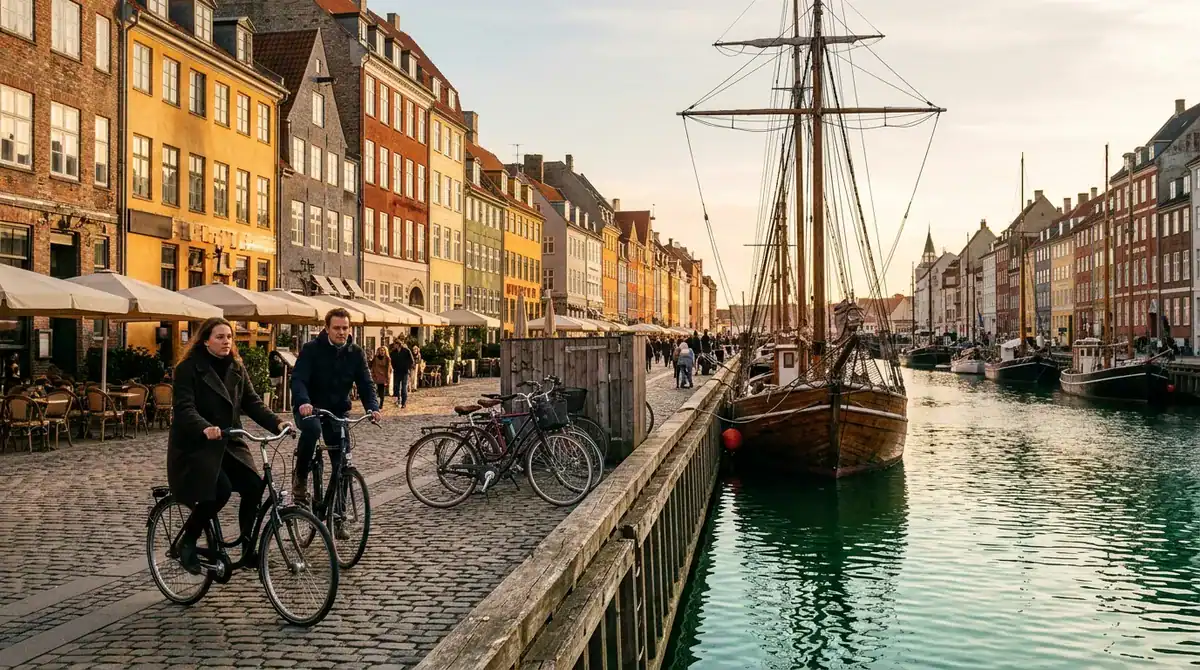
Nyhavn is the picture most people carry home from Copenhagen. Its colourful historic townhouses line a canal, with cafés spilling onto the quay and old wooden boats moored along the water. The best thing to do here is stroll beside the canal, admire the houses and boats, and stop at a waterside table when one catches your eye.
Go early in the morning or in the evening if you want photographs with fewer people around. Several companies run canal tours from Nyhavn, so you can see the waterways and landmarks from the water once you’ve enjoyed the view from the quay.
Nyhavn has more depth than its postcard fame suggests. Hans Christian Andersen lived at three addresses here, and that connection gives the harbour a literary story. It is also a working neighbourhood, not a museum. Inside the Nyhavn Bridge, the harbour is a veteran-ship and museum harbour, and mooring is limited to association members or guests with vessels of special historical interest.
First-time visitors and photographers will get the most out of it. The waterfront stroll is free, while food and boat tours are optional extras. Cobbled surfaces in the old inner city can be hard to navigate in a wheelchair, so plan your route with that in mind.
At a glance
- Best for: First-time visitors and photographers
- Hours or Season: Sunset or before 9 a.m. for fewer crowds
- Cost: The waterfront stroll is free; food and boat tours are optional
- Accessibility: Cobbled surfaces in the old inner city can be difficult to navigate in a wheelchair
Rosenborg Castle: Crown Jewels in a Renaissance Palace
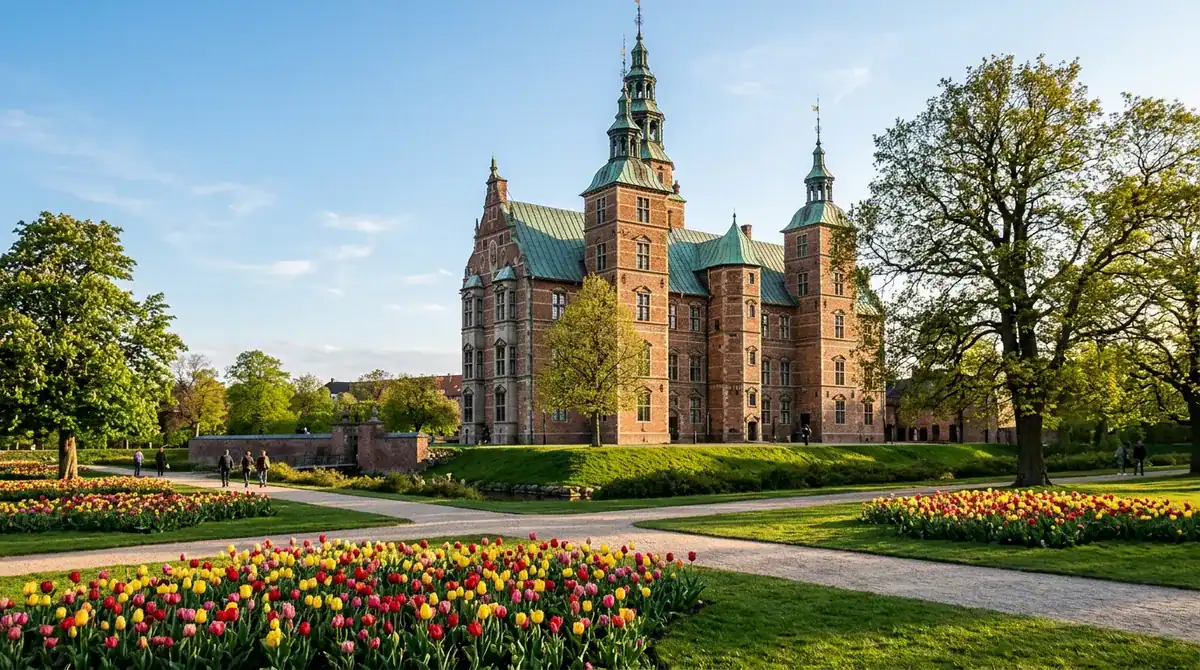
Rosenborg Castle is a Renaissance royal residence that Christian IV built beside King’s Garden, and it now operates as a museum in the heart of the city. Start with the king’s audience rooms and bedchamber, then head down to the Treasury beneath the castle, where the Danish crown jewels and regalia are on display.
The Knights’ Hall is the highlight for many visitors. It holds the coronation thrones, three life-size silver lions and tapestries showing battles between Denmark and Sweden. The castle is relatively small, so the visit feels focused. Entry is by timed slot in ten-minute intervals, and those slots can sell out in peak season, so book before you travel.
Art and design fans, history lovers and anyone curious about royal interiors will get the most out of a visit. Pair it with a stroll through Kongens Have next door for a relaxed half-day in the centre. Be ready for stairs and narrow doorways, because the castle has no lift.
At a glance
- Best for: Danish history, architecture and decorative arts fans
- Hours or Season: Generally open daily from 10:00 to 17:00, with shorter 10:00 to 16:00 hours and Mondays closed from 2 November to 23 December
- Cost: Adult admission is 140 DKK online or 150 DKK at the door, and visitors under 18 enter free
- Accessibility: No lift and many stairs; wheelchair users can visit only the ground level and the Treasury, with a companion to help on the steps
Christiansborg Palace: Parliament, Tapestries and a Free Tower
Christiansborg Palace sits on Slotsholmen, where royal ceremony and modern democracy share the same walls. The current palace, completed in 1928, combines royal reception rooms with Denmark’s Parliament and the Prime Minister’s Office, so you may walk past politicians at work while you tour.
The Great Hall is the highlight. Bjørn Nørgaard’s colourful tapestries portray 1,000 years of Danish history, and they reward a slow look. Underground, the ruins include remains of Absalon’s Castle, the medieval fortress that stood on this spot long before the palace rose above it. Paid entry covers the reception rooms, the Royal Kitchen and the Royal Stables.
The palace tower is free to climb. It stands 106 metres high and has a lift to the top, but the viewpoint has limited space, so queues can build during busy hours. Visitor areas can close without notice for official events, so keep your afternoon flexible.
History fans, travellers curious about Danish politics, and art and architecture enthusiasts will get the most from a visit.
At a glance
- Best for: History fans, travellers curious about Danish politics, and art and architecture enthusiasts
- Hours or Season: From 30 March to 1 November 2026, the reception rooms, ruins and Royal Kitchen are open daily from 10:00 to 17:00, and the Royal Stables from 13:30 to 16:00
- Cost: The palace tower is free; the reception rooms, Royal Kitchen and Royal Stables are paid
The Round Tower: Spiral Ramp to a City View
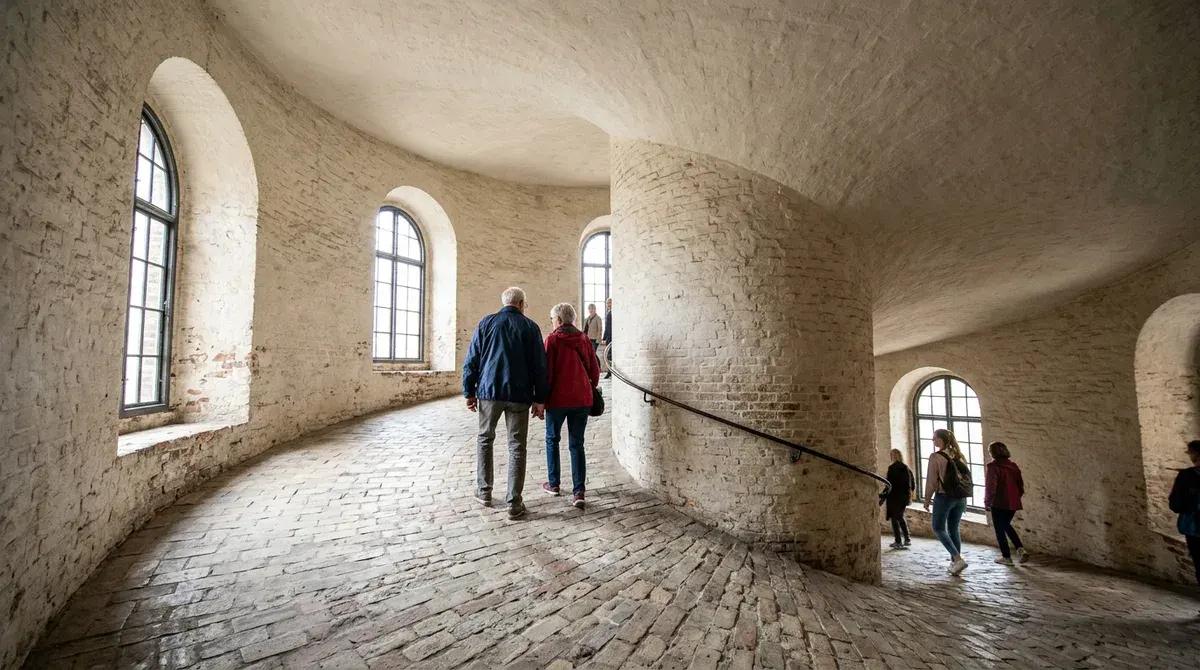
The Round Tower (Rundetårn) was completed in 1642 as part of the Trinity Complex, which was meant to bring an observatory, the University Library and Trinity Church together. Its spiral ramp winds 7½ times around the hollow core, so you walk up gradually rather than climbing a steep staircase. It makes an easier climb than the Church of Our Saviour, and it stays open for more of the year.
The ramp leads to the Library Hall, once home to the University of Copenhagen’s book collection. Today it hosts changing exhibitions, concerts and cultural events. Final stairs lead to the platform, where the 360-degree view stretches across the rooftops and as far as Sweden. Queues can form at peak times, though the operator says waits rarely exceed 20 minutes.
At a glance
- Best for: Culture-minded visitors, families and anyone who wants a city view with a scientific history
- Hours or Season: Winter 10:00 to 21:00 on Mondays and Tuesdays, and 10:00 to 18:00 Wednesday to Sunday; summer 10:00 to 20:00 daily. See the official site for current details.
- Cost: 60 DKK for adults, 40 DKK for students, free for children aged 0 to 17
- Accessibility: No elevator, and the top platform is not wheelchair-accessible; the Library Hall can be reached, though its incline can be difficult for manual wheelchairs
Botanical Garden: A Free Leafy Escape
The Botanical Garden is one of the best free walks in the city centre. Its living plant collection serves research, education and nature conservation, and the grounds are laid out in themed areas, including the Rock Garden, the Danish Quarter, a lake and Observatory Hill. Stroll the paths, sit by the water, or climb to the Stone Mounds for views of the city’s spires.
The Palm House is the garden’s historic glasshouse, filled with tropical plants. Its ticket, which costs 70 DKK for adults and 40 DKK for children under 18, also covers the Butterfly House. Renovation currently closes the warm-subtropics and dry-tropical sections, but the rest of the Palm House, the Butterfly House and the Succulent House remain open.
Plant lovers, photographers and anyone wanting a calm walk will enjoy it most. Most outdoor areas suit wheelchair users, though the Rock Garden and Observatory Hill are steep.
At a glance
- Best for: Plant lovers, photographers and anyone wanting a peaceful walk
- Hours or Season: 8:30 a.m. to 6 p.m. from March 1 to October 24, and 8:30 a.m. to 4 p.m. from October 25 to February 28
- Cost: Free to enter the garden; Palm House admission is extra
- Time Needed: About 1 to 1.5 hours for the garden, or 2 to 3 hours with the Palm House and Butterfly House
- Accessibility: The lower Palm House greenhouses, including the Butterfly House, are not wheelchair-accessible
Kastellet: A Star-Shaped Fortress for Morning Walks
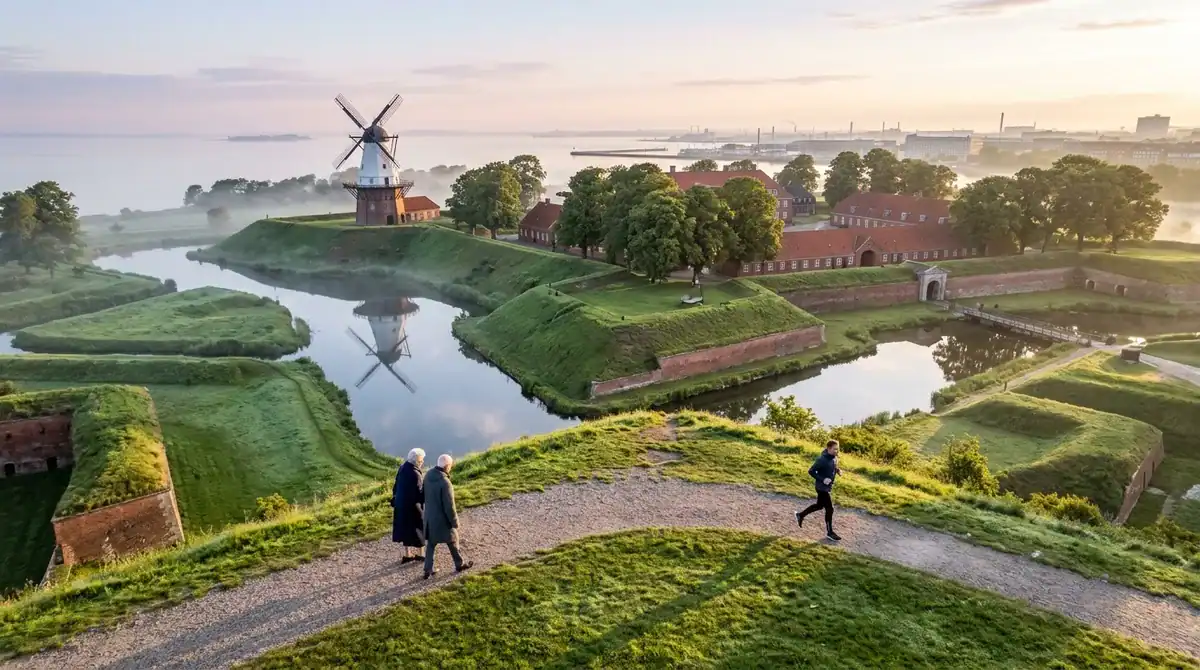
Kastellet is a five-pointed star fortress that is still an active military barracks, and it doubles as a green oasis in the middle of the city. The main thing to do is walk the ramparts and public paths, where the moat opens out below you and you catch glimpses of a church, a windmill and a military memorial.
Access is limited to designated public areas, and some streets and spaces are reserved for military use. You won’t get a full tour of the fortress buildings, so think of this as a scenic loop rather than a sightseeing stop with set exhibits.
Early mornings and late evenings are the best times for photographs and quiet. The park has more than 200 kinds of herbs and grasses, varied birdlife and seasonal wildflowers. Near the memorial, an exhibition on Denmark’s international missions opened in 2020 beside the memorial to those who have served. Afterwards, stroll along the water toward the Little Mermaid.
At a glance
- Best for: Early risers, photographers and anyone wanting a peaceful walk with a military twist
- Hours or Season: Open 06:00 to 22:00 in summer and 06:00 to 20:00 in winter; see the official site for current details
- Cost: Free to enter
- Accessibility: Toilets with handicap access on Langelinie and by Langeliniebro
Meatpacking District: Kødbyen’s Food, Art and Nightlife
Kødbyen, the Meatpacking District, sits in Vesterbro behind Copenhagen Central Station and has been at the heart of the city’s food industry for more than 100 years. Its municipal buildings come in three generations, and the Brown and White districts date from 1878 and 1934. Their industrial character is still visible alongside newer cultural venues.
Nyhavn
Summer evenings bring lively crowds who gather outdoors between visits to the bars and clubs. There is no single exhibit or fixed route, so the fun comes from wandering, eating and drinking. Each venue sets its own hours and prices, and the official visitor page covers the district’s practical details.
At a glance
- Best for: Foodies, art lovers, night owls and architecture fans
- Time Needed: About five minutes to cross, but allow longer for dinner and drinks
- Cost: No district-wide price; each venue sets its own
- Accessibility: Two disabled parking spaces at Flæsketorvet
Freetown Christiania: Copenhagen’s Alternative Community
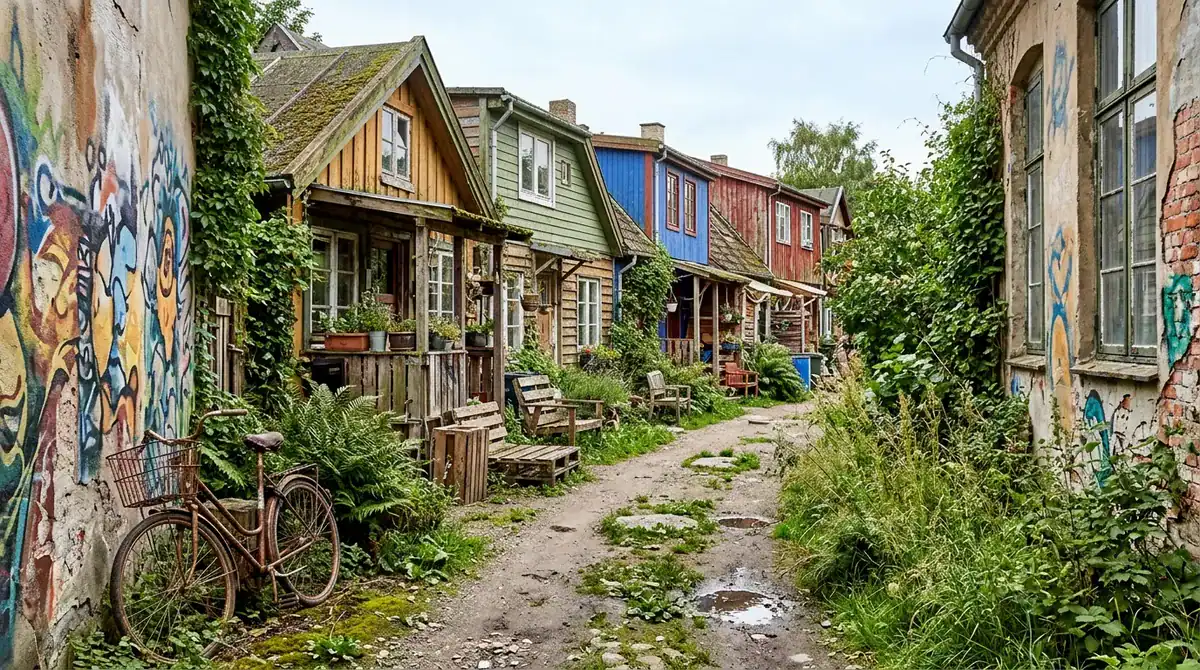
Freetown Christiania is a green, car-free neighbourhood where you can spend an afternoon wandering. It was established in 1971 on the former Bådsmandsstræde Barracks, beside the 17th-century Christianshavn Ramparts. The paths lead past homemade architecture, art, music, workshops and open spaces, and the cafés and galleries set their own opening times.
The surface is unpaved, so expect uneven footing and wear sturdy shoes. Resident-led tours run 1.5 to 2 hours and cover the neighbourhood’s origins, principles and architecture. Open walk-in tours leave at noon on Saturdays and Sundays, and the resident-run operator lists a standard adult tour at 100 DKK.
What makes it special is the contrast. The old fortifications are part of an open recreational area, yet people still live, make and gather inside them. It is not a museum or a single gated attraction, so you can take your time and let the place unfold.
It suits first-time visitors curious about Copenhagen’s history, architecture and art, along with anyone interested in alternative urban life. Residents live here, so respect their homes and ask before taking close-up photos of people.
At a glance
- Best for: First-time visitors, art and architecture fans, and anyone curious about alternative urban life
- Hours or Season: Open around the clock; cafés and galleries set their own hours
- Cost: Free to walk around; a standard adult guided tour is 100 DKK
- Time Needed: Guided tours run 1.5 to 2 hours
- Accessibility: Unpaved paths with uneven footing
Strøget: Copenhagen’s Long Car-Free Shopping Street
Strøget is a roughly 1.1-kilometre pedestrian route of four streets running from City Hall Square to Kongens Nytorv, and it is one of the easiest walks through the historic centre.
Ny Carlsberg Glyptotek has welcomed visitors since 1897, and its more than 10,000 works span ancient Egyptian, Greek and Roman sculpture, Etruscan art, French painting and sculpture, and Danish Golden Age art. You can move from Egyptian antiquities to Impressionist painting and sculpture in a single visit, which makes it one of the most varied art stops in the city.
The heart of the museum is the glass-domed Winter Garden, where palm trees grow under the roof and give the rooms a Mediterranean glow. The complex brings together buildings by Vilhelm Dahlerup, Hack Kampmann and Henning Larsen, so historic halls and modernist additions connect as you walk through. The garden and café make good places to pause between galleries.
Galleries can get crowded on the last Wednesday of each month, when admission is free for everyone. The listed historic building is not fully wheelchair friendly, but several exhibitions can be reached by a handicap lift or a regular lift. It suits art and architecture fans most.
At a glance
- Best for: Art and architecture fans, with the Winter Garden as a pause for visitors who want a lighter visit
- Hours or Season: Closed Mondays; 10:00 to 17:00 Tuesday, Wednesday and Friday through Sunday; open until 21:00 on Thursdays
- Cost: DKK 150 for adults or DKK 135 when bought online; DKK 120 or DKK 108 online for visitors under 27 and students; free for under 18s and on the last Wednesday of each month. Current details are on the official site
- Accessibility: The listed historic building is not optimally equipped for wheelchair users, though several exhibitions are reachable by a handicap lift or regular lift
Copenhagen Contemporary: Modern Art in a Shipyard
Copenhagen Contemporary fills 7,000 square metres of former B&W welding halls on Refshaleøen with changing exhibitions, large-scale installations, performance art and monumental video works. Many of the works can be entered and explored physically, so the visit feels more like walking through an artwork than standing in front of a wall.
Expect vast industrial halls rather than white-walled galleries. Plan one to two hours, though the exhibitions on show and how long you linger with each work will decide the rest. You don’t need to book ahead, but busy periods bring queues, and the queue for James Turrell’s Aftershock may close before you arrive. The centre has three floors with lifts, ramps at both entrances and accessible toilets, though Aftershock cannot be experienced in a wheelchair.
Contemporary-art and design fans will find plenty to discuss, and curious first-time visitors get a taste of Copenhagen’s creative side. Families can join the centre’s workshop, which offers exhibition-inspired activities on weekends and school holidays. Afterwards, the waterfront setting of Refshaleøen makes a natural place for a long lunch.
At a glance
- Best for: Contemporary-art and design fans, curious first-time visitors and families
- Hours or Season: Tuesday, Wednesday, Friday, Saturday and Sunday 11:00 to 18:00, Thursday 11:00 to 21:00, closed Monday
- Cost: 140 DKK for adults, 95 DKK for students, 25 DKK for ages 3 to 17, free for ages 0 to 2; free with the Copenhagen Card
- Time Needed: 1 to 2 hours
- Accessibility: Lifts, ramps at both entrances, accessible toilets and manual wheelchairs to borrow
Studio Arhoj: Contemporary Craft Being Made

Studio Arhoj is a working design studio in central Copenhagen, and its public shops at Skindergade 7 and Nørregade 7 let you see craft up close. Browse the shelves for ceramics, glassware, prints and other handmade pieces, and when production is underway, watch makers throw pots, glaze ceramics and blow glass.
The draw is seeing contemporary craft being made, not just displayed. Visit Copenhagen describes the studio as exploring the visual relationship between Scandinavian and Japanese design traditions, and it keeps crafts such as wheel throwing and glaze construction alive. You can spot that blend in the forms and glazes on the shelves, which gives the visit a character all its own compared with a formal museum.
Plan a browse on a Saturday, when the Skindergade flagship is open from 9:00 to 19:00. The shops suit design lovers, craft-curious travellers and anyone hunting for locally made souvenirs.
At a glance
- Best for: Design lovers, craft-curious travellers and souvenir hunters
- Hours or Season: Stores generally open daily from 10:00 to 18:00, with the Skindergade flagship open 9:00 to 19:00 on Saturdays; see the official site for current hours and holiday closures
Church of Our Saviour: The Climb With a Gilded Spiral
Our Saviour’s Church, consecrated in 1696, rises above Christianshavn with a Baroque tower designed by Lauritz de Thurah and completed in 1752. Its gilded spiral outdoor staircase wraps the spire, and 150 of the 400 steps sit outside before you reach a viewing point 86 metres above the city.
The stairways are narrow and steep, and capacity is limited, so the church recommends booking your tower ticket in advance. Demand peaks from about 10:00 to 17:00 on Fridays through Mondays. The final section is exposed, and the tower may close temporarily in rain, snow or strong winds.
For 2026, adult tower tickets cost DKK 70, students and visitors aged 65 or older pay DKK 53, and children pay DKK 20. Copenhagen Card holders enter free. The tower is open daily from 9:00 to 20:00 but closes throughout January, and you can find current details on the official site. The church interior is free to visit and is an easier alternative if heights make you uneasy.
At a glance
- Best for: Confident climbers and photographers who want wide views across the city
- Hours or Season: Tower open daily 9:00 to 20:00, closed throughout January
- Cost: 2026 tower admission DKK 70 for adults, DKK 53 for students and seniors 65+, DKK 20 for children; interior free
- Accessibility: Narrow, steep staircases only, not suitable for visitors who cannot manage 400 steps
Amalienborg Palace: Royal Square and the Changing of the Guard
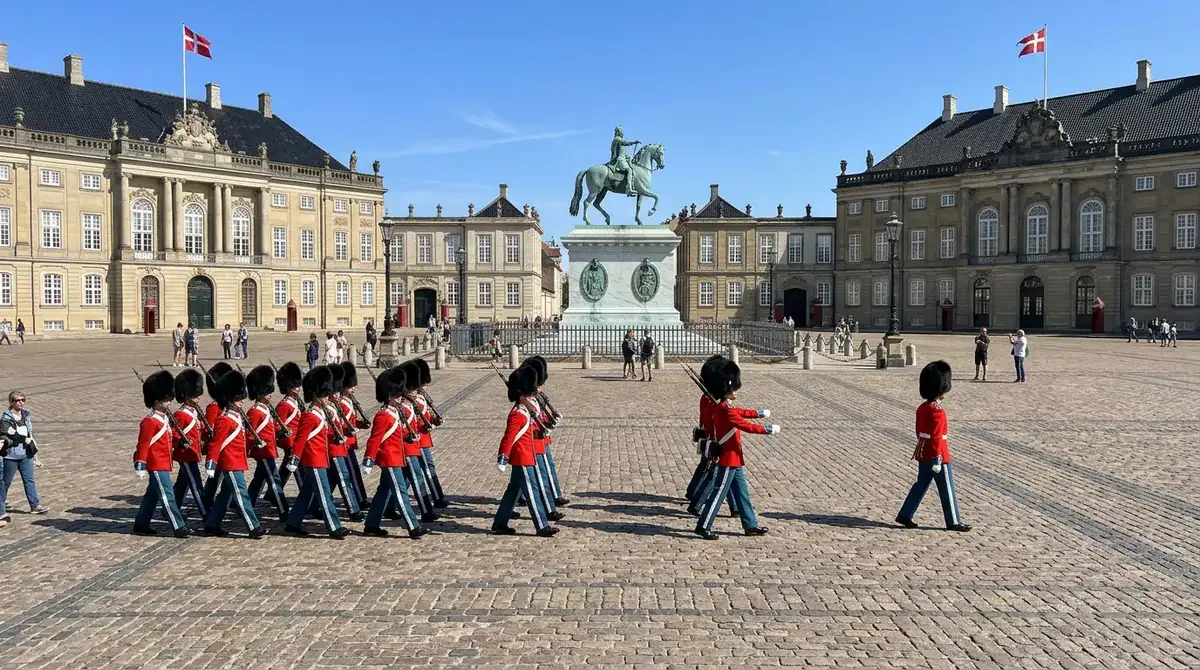
Amalienborg has been the Danish royal family’s Copenhagen residence since Christiansborg Palace burned in February 1794. Four palaces stand around an octagonal square, with a statue of Frederik V at its centre. Walk the square slowly and you can see how the buildings face one another across the open space.
At noon each day, the Royal Life Guard performs its changing of the guard on the palace square, and visitors can watch from there. It’s a good way to start an afternoon of royal history.
Only part of the complex is open to the public. The Amalienborg Museum occupies Christian VIII’s Palace, where you can tour royal rooms and collections, including pieces displayed in the Fabergé Chamber. The listed general hours are 10:00 to 16:00, with seasonal and holiday exceptions. The other palaces are still used by the royal family, so the museum is the only part you can enter.
It suits first-time visitors interested in royal history, architecture lovers and photographers who want a formal setting.
At a glance
- Best for: First-time visitors, royal history fans, architecture lovers and photographers
- Hours or Season: General museum hours are 10:00 to 16:00, with seasonal and holiday exceptions
Kongens Have: The King’s Garden Picnic Spot
Kongens Have, the King’s Garden, wraps around Rosenborg Castle in central Copenhagen. Christian IV started it in 1606 as a pleasure garden that also supplied fruit and vegetables to the royal household, and it has been open to the public since the 1770s. The 12-hectare Renaissance-style garden still keeps much of its historic path layout and its old lime-tree avenues.
This is where Copenhageners go to picnic on the lawns, stroll the tree-lined paths and pass the rose garden and sculptures. Children head for the fairytale-themed playground, and the traditional puppet theatre adds a playful touch. On sunny days it gets busy, and the Danish Agency for Culture and Palaces estimates about three million visits a year. Entry to the garden is free, but Rosenborg Castle is a separate visit.
The park opens at 7:00 each day and closes at 17:00 in winter and 22:00 from May through August. The paths are paved and firm, and access is step-free, which makes it easy to get around with a pushchair or wheelchair.
At a glance
- Best for: Picnickers, families and anyone wanting a relaxed walk in the city centre
- Hours or Season: Opens 7:00 daily; closes 17:00 in winter and 22:00 from May to August
- Cost: Free to enter; Rosenborg Castle is a separate visit
- Accessibility: Step-free access and a firm paved surface
Designmuseum Danmark: Danish Design Under One Roof
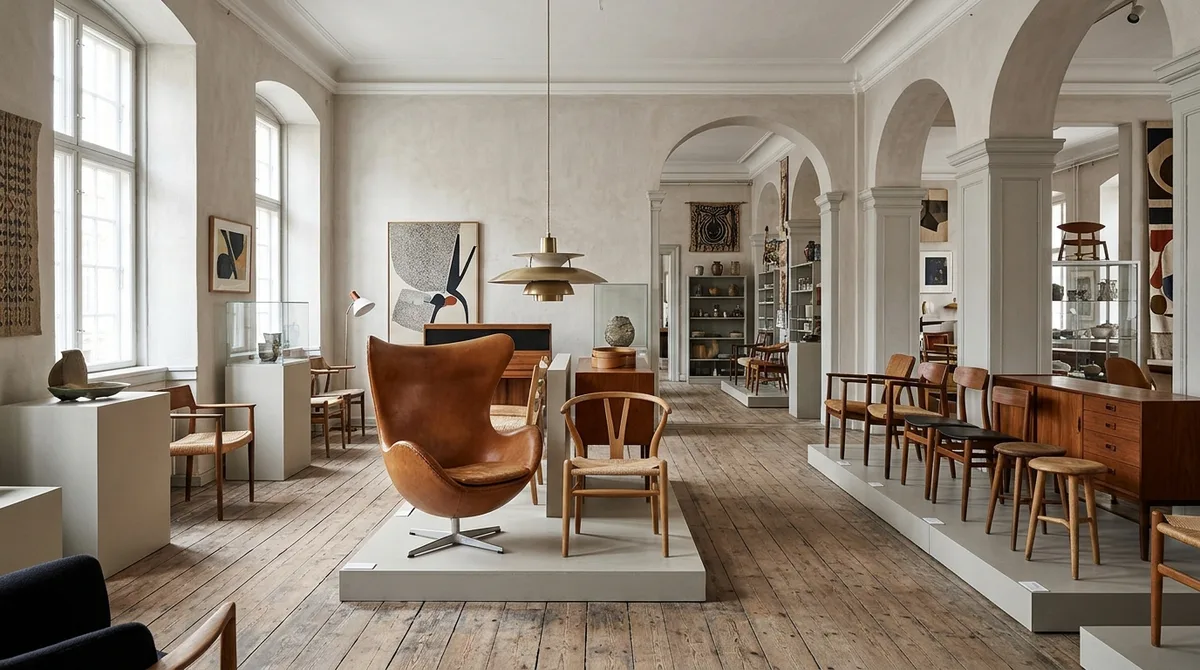
Designmuseum Danmark is the place to trace how Danish design grew from its historic collections into modern furniture. The museum presents Danish and international design, crafts and applied arts under one roof, and its permanent Danish Modern exhibition follows Danish design from the 1920s to 2000 through iconic objects.
The building is part of the story. The museum was founded in 1890 and moved in 1926 into the former Royal Frederik’s Hospital, a Rococo building constructed in 1752–57 and adapted for museum use by architects Ivar Bentsen and Kaare Klint. Plan at least an hour to see the whole museum. The garden, café, shop and library are free to enter, so you can relax there without an exhibition ticket.
The listed adult admission is DKK 140, with DKK 90 for visitors aged 18 to 26 and students, and children aged 0 to 17 enter free. Wheelchair users can reach the main floor, exhibitions, café, shop and library, but there is no elevator to the first floor. For current prices and hours, see the official site.
At a glance
- Best for: Art and design fans and anyone curious about Danish design culture
- Hours or Season: Tuesday to Sunday 10 a.m. to 6 p.m., Thursday until 8 p.m., Monday closed
- Cost: Listed adult admission DKK 140; free for children aged 0 to 17
- Time Needed: At least one hour
- Accessibility: Main floor accessible to wheelchair users; no elevator to the first floor
Assistens Cemetery: Literary Graves in a Leafy Nørrebro Park
Assistens Cemetery dates to 1760, and about one-quarter of its grounds are still an active burial site, so it is a place of remembrance as well as a green space for the neighbourhood. Locals walk, cycle, run and picnic here. The main paths are paved and easy to follow, while the smaller routes are narrow dirt trails.
The graves of Hans Christian Andersen and Søren Kierkegaard draw literary visitors. The municipality’s Storyhunt audio walk is free and takes about 1.5 hours, giving you a structured route between the notable graves. In summer, free public guided tours run, and groups of at least 10 can book a tour at any time of year. The central burial areas are reserved for mourners, so keep to the paths there and don’t sit down.
It suits history and literature fans, and anyone who likes a quiet walk among old trees and headstones on a weekday afternoon.
At a glance
- Best for: History and literature fans, and quiet walkers
- Hours or Season: 7 a.m. to 7 p.m. from October through March, and 7 a.m. to 10 p.m. from April through September; see the official site for current details
- Cost: Free to enter; the Storyhunt audio walk is free
- Time Needed: About 1.5 hours for the audio walk
- Accessibility: Main paths are paved; smaller routes are narrow dirt trails
Gråbrødretorv: A Hidden Square With a Plane Tree
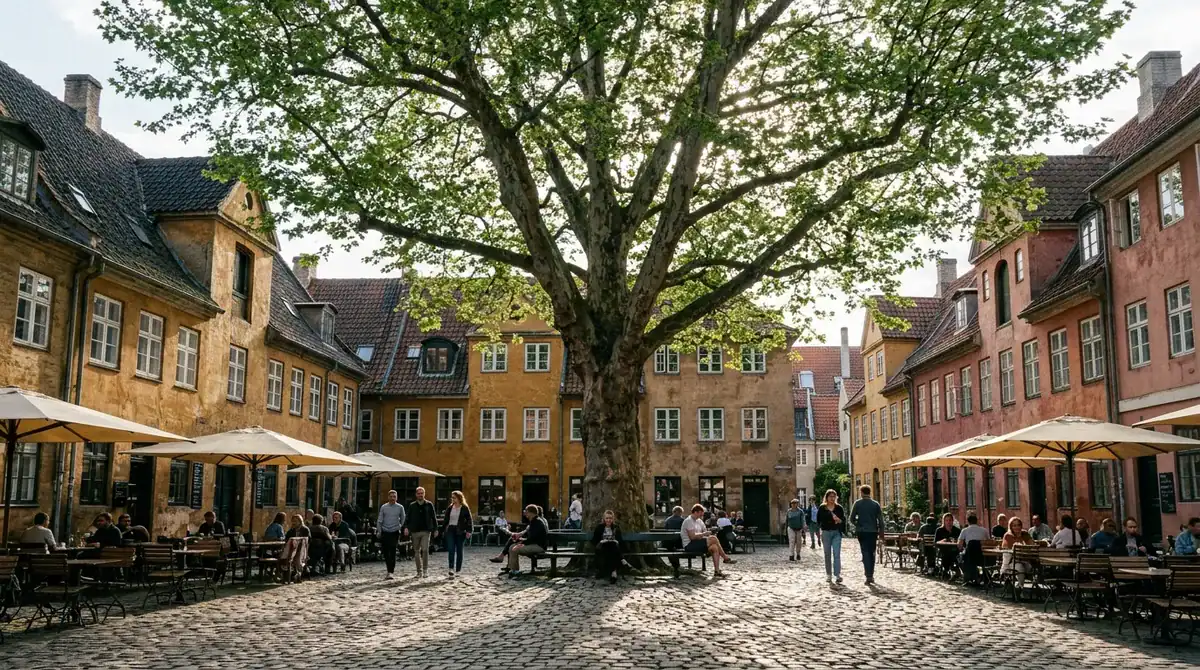
Gråbrødretorv is a small historic square in central Copenhagen, and it’s the kind of place you stumble upon while wandering between bigger sights. Find a spot near the large plane tree, where a fountain anchors the middle of the square, and take a few minutes to slow down.
The name recalls a Franciscan monastery that stood on the site from 1238. The monastery was closed and demolished around 1530, but the square kept its name. Several surrounding buildings date from the early 1730s, rebuilt after Copenhagen’s great fire of 1728, and their colourful façades show that rebuilding.
It feels far quieter than the busier streets just outside. The official VisitCopenhagen listing describes it as a quiet place for a stroll, with occasional outdoor concerts. It suits travellers who want a brief, atmospheric break, local street scenes or architectural details rather than a ticketed attraction, and a café table nearby makes a relaxed midday pause.
At a glance
- Best for: Travellers after a brief, atmospheric break, street scenes and architectural details
- Hours or Season: Occasional outdoor concerts take place on the square
- Cost: Not a ticketed attraction
Superkilen: Nørrebro’s Colourful Urban Park
Superkilen is a long public park in outer Nørrebro, stretching 750 metres and covering 30,000 square metres. Designed by BIG, Topotek1 and the artist group SUPERFLEX, it is divided into three colour-coded areas. The Red Square hosts urban life and events, the Black Square works as a neighbourhood gathering place, and the Green Park suits picnics, sports and dog walking. Walking or cycling through all three shows how quickly the mood shifts from bright street life to open lawns.
The park’s furniture and objects are the real draw. Its design includes 108 plants and pieces of street furniture, among them swings from Iraq, benches from Brazil and a fountain from Morocco. Residents suggested items from their own countries or travels, and the Danish Architecture Center describes the result as 99 urban objects from 59 countries. The Black Square adds chess tables, barbecue grills and a large octopus playground.
Architecture fans and photographers will appreciate the sculptural forms and graphic lines, which Visit Copenhagen notes make the park a photography backdrop. Families and skateboarders keep it lively, so it suits anyone curious about everyday neighbourhood life.
At a glance
- Best for: Architecture and design fans
- Best for: Photographers
- Best for: Families
- Best for: Walkers and cyclists exploring Nørrebro
Jægersborggade: Nørrebro’s Independent Shopping Street
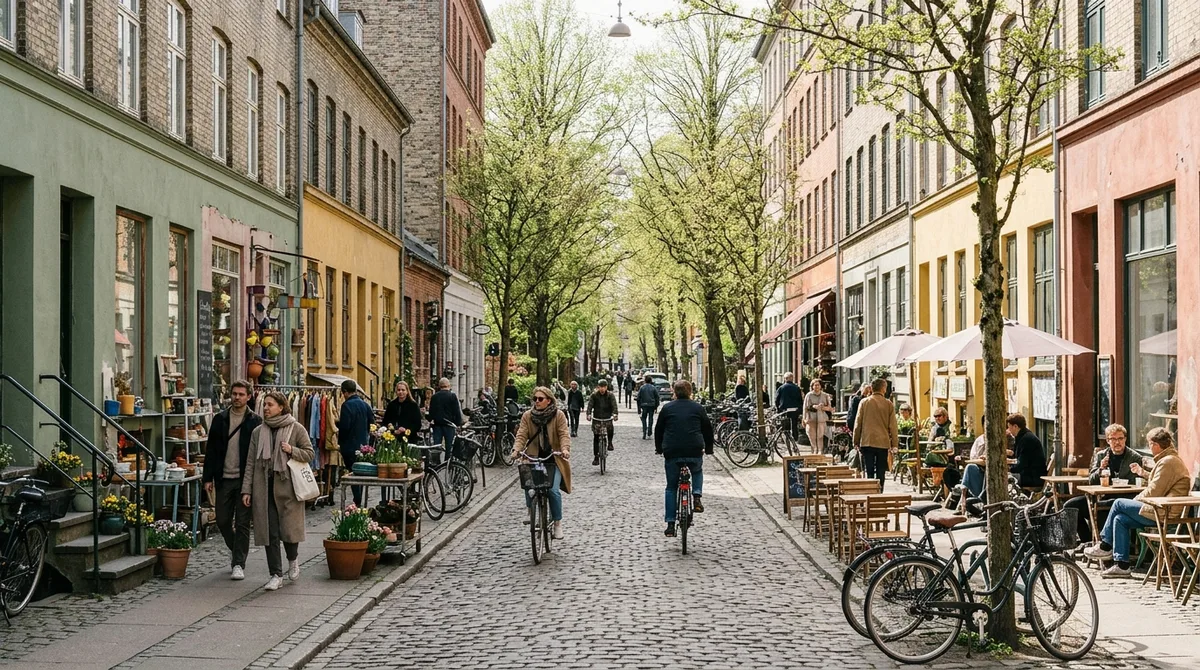
Jægersborggade is a small residential street in Nørrebro, and the best way to enjoy it is to wander slowly. Around 40 galleries, organic-produce shops, vintage clothing stores, ceramics and jewellery studios, wine bars, coffee shops and restaurants line the road. Start with a cup from Coffee Collective, the specialty micro-roastery, then work your way along the street at your own pace.
The street has changed from a troubled street into one of the city’s lively, youthful, grassroots areas, and you can feel that in its everyday mix of neighbourhood life and creative studios. Each business sets its own hours, so there is no single schedule. The jewellery shop LADYFINGERS, for example, opens Tuesday to Friday from 11:00 to 18:00 and Saturday from 11:00 to 16:00, and it is closed on Sundays and Mondays.
Visit in spring for the flea market, when the pavements fill with secondhand finds. It suits food lovers, design fans and browsers who enjoy poking through shops and stopping for a long lunch.
At a glance
- Best for: Food lovers, design fans and browsers
- Hours or Season: Individual shops set their own hours, and a flea market runs each spring
- Cost: No general admission; shop prices vary
National Museum of Denmark: Danish History From Prehistory Onward
The National Museum of Denmark fills the 18th-century Prince’s Palace in central Copenhagen. Its galleries trace Danish and world history from prehistory through the Viking Age and into later periods, and archaeological finds and historical objects tell the story in order.
Crowds build in high season, so a weekday visit early in the day is the easiest way to see the galleries at a relaxed pace. Check the official site for current opening days and ticket prices.
Families should know that the hands-on Children’s Museum is temporarily closed while it is rebuilt, with a new version planned for summer 2027. The whole venue is wheelchair accessible, and visitors can borrow a wheelchair or walker.
History fans will find the chronology rewarding, and first-time visitors who want to understand Danish culture will get a solid foundation for the rest of their trip.
At a glance
- Best for: History fans and first-time visitors curious about Danish culture
- Hours or Season: Daily 10 a.m. to 5 p.m. from April through October; Tuesday to Sunday 10 a.m. to 5 p.m. from November through March; closed December 24, 25 and 31
- Cost: 150 DKK at the ticket desk or 135 DKK online; free for visitors under 18
- Accessibility: Entire venue wheelchair accessible; wheelchairs and walkers available to borrow
Museum of Copenhagen: The City’s Story in 14 Locations
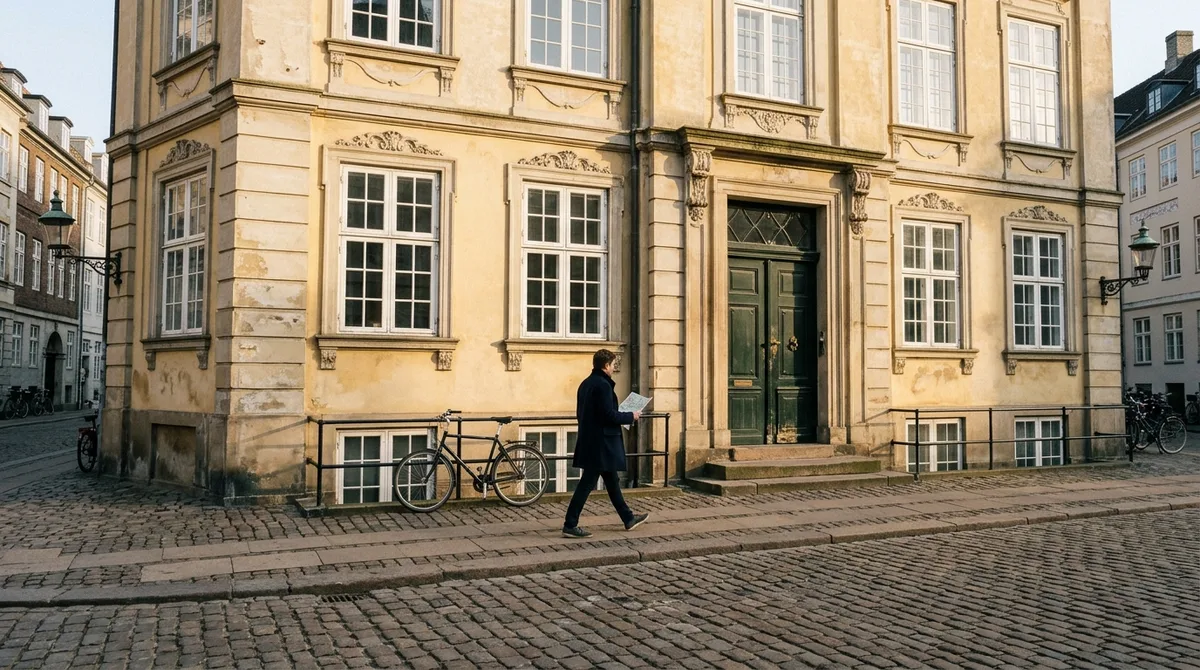
The Museum of Copenhagen sits in a historic building just behind City Hall, and it follows the city’s story through 14 key locations. The permanent exhibitions span about 12,000 BC to the present, with more than 400 artefacts, archaeological finds and interactive installations that use sound, voices and film.
Many visitors linger over the large interactive model of Copenhagen and the panorama, which help you picture the streets you’ll walk later. Look up at the main staircase too, where an 1902 stained-glass window by Agnes Slott-Møller catches the light. School groups often arrive before noon, so an afternoon visit is usually calmer.
The front garden and the museum shop are free to visit, while the Archaeological Workshop opens only on selected occasions. Because it gives you the backstory before you head out, it’s a useful first stop for travellers interested in local history and everyday life.
At a glance
- Best for: First-time visitors, history fans and anyone curious about everyday life in the city
- Hours or Season: Monday to Wednesday and Friday 10:00 to 17:00, Thursday 10:00 to 20:00, weekends 11:00 to 17:00 (see the official site for current details)
- Cost: Adult admission DKK 110; visitors under 18 enter free, and admission is free on Wednesdays
- Time Needed: About half an hour for a quick visit, though longer is recommended to explore the exhibits
- Accessibility: Level-free access and lifts throughout, with wheelchair-accessible toilets in both basement wings
Thorvaldsens Museum: Neoclassical Halls of Bertel Thorvaldsen
Thorvaldsens Museum is devoted to the sculptor Bertel Thorvaldsen, and it opened in 1848 as Denmark’s first museum. Its galleries hold his marble and plaster sculptures, along with his models and drawings, alongside paintings, antiquities, coins and personal items.
The building is part of the experience. Michael Gottlieb Bindesbøll designed the rooms in bright colours, partly inspired by Pompeii and Herculaneum. High windows let the light shift across the marble through the day, so the same figure can look different from one hour to the next.
Adult admission is DKK 110, children under 18 enter free, and seniors pay nothing on Tuesdays. A free audio guide adds useful context about the sculptures and their history. The courtyard is closed during restoration work due to finish in 2027, and the three levels have no accessible entrance or lift. For the latest prices, see the official museum site.
At a glance
- Best for: Art and architecture fans
- Hours or Season: Tuesday to Sunday, 10 a.m. to 5 p.m.; closed Mondays
- Cost: DKK 110 for adults; free for under 18s, free for seniors on Tuesdays and free for everyone on Wednesdays
- Accessibility: No accessible entrance or lift between the three levels
Dyrehaven: Deer Park for a Day Trip North
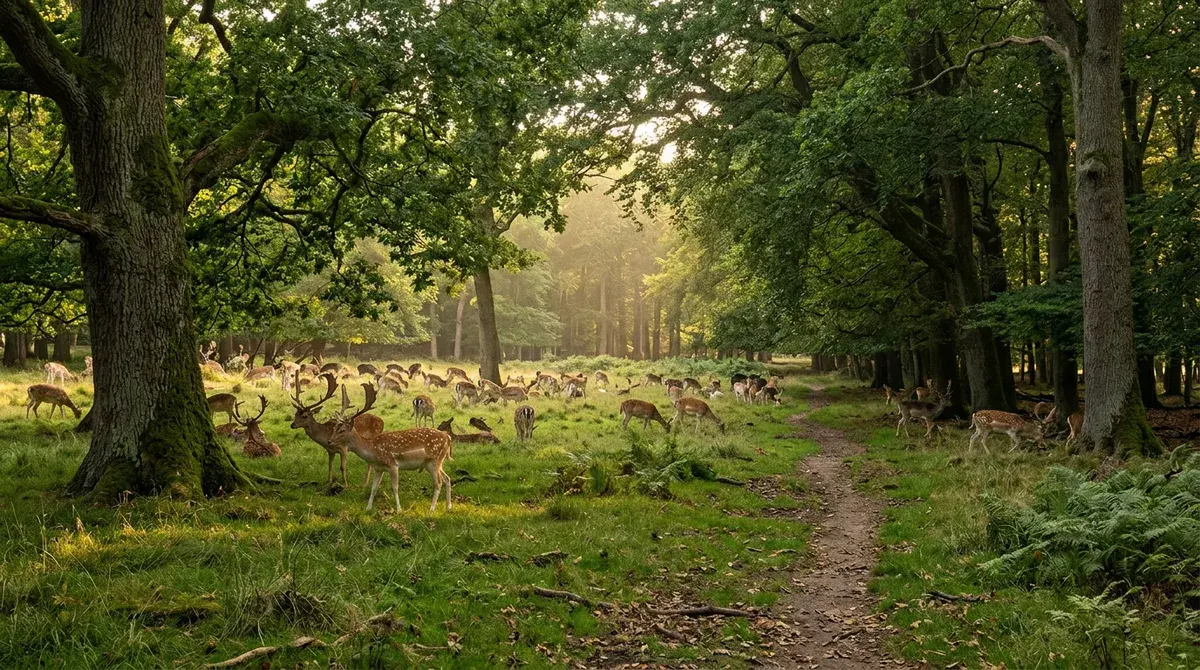
Dyrehaven, officially Jægersborg Deer Park, is a large woodland and open landscape north of Copenhagen, and a short S-train ride from the centre brings you to Klampenborg Station. The best way to explore is on foot or by bike, following star-shaped paths and old hunting roads among free-roaming deer. The Danish Nature Agency counts about 300 red deer, 1,600 fallow deer and 100 sika deer in the park.
The landscape is a historic one. Its paths were laid out for royal parforce hunts, and Jægersborg Dyrehave forms part of the UNESCO-listed Par force hunting landscape in North Zealand, inscribed in 2015. The late-Baroque Hermitage Palace stands where five hunting paths meet. You can admire it from outside, but it is closed to the public, apart from the occasional fundraising event.
At a glance
- Best for: Families, walkers and cyclists
- Hours or Season: Open around the clock
- Accessibility: Paved roads and paths suit wheelchair users, people with walking difficulties and prams; dogs must be kept on a leash
Amager Strand: Sandy Beach on the Harbour
Amager Strand is where we’d head when the city feels too busy and you want sand under your feet. This large waterside beach park sits about 5 km from the centre, built around a lagoon and an artificial beach island completed in 2005. Walk the promenade and the character shifts: the northern end is dune-like and natural, while the southern end has a more urban beach-and-park feel.
Once you arrive, you can swim, rent a kayak or stand-up paddleboard, try surfing or start a game of beach volleyball. The shallow lagoon is especially suitable for small children. Before you go in, check the bathing-water quality and swim only where it is permitted.
Locals use the park as much as visitors do. People stroll, run or rollerblade the promenade, and the five beach stations give you places to change and rest. Toilets run from 8 a.m. to 10 p.m. from May 15 to September 15, and until midnight on Fridays, Saturdays and Sundays from June 1 to August 31, so Amager Strandpark’s official page is the best place for current hours.
At a glance
- Best for: Families, watersports fans and anyone wanting a seaside afternoon in the city
- Hours or Season: Toilets 8 a.m. to 10 p.m. from May 15 to September 15, and 8 a.m. to 6 p.m. from September 15 to May 15 (extended to midnight on weekends in summer)
- Accessibility: Concrete paths between beach stations, accessible toilets and an accessible bathing path and lift at Helgoland Bathing Centre
Inderhavnsbroen: The Kissing Bridge Walk
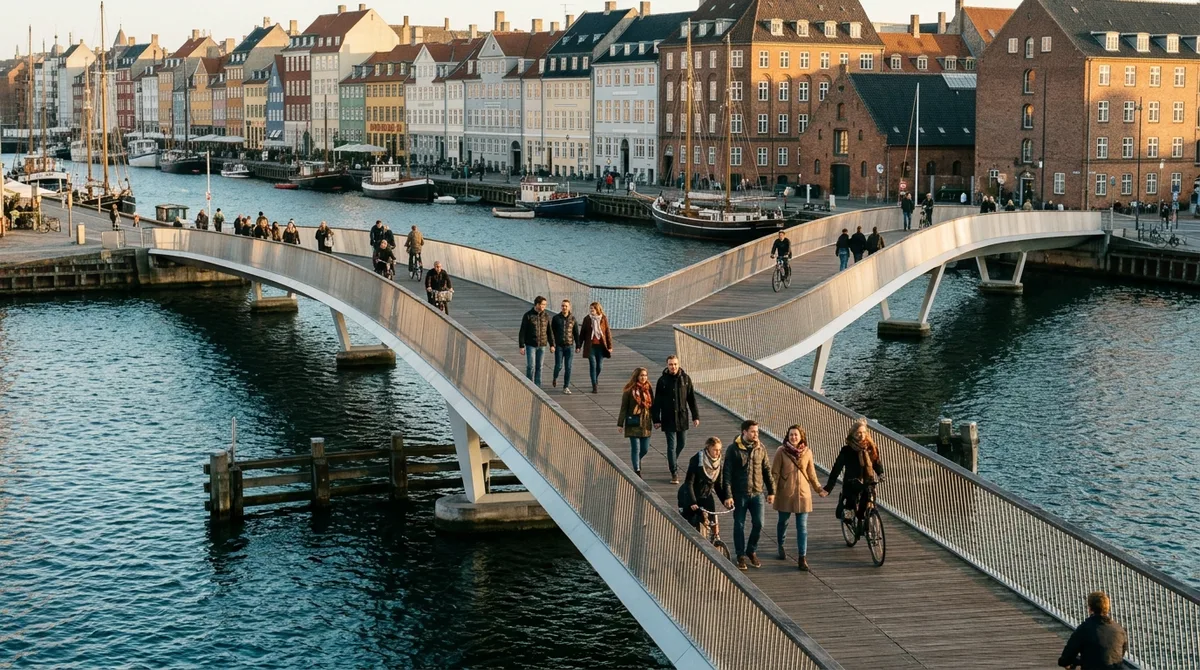
Inderhavnsbroen, the Inner Harbour Bridge, is a 180-metre walking and cycling link that starts at the end of Nyhavn and carries you across to Christianshavn. It completes the Harbour Circle, the waterfront route around the city, so it slots neatly into an evening stroll. Expect cyclists sharing the deck with pedestrians, and step aside when bikes approach.
The bridge has designated platforms where you can stop to look over the harbour and down the Nyhavn canal. Its sections slide horizontally apart for passing boats and meet again when closed, a motion that earned it the nickname the Kissing Bridge. The city publishes boat-passage windows of 05:30–06:30, 09:00–14:00 and 18:00–22:00 on weekdays, and 05:30–22:00 at weekends, but these are boat hours, not visitor hours.
This is a short, scenic crossing rather than a staffed attraction, with no exhibits and no published opening hours. A 2015 municipal committee record described planned stair and ramp access on the Christianshavn side but raised concerns for wheelchair users, people with walking difficulties and parents with prams. Photographers and evening walkers will get the most from it.
At a glance
- Best for: Walkers, cyclists and photographers exploring the waterfront
- Hours or Season: No published visitor hours; boats pass during scheduled windows
- Cost: No ticket price is listed for the crossing
- Accessibility: 2015 committee concerns about access from the Christianshavn side for wheelchair users, people with walking difficulties and prams
Nyboder: Yellow Naval Houses Still Lived In
Nyboder is a row of yellow terraced houses where the first 20 homes went up in 1631, built under Christian IV for enlisted sailors and their families. Stroll the streets slowly and you can admire the uniform yellow façades and the lanes that run between the rows. Because it is still a living residential area, many of the homes you pass continue to serve as residences for Danish Armed Forces personnel, so you are walking through a neighbourhood rather than an open-air exhibit.
The local-history museum, Nyboders Mindestuer, sits in a house dating to 1635. Inside you’ll find an 1880s home display, a model of Nyboder as it looked in 1760 and other historical objects. A guided walk of about 1.5 hours can include a historic Nyboder apartment as well as the surrounding streets.
It suits history fans, architecture lovers and anyone who wants a quiet stroll away from the busier sights.
At a glance
- Best for: History fans, architecture lovers and quiet walkers
- Hours or Season: Museum open Sundays from 11 a.m. to 2 p.m., with exceptions including Easter Sunday and Whit Sunday
- Cost: 40 DKK for adults; children, veterans and visitors with military ID enter free
- Time Needed: About 1.5 hours for a guided walk
Sydhavnstippen: Wild Greenery Over a Former Landfill
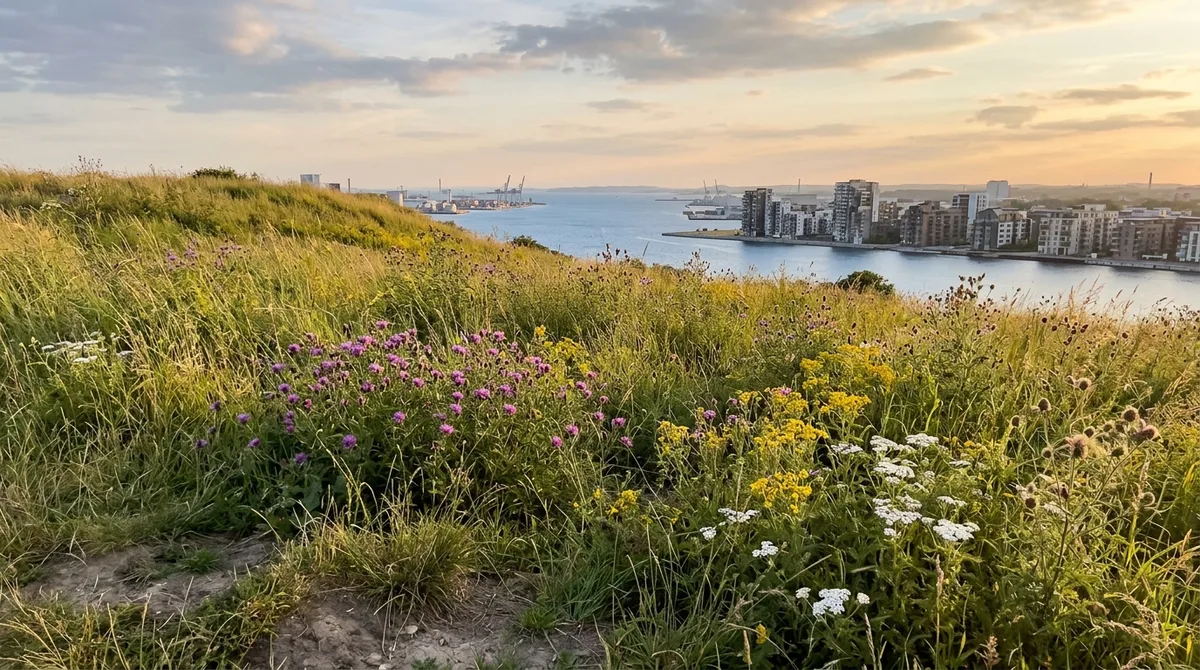
Sydhavnstippen, known locally as Tippen, is a self-grown nature and cultural area in Sydhavnen, built over an old landfill. Rubble mounds and fragments of concrete, wreckage and asphalt form an unusual shoreline, and nature has reclaimed the ground. You can walk or cycle the paths beside the water and look out for birds, wild plants and the sheep, goats and alpacas that graze here.
The animals move between two enclosures: the north one in summer and the south one in winter. Visitors should not feed them, and dogs must stay leashed outside the dog run. The area has four entrances, and the nearest S-train station, Sjælør, is about 500 metres north of Karens Minde Cultural Centre. The natural area is always open and free. The bridge between Thomas Koppels Allé and Sydhavnstippen was closed until July 2027 as of October 2026, so use the other bridges over the freight railway, which remain open, as the official site explains.
Sydhavnstippen suits nature walkers, wildlife watchers and families who want something different from a formal city park. Its informal, self-grown character offers a close look at everyday life in Sydhavnen, and a loop on foot or by bike makes a relaxed, quirky afternoon.
At a glance
- Best for: Nature walkers, wildlife spotters and anyone wanting a low-key outing
- Hours or Season: Always open; sheep, goats and alpacas graze the north enclosure in summer and the south enclosure in winter
- Cost: Free to visit
Planning Your First Copenhagen Trip
Start by choosing one base and one sight you won’t want to miss. If you’re visiting in spring or summer, pair a sunset walk along Nyhavn with a climb of the Round Tower. If street life matters more, a Saturday in Nørrebro around Jægersborggade and Superkilen may suit you better.
Then open your calendar and check the dates you’ll be in town. Peak season is when popular timed entries, such as the slots at Rosenborg Castle, are most likely to sell out, so booking early is worth the effort.
Next, write down your arrival and departure times. If your flight leaves early, plan your last night near a metro line so you can reach the airport without a rushed taxi. If you’ll arrive late, check which station is closest to your accommodation before you land.
Finally, pick one free morning for the places that cost nothing. The Botanical Garden, Kastellet and the Amager Strand promenade all reward an unhurried start, and a quiet walk before the crowds arrive is the best way to settle into the city.