

Traveling with ADHD is easier when you plan around the things that tend to slip, like packing, medication, and keeping track of small essentials. Trouble organizing tasks, forgetfulness, and frequently losing necessary items are all signs the CDC lists among common ADHD symptoms. Each one can show up at a crowded airport gate or in a half-packed suitcase the night before departure. Medication adds another layer, since travelers are advised to account for time-zone changes, carry medicine in hand luggage, and prepare for delays. The answer is rarely more willpower. It is a few reliable systems set up before you leave.
Medication needs the earliest attention. Many countries allow a 30-day supply of certain medicines, but they may require a prescription or medical certificate, and some restrict ADHD medicines entirely. Check the rules for your destination and every transit country before you book. Keep medicines in their original labeled containers in your carry-on, and bring enough for the trip plus extra in case of delays. Ask your prescriber early how to adjust timing across time zones, since dosing is usually based on the time since your last dose rather than the local clock.
Key Takeaways
- Travelers with ADHD should check the medicine rules for their destination and every transit country before booking, because some countries restrict amphetamine/dextroamphetamine and lisdexamfetamine entirely.
- Travelers with ADHD should keep all medicines in their original labeled containers in the carry-on, with enough supply for the full trip plus extra days in case of delays.
- Travelers flying from the United States can carry medically necessary liquids above the 3.4-ounce or 100-milliliter limit, but they must declare them to the officer before screening.
- Travelers with ADHD who need help boarding or a seat change should contact the airline early, since airlines may request up to 48 hours’ notice for certain accommodations and the request should be confirmed in writing.
- Travelers with ADHD can pack more reliably by using a reusable checklist and keeping chargers, ID, tickets, and medicine together in one zippered pouch that stays in the same pocket on every trip.
What Makes Trips Harder When You Have ADHD
Organization and follow-through are often where travelers with ADHD feel the strain first. Planning a trip means dozens of small jobs: comparing flights, booking a room, saving confirmation emails, and remembering which app holds the train ticket. A booking left half finished on Tuesday can turn into a missed check-in on Friday.
Those same difficulties show up on travel days. A phone charger left beside a hotel bed, a boarding pass buried in an inbox, or a passport slipped into the wrong pocket can eat up time before the journey has really begun. Missing a connection because the next gate was across the terminal is common, and it can feel like proof that you are bad at travel.
Experiences vary widely. Some travelers struggle most with packing, others with bookings, and others with the long gaps between flights, when the day has no structure at all. The right travel system depends on which challenges affect you most, so it helps to notice where things have slipped on past trips.
ADHD also brings real strengths onto the road. Energy keeps you moving through a crowded night market, adaptability helps when a museum closes early, and enthusiasm for new places can turn a wrong turn into the best afternoon of the trip. Many people with ADHD are quick to find a workaround when the plan falls apart.
Setbacks happen to everyone, but planning for them makes them easier to handle. Keep a spare charger and short cable in the same zippered pocket every time, and save photos of your passport and booking references in one folder on your phone. When a lost item or a missed train happens, a backup you set up in advance turns a crisis into a fix, which keeps frustration from spiraling into self-criticism.
Can You Travel Abroad With ADHD Medication?
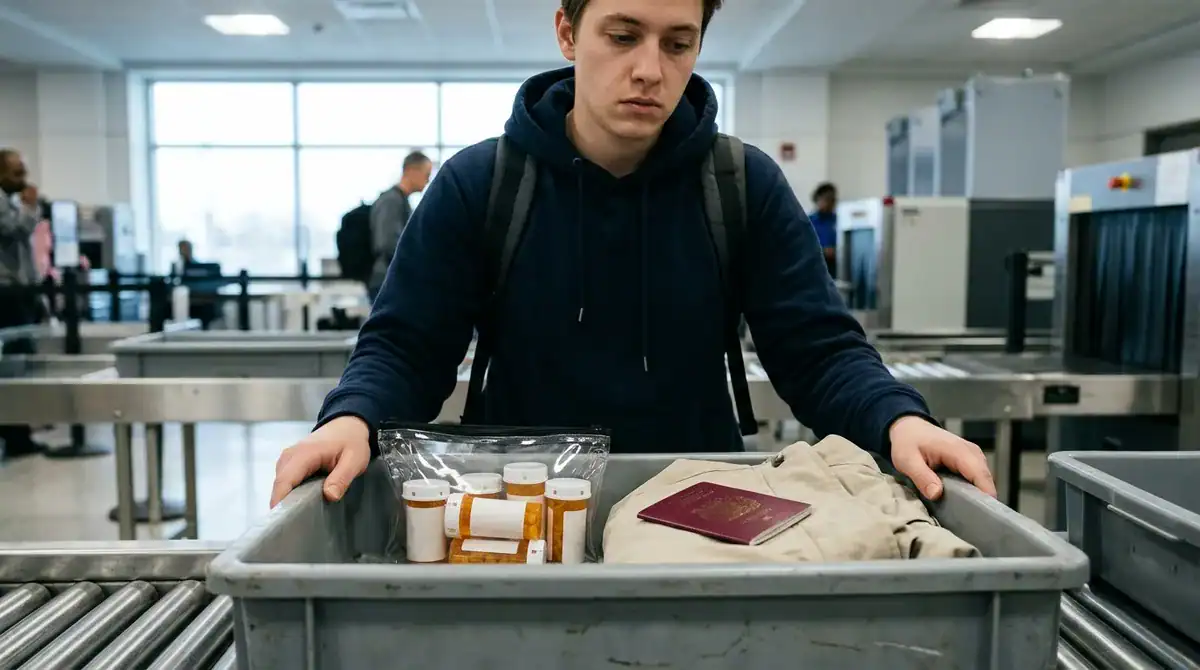
Yes, you can travel abroad with ADHD medication, but the rules are strict enough that you should start checking them as soon as your destinations are set. Some countries require paperwork that takes time to arrange, so medication belongs at the top of your planning list.
Start with the law, not the luggage. The CDC’s Yellow Book notes that amphetamine/dextroamphetamine and lisdexamfetamine, two medicines used for ADHD, are illegal at some international destinations. Check every transit country on your route as well, because a connecting flight can bring you under a second set of rules.
Next, look at what each country expects on paper. Many countries accept a 30-day supply of certain medicines, but they may still ask for documentation. Ask your prescriber for a letter that names the medicine by its generic name, lists the dose, and includes a contact number for the prescriber. Then keep a copy in your carry-on and another in your phone.
Pack every medicine in its original labeled container, with the pharmacy label facing outward so it is easy to read at a checkpoint. Keep all of it in your carry-on rather than checked luggage, so your medicine stays with you if a bag is delayed or lost. Store the bottles together in one clearly marked pouch that lives in the same pocket on every trip.
If you are flying from the United States, the TSA’s medical guidance allows medically necessary liquids, gels, and aerosols above the usual 3.4-ounce or 100-milliliter limit, provided the amounts are reasonable. You still need to declare them to the officer before screening, so plan a few extra minutes at the checkpoint.
Count your doses before you leave. Bring enough for the full trip plus extra in case a flight is delayed or a connection falls through. Keep the spare in a different compartment of your carry-on, so one lost pouch does not leave you without medicine.
Crossing time zones changes the clock, but it does not change how your body handles a dose. Dosing is based on the time since your last dose rather than the local time of day, so ask your prescriber to map out an adjusted schedule for each time zone on your route before you go.
Work through the steps below in order, starting as soon as your itinerary is firm:
- Confirm the rules for your destination and every transit country, including whether amphetamine/dextroamphetamine or lisdexamfetamine is restricted there.
- Request a travel letter or medical certificate from your prescriber that matches the requirements you found.
- Book an appointment with your prescriber to plan dose timing across each time zone on your route.
- Calculate the number of days your trip requires, then add extra medicine for possible delays.
- Place each medicine in its original labeled container and pack the containers together in your carry-on.
- Declare your medicines and any medically necessary liquids to the officer at the security checkpoint.
How Do You Pack Without Losing Things?
You can pack without losing things by setting up a few fixed systems: a reusable checklist, one pouch for the items you cannot afford to lose, a home base for travel gear, and a short check at the door. Each system takes the memory work off your plate, so you are ticking boxes instead of trying to recall everything at midnight.
Start with a master checklist for each type of trip. Keep one for city breaks, one for beach stays, and one for hiking trips, either in a notes app or on a printed sheet in your travel folder. After each trip, cross off what you used, add what you missed, and save the updated version. Over time, the list reflects your real habits rather than a guess made under pressure.
Next, gather the small essentials into one clearly labeled pouch that stays in your carry-on on every trip. Put your chargers, a short spare cable, your ID, and your printed or saved tickets inside it, along with the medicine containers. Choose one zippered pocket and never move the pouch from it, so you always know where to reach first.
Pack in stages over several days instead of all at once. Early on, wash and fold clothes you already know you will wear. A few days out, fill toiletries and chargers. In the last day or so, add the things you use daily, such as your phone, glasses, and water bottle. Splitting the job this way cuts down on procrastination and the endless small decisions that drain energy before a trip begins.
Choose a home spot for travel items so they are never scattered around the house. A hook, a shelf, or a bin near the front door works well. Keep the pouch, your checklist, and a travel folder there, and return each item to that spot after every trip, even if you plan to pack again soon.
Before you leave, do a second check at the door. Go through three steps:
– Bag: zip it, then confirm the pouch is in its pocket. – Pouch: open it and check that the chargers, ID, tickets, and medicines are all inside. – Documents: look at the passport and booking details, then tick them off on your checklist.
Saying each item aloud as you check it helps your attention stay on the task. If something is missing, you catch it in your home rather than at a gate.
Building a Trip Schedule That Leaves Room to Breathe

Planning a trip involves dozens of small decisions, and executive dysfunction can make each one feel heavier than it should. A schedule that leaves every choice for the road tends to stall. Settle the choices now, while you are calm and have time to think.
Start by limiting fixed commitments. Choose one anchor event per day, such as a timed museum entry or a guided tour, and leave the rest open. A day with one booked activity has room for a wrong turn, a long lunch, or a nap when the time difference catches up with you.
Buffers matter most around the moments you cannot control. Leave generous gaps before flights, after check-in, and between train transfers, and be realistic about how long it takes to walk between platforms or terminals. Travelers are advised to account for time-zone changes and prepare for delays, so keep your first day or two after arrival light. Skip the long hike and the dinner reservation across town on the day you land.
Write decision points into the itinerary itself. Instead of noting “explore Colonia del Sacramento,” try “Saturday, 2 p.m.: if the morning ferry from Montevideo is delayed, skip the lighthouse and walk the old town instead.” When the choice is already on the page, you follow the plan rather than debating on a hot street.
Reward moments keep motivation steady over long days. Put your favorite meal on the schedule, along with a quiet walk along the coast or an afternoon with nothing planned. These are not extras to squeeze in later. They are the parts of the day that carry you through the rest of it.
Planning tasks are easier when you split them into small sessions:
– One flight search or fare comparison per sitting – One booking, followed by saving its confirmation in your travel folder – One day of itinerary research, ending with a note about the next step
Put each session on your calendar, and stop when the time is up, even if the booking is half finished. Picking up the next session later is far easier than trying to finish everything in one go.
Can You Fly With ADHD and Get Help at the Airport?
Yes, you can get extra help at a U.S. airport, but the support is optional, and you have to ask for it. TSA Cares offers optional checkpoint support for travelers who may need extra help getting through screening. Contact the program before your trip so the airport team can plan for your arrival and your flight.
Disability protections in the air work differently. Under the Air Carrier Access Act and 14 CFR Part 382, a disability is defined as a physical or mental impairment that substantially limits one or more major life activities, a record of such an impairment, or being regarded as having one. Meeting that definition does not make every accommodation automatic, so an ADHD diagnosis alone does not guarantee a specific service on every flight.
Airlines generally cannot require advance notice of a disability. However, the rules allow airlines to request up to 48 hours’ notice for certain accommodations, including some equipment. If you think you will need help boarding, a seat change, or assistance with equipment, contact the airline well ahead of time and get the request confirmed in writing.
Ask for help at each step, not just once. Mention your needs when you book, confirm them at check-in, and check again at the gate, since staff may not see a note in your reservation until the moment you arrive.
Overstimulation is often the hardest part of an airport day, and a few habits can soften it. Arrive earlier than you think you need to, so the security line feels like a steady queue instead of a race. Pack noise-reducing headphones in the same pocket as your chargers, and put them on as soon as the terminal starts to feel loud.
Scout the quiet spots before you need them. Look for a gate away from the main walkway, a seat away from the departure board, or a quiet room if the airport has one. Walking to a calmer corner for ten minutes can reset a crowded afternoon.
At the checkpoint, keep your medicine pouch easy to reach and have your declared liquids ready for the officer. Taking a breath before you step into the bin lane helps you stay focused on each step.
Handling Overstimulation and Frustration on the Road

Busy destinations can overwhelm any traveler, and ADHD can make the build-up come faster. Learn your early warning signs so you can step in before a rough afternoon becomes a meltdown. Irritability with a travel companion, trouble choosing between two simple options like which café to try, or a sudden urge to rush through a museum you had been looking forward to are all common signals. When you notice them, step away. Find a bench, a shaded courtyard, or a quiet side street, and rest before deciding what comes next.
Build one low-stimulation activity into every day. A slow breakfast at a neighborhood bakery, a walk through a botanical garden, or an hour with a book on a park bench all count. Treat that time as a fixed part of the schedule, not a backup for when everything else has gone wrong.
When plans fall apart, such as a canceled ferry or a closed museum, resist the urge to rebuild the whole day at once. Choose one next step, like the nearest open café or the lunch you already wanted, and take only that step. Decide the rest once you have eaten and sat down.
Frustration over small errors is common. Boarding the wrong metro line or forgetting your water bottle at the hostel does not mean you are bad at travel. Many people feel that sting after a minor slip, and naming it out loud, with something like “that was annoying, and I can still enjoy this,” often shortens it.
Simple rewards keep motivation going through tiring stretches. Pick something small and tie it to a finished task: a scoop of gelato after getting through a long transit day, a favorite show on the laptop once you are checked in, or a window seat on the train with a sandwich you chose yourself. Rewards work best when they arrive right after the effort, so the link between the two stays clear.
How Do You Travel With an ADHD Child or Partner?
You travel most smoothly with an ADHD child or partner when you divide the work into named jobs, write them on a shared checklist, and build each day around the routines and movement your companion needs. This is a common situation. The CDC reported that 7 million U.S. children ages 3 to 17, or 11.7 percent, had a current ADHD diagnosis based on data collected in 2024.
Packing and medication are where couples often lose time. Sit down together about a week before departure and write one checklist with a line for each job and a single owner beside it. One person might pack the medicine pouch, another might confirm the prescriber’s travel letter, and a third might check the chargers at the door. Tick items off together on the morning you leave, and keep the sheet in the travel folder you already use.
Routine anchors children, and it still matters across time zones. Keep bedtime, meal times, and quiet time as close to home patterns as you can. Shift them by small steps over the first few days rather than all at once. A child who usually eats dinner at 6 p.m. can have an early, familiar meal on the first evening, and a snack from home can bridge a long gap between flights.
Movement needs a place on the schedule too. Plan one active block each morning, such as a playground, a beach run, or a walk to the nearest bakery. Follow it with a downtime stop, like a shaded bench or a hotel room with the blinds down. Alternate energetic and calm activities through the day, and let your child choose the order when you can.
Many women and girls with ADHD were diagnosed late, sometimes after years of managing everyday planning alone. They often carry the family’s lists, bookings, and reminders in their heads, which adds a second layer of work to any trip. If that describes you, give a partner or older child a named share of the checklist, so the system does not depend on your memory alone.
Your Pre-Departure Checklist for ADHD-Friendly Trips
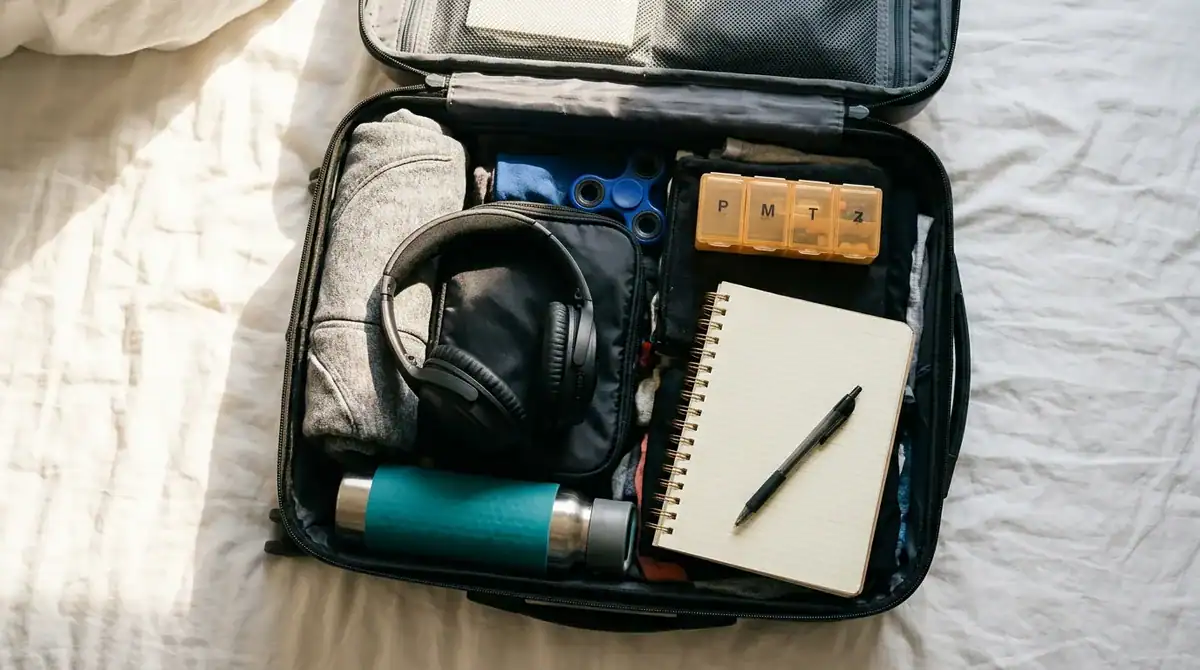
Start with medication, since it has the longest lead time. Confirm the rules for your destination and every transit country, then check that your prescriber’s travel letter is ready and that your supply covers the full trip plus extra days. Give yourself time to act on anything you find, because paperwork often takes longer than expected.
Before you leave, run a final check on your gear:
- Open the essentials pouch and compare it with your master checklist.
- Confirm that every medicine is in its labeled container inside the pouch.
- Contact TSA Cares before your flight if you want checkpoint support.
Plan the first day on paper, too. Keep one anchor activity, leave generous gaps after you land, and write down the route from the airport to your room so you are not searching for directions while tired. Choose one reward for the first full day, such as a long coffee on a sunny terrace, and add it to the schedule before you leave.
Your First Steps This Week
Pick one trip you are planning in the next few months and write down every country on the route, including each connecting airport. That list tells you which medicine rules to check first. Checking them takes the longest, so start today.
Send your prescriber a message this week asking for a travel letter that names your medicine by its generic name and lists your dose. In the same message, ask for an adjusted dosing plan for each time zone on your route. Then book the appointment before your calendar fills up.
Next, open the itinerary you are working from and add a buffer before every flight, train, and ferry. If your route runs from Montevideo to Colonia del Sacramento, check the ferry times and leave the afternoon of your arrival day open. Trvrsl’s itinerary guides include travel times, fares, and tips, which makes them a useful place to fill in those gaps.
Finally, set a reminder for the evening before you leave, labeled “pouch check.” When it goes off, go through the bag, pouch, and documents steps from earlier and tick each item on your sheet. If you want a destination to practice on, start with a Trvrsl itinerary guide and build your first checklist around it.