
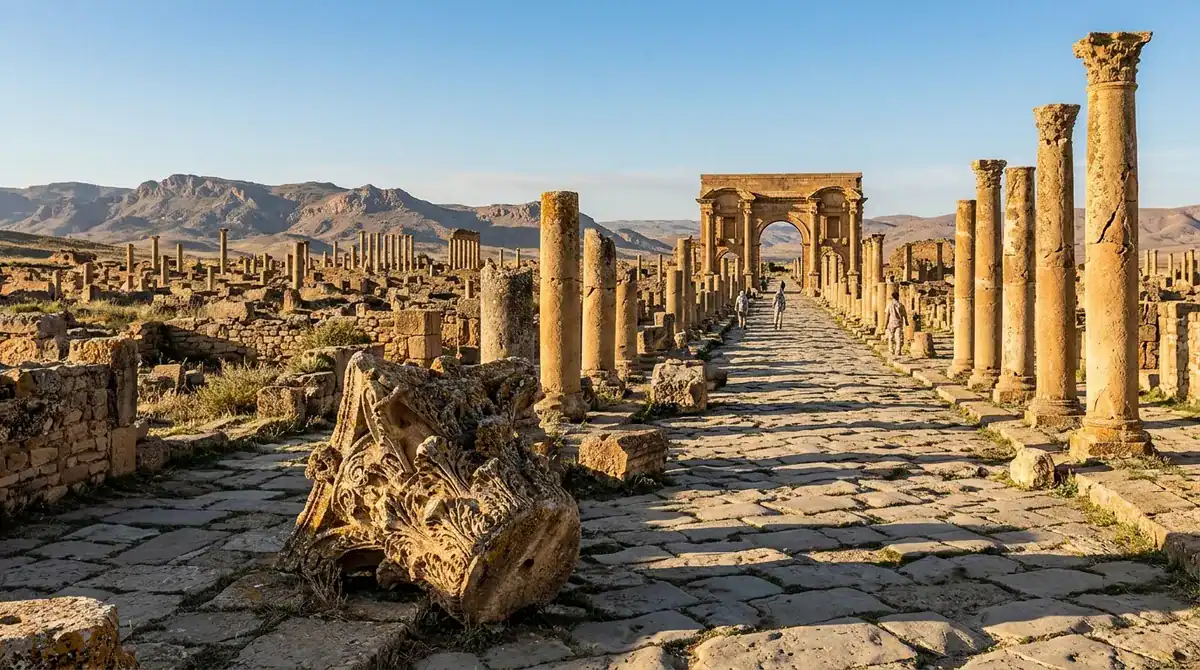
An Algeria travel guide starts with a country of striking contrasts. It holds seven UNESCO World Heritage properties, from Roman cities in the north to prehistoric rock art in the Sahara to the south. Timgad and Tassili n’Ajjer were both inscribed in 1982, and together they show how much history and landscape can fit inside one country.
We think of Algeria as two trips in one. The north rewards several days of ruins, Mediterranean coastline and mountain villages, while a guided Sahara journey needs roughly a week. The Tassili n’Ajjer plateau alone covers 72,000 square kilometres, and tourism there is strictly controlled, so you travel with an official guide. Before you book, check visa rules. U.S. travelers need a visa, and their passport must be valid for six months beyond arrival. Plan your route early, and you can see both sides of the country.
Key Takeaways
- Avoid calling the Royal Mausoleums of Ancient Algeria UNESCO-listed, since the group is still only on the Tentative List.
- Travelers should budget €130 to €260 or more per day for a deep-desert trip, excluding international flights.
- UK government advice warns against all travel within 30 kilometres of Algeria’s borders with Libya, Mauritania, Mali or Niger.
- Travelers with food allergies should carry an allergen card written in French and Arabic, showing it to every cook.
What Makes Algeria Worth Visiting?
Algeria stands out among North African destinations because it offers two very different journeys in one country. Along the Mediterranean, Roman and older ancient sites reward slow exploration, and farther south, the Sahara opens onto some of the most dramatic desert scenery in the region.
Six of Algeria’s UNESCO World Heritage properties are cultural. The seventh, Tassili n’Ajjer, is mixed, which means UNESCO recognizes both its natural landscape and the human history carved and painted into its rock. Those prehistoric images are a reminder that people have lived in this desert for thousands of years, long before modern travelers arrived.
In the north, you can walk through the remains of Roman towns, with columns, street grids and theaters that still hint at how busy these places once were. In the south, the Djanet oasis region offers a different pace entirely: palm groves, sandy plains and rock formations rising out of the desert floor.
First-time visitors usually have three options. You can focus on the north for a shorter city-and-coast trip, head straight into the desert for a more remote adventure, or combine both if your schedule allows. Each choice shapes how you plan your route, what you pack and how much time you give yourself, and the sections ahead walk through each of those decisions.
Where Are Algeria’s Best Roman Ruins?
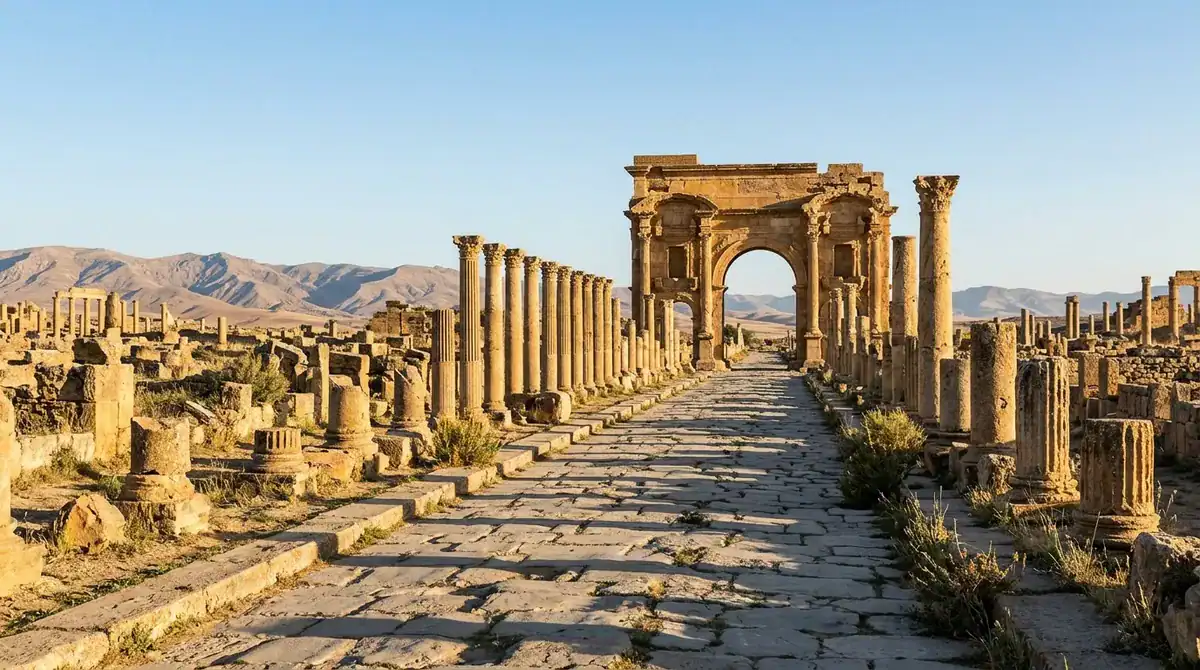
Timgad is the headline Roman city in Algeria, and it is already on the UNESCO World Heritage List. Its grid of stone streets, columns and public buildings was laid out as a planned town, so you can read how Romans organized daily life almost block by block. Timgad and Tassili n’Ajjer were both inscribed in 1982, which makes Timgad a dependable anchor for any ancient-sites itinerary.
Plan at least half a day for Timgad, and go early, when the stone is cool and the light is low and warm. Walk the main axis slowly, then climb to the edge of the site for a view across the surrounding plain. Photographers will find that late afternoon light brings out the texture of the worn pavements.
The royal mausoleums are a different story. The Royal Mausoleums of Ancient Algeria sit on UNESCO’s Tentative List, an inventory of properties a country intends to consider for nomination. Being on that list is a first step, not a designation. Among the monuments in the group are the Medracen, a massive circular tomb near Batna, and the Tombeau de la Chrétienne near Tipaza on the coast.
The nomination has moved forward. In November 2026, Algeria’s state news agency reported that the file met UNESCO’s technical requirements and advanced to preliminary evaluation. That is real progress, but the mausoleums are not yet inscribed on the World Heritage List.
For your planning, treat the mausoleums as a site to watch rather than a guaranteed highlight. You can still add them to a northern route, and you will see impressive monuments either way. Just avoid describing them to friends as UNESCO-listed until the evaluation is complete.
Exploring Algiers, the Kasbah and the Coast
Most travelers will want to start in Algiers, and the capital makes a better base than its reputation suggests. Give it a few days before you head inland, so you can settle into the country’s rhythm before the long road trips begin.
The Kasbah of Algiers is the walled old quarter, a maze of narrow lanes, steep stairways and whitewashed houses climbing the hillside above the harbor. Wander without a fixed plan, and you will stumble onto small squares, quiet courtyards and cafés with views. Head to the higher stairways, where the sea appears between rooftops, and stay until the light turns gold. Wear shoes with good grip, because the stone steps can be slippery.
Getting around the city is straightforward. A recent city guide lists metro fares of 50 Algerian dinars for a single ride and 400 dinars for ten rides, and the airport train costs 80 dinars to central Algiers.
Once you have had your fill of the city, take the coast road west to Tipaza, a Roman port town where ruins sit right beside the water. It is a welcome change from dunes and stone columns inland. Spend an afternoon on the beaches, eat grilled fish by the sea and let the pace slow down.
For a rough sense of cost, a mid-range northern budget typically runs about €50 to €100 per day, not counting international flights. That is far less than a guided desert expedition, so a few days in the capital and along the coast is an easy way to start your trip. A sensible pattern is three days in Algiers, two or three on the coast, then inland toward Timgad with your energy fully restored.
Hiking the Kabylie Mountains and Eating Local Food
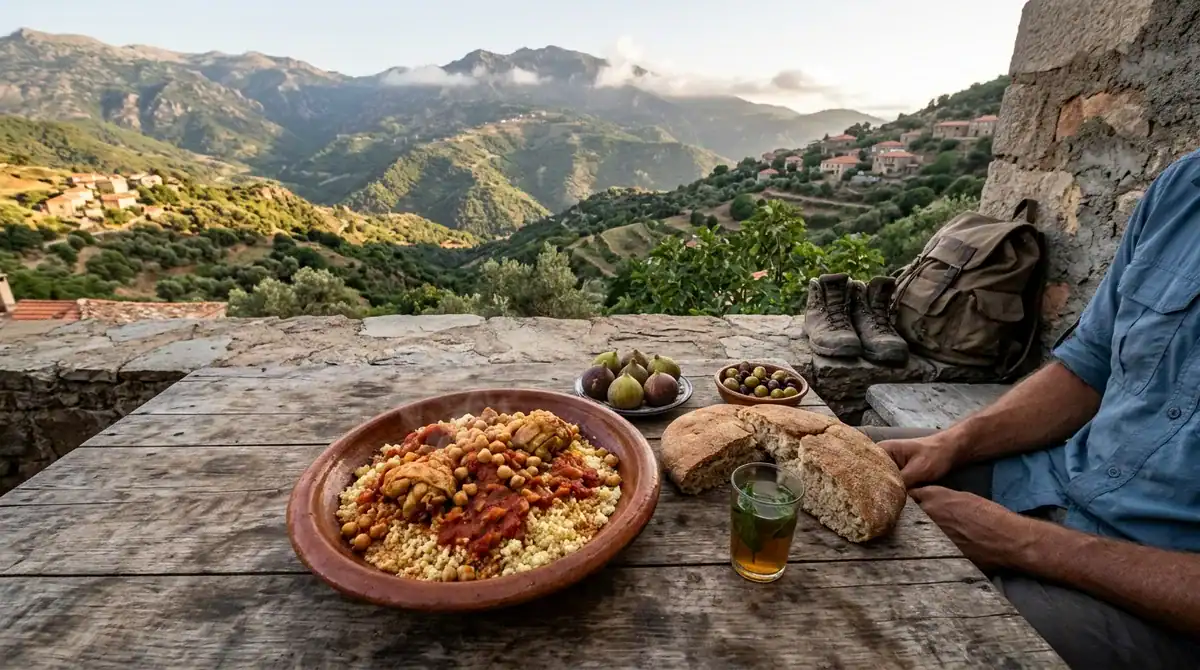
Set the Sahara aside for a few days and head east of Algiers into the Kabylie Mountains. Green hills roll one after another here, with terraced slopes, olive groves and villages clinging to the ridges. Footpaths link the hamlets, so you can walk from one village to the next and stop for mint tea whenever the view invites you to linger.
Start early, carry more water than you think you need, and ask your host or a local guide about conditions before you set out. Mountain weather can change quickly, so choose a clear morning for the longer climbs.
Algerian cooking is generous and unfussy. Couscous anchors many family meals, often steamed slowly and served with vegetables and meat. Grilled meats appear at roadside grills and in small restaurants, and round loaves of bread arrive with nearly every meal. Seasonal produce fills the markets, from tomatoes and peppers in summer to fresh greens and fruit in other months, so ordering what is in season is a delicious habit to adopt.
Food allergies need a little preparation. French is widely spoken alongside Arabic, so learn a simple sentence such as “Je suis allergique aux arachides” (I am allergic to peanuts), and swap in the ingredient you avoid. Carry a card listing your allergens in French and Arabic, and show it to the cook or server.
Markets are the best place to check ingredients, since you can see the spices, oils and breads you are buying. In small restaurants, ask whether dishes contain nuts, butter or shared cooking oil, and ask to speak with the cook if the answer is unclear.
Is a Sahara Trip Worth the Cost?
Yes, a Sahara trip is worth the cost if you want the scale and ancient rock art that the north cannot offer, as long as you plan it as a guided expedition with its own time and budget.
Tassili n’Ajjer is large enough to humble any itinerary. The plateau covers 72,000 square kilometres, and the distances between its sandstone formations and painted sites take far longer to cover than a map suggests. Because tourism there is strictly controlled, UNESCO says visitors are accompanied by an official guide, so you will not set out alone.
The U.S. Department of State is equally clear about overland travel, advising against long Sahara journeys outside an organized tour group. Treat that as a practical rule for planning, not a formality.
Time is the other big difference. A guided Sahara trip needs roughly a week, while the north works well over several days. That week is not padding. A good share of it goes to the road itself, so you need days for the drive in, time among the painted caves and the drive back, plus a spare day for weather or vehicle delays.
Costs follow the same pattern. General market figures put a deep-desert trip at about €130 to €260 or more per day, excluding international flights. Northern mid-range travel sits well below that. The price climbs with remote routes, private vehicles and the work of carrying water, fuel and supplies far from towns.
For many travelers, the best answer is to do both. Spend a few days on the Roman ruins and the coast, then budget the desert as a separate block. Ask any operator for a day-by-day itinerary, confirm which guide and vehicle are included, and book early so the dates line up with your visa and flights.
Do You Need a Visa to Visit Algeria?
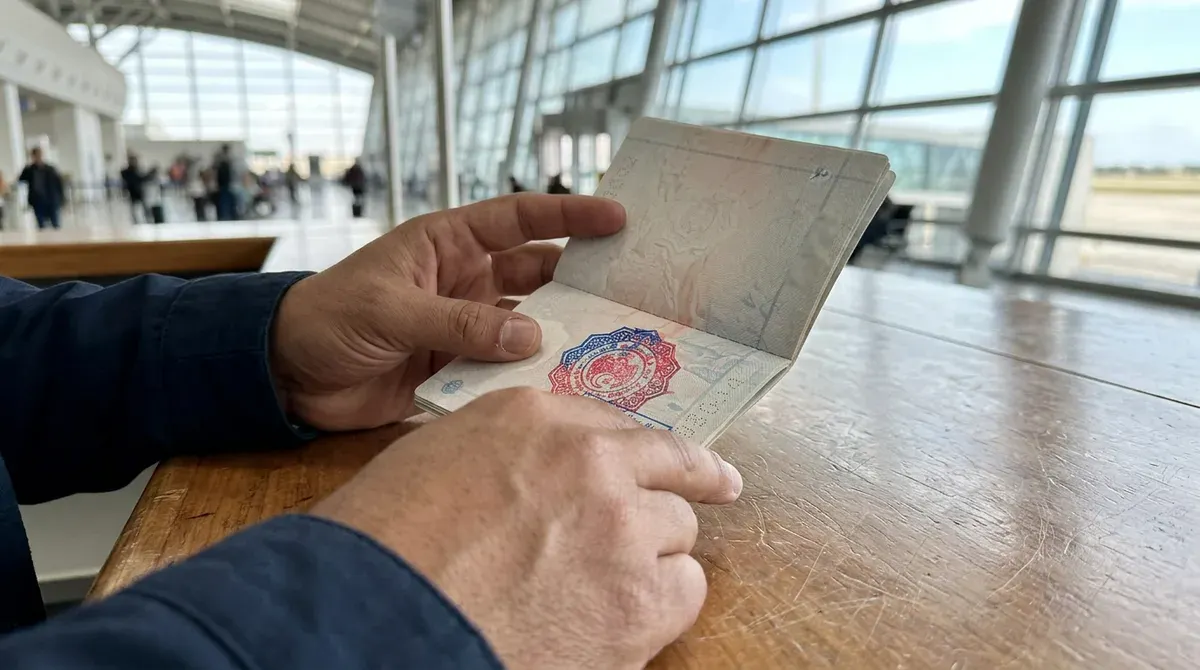
Visa rules depend on your nationality and your route. U.S. citizens need an Algerian visa before travel, with one exception: travel to certain southern cities with an approved travel agency. Before you book, confirm whether your itinerary falls under that exception, because it changes what paperwork you need.
Your passport also has to meet a validity rule. For U.S. travelers, it must be valid for six months beyond your arrival date, so check the expiry date now rather than after your flights are booked.
Requirements for other nationalities may differ, so start with the rules for your own passport. Then check them again once your route is set, since the cities you visit can matter as much as where you are from. Your checklist should include:
- A passport valid for six months beyond arrival
- A visa for your nationality, or confirmation that your southern route qualifies for the exception
- Authorization for any drones, binoculars or telescopes you plan to bring
Photographers should pay special attention to equipment. UK government guidance says drones, binoculars, telescopes and some photography equipment require authorization before you bring them into Algeria. If your camera kit includes a long lens or a drone for the desert, sort out that paperwork early, well before you pack.
Is Algeria Safe to Visit Right Now?
Algeria is open to travelers who plan carefully, and official advice is clearest about the edges of the country. The borders and the far south carry the most caution, so the first step is to match your route against the warnings before you book anything.
The U.S. advisory is Level 2, and it advises against travel to specified border and southern areas. Read the named areas closely, because the restrictions apply to specific zones rather than to the whole country. The same advisory says not to make long overland Sahara journeys outside an organized tour group, which is why desert trips need a guide, a vehicle and a schedule arranged in advance.
The UK Foreign, Commonwealth & Development Office is even more specific about borders. It advises against all travel within 30 kilometres of Algeria’s borders with Libya, Mauritania, Mali and Niger, and it lists specified areas along the Tunisia border as well. Algiers, Tipaza and the Kabylie hills lie well away from those zones, so the routes in this guide stay clear of the strictest advice.
Remote desert areas also need organized support. Fuel, water and help with breakdowns are hard to find far from towns, so a trip into the Tassili n’Ajjer plateau or the Djanet oasis region should be arranged before you leave home.
Equipment needs the same forethought. Before you pack, check the list for each item in your kit:
– Confirm which of your cameras, lenses and optics need authorization – Ask about drone permission early, since it can take time – Keep copies of every approval with your passport – Pack any restricted equipment only after the paperwork is settled
Best Time, Getting Around and Money Matters
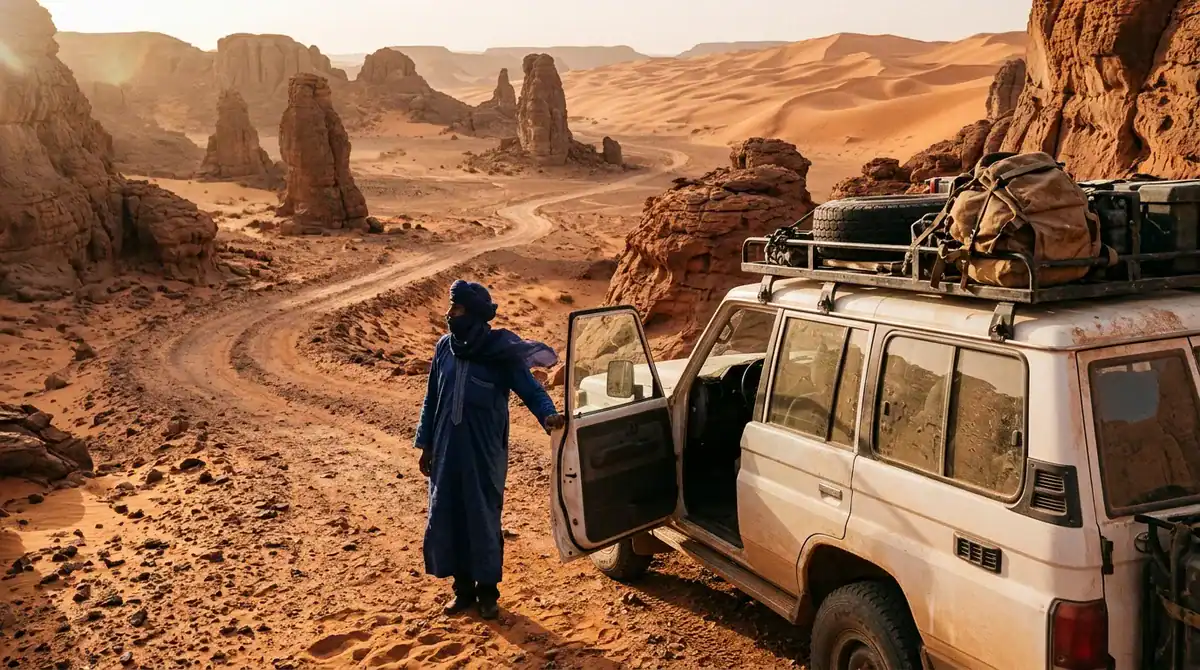
The best months for the north are spring and autumn, when the days are warm and the coastal evenings are mild. Summer can be hot and crowded along the shore, so if you go then, plan your sightseeing for early morning and late afternoon. The Sahara follows its own pattern. Days in the desert can be very hot, and nights can turn cold, so cooler months suit a desert trip best.
Air travel is the quickest way to cover long distances, while trains and buses are good for the coast and the main northern towns. A rental car gives you the most freedom in the Kabylie hills, but roads outside the cities can be slow. Desert travel is usually arranged through a tour operator, because fuel, water, vehicles and guides are hard to find far from towns, and the Tassili n’Ajjer plateau is visited only with an official guide.
Algiers metro tickets are inexpensive. A single ride costs 50 Algerian dinars, and a ten-ride pack costs 400 dinars, so it works out cheaper per trip if you plan several journeys. The airport train costs 80 dinars to central Algiers, which makes it an easy first ride after you land.
The currency is the Algerian dinar, so exchange some money before you head south. ATMs are available in Algiers and other big cities, but they can run out of cash or fail, so do not rely on them alone. In smaller towns and across the desert, carry enough cash for fuel, meals and guides. Keep small notes for taxis, markets and tea stops.
Pack for a climate that changes quickly. Your kit should include:
– Light layers for the coast and the mountains – A hat, sunglasses and high-factor sunscreen for the desert sun – A warm fleece or jacket for cold desert nights – Sturdy shoes with good grip for stone streets and trails
Buy a local SIM card at the airport or in the city with your passport, then check coverage for your route. Signal fades in remote areas, so download offline maps before you leave town. Algeria uses European-style round plugs, so bring an adapter, and check your devices before plugging them in.
Mapping Out Your First Algeria Trip
Your next step is to pick one of the three routes and write it down with dates. A northern loop through Algiers, the coast and Timgad fits into several days, while a desert add-on needs its own block of about a week. Sketch that on paper before you look at flights, because the dates will shape everything else.
Then work through the checklist in order. Confirm your passport’s expiry date, look up the visa rule for your nationality, and check whether your planned southern cities fall under the travel-agency exception. If drones, binoculars or a long lens are on your packing list, start that authorization now rather than at the airport.
If the Tassili n’Ajjer plateau is on your list, contact a tour operator and ask for a day-by-day route, the name of your official guide, and details of the vehicle, water and fuel arrangements. Save that reply alongside copies of your passport and visa. Once those answers are in hand, you can book the north and the desert with confidence and turn to the fun part: choosing which Roman street you will photograph first.