
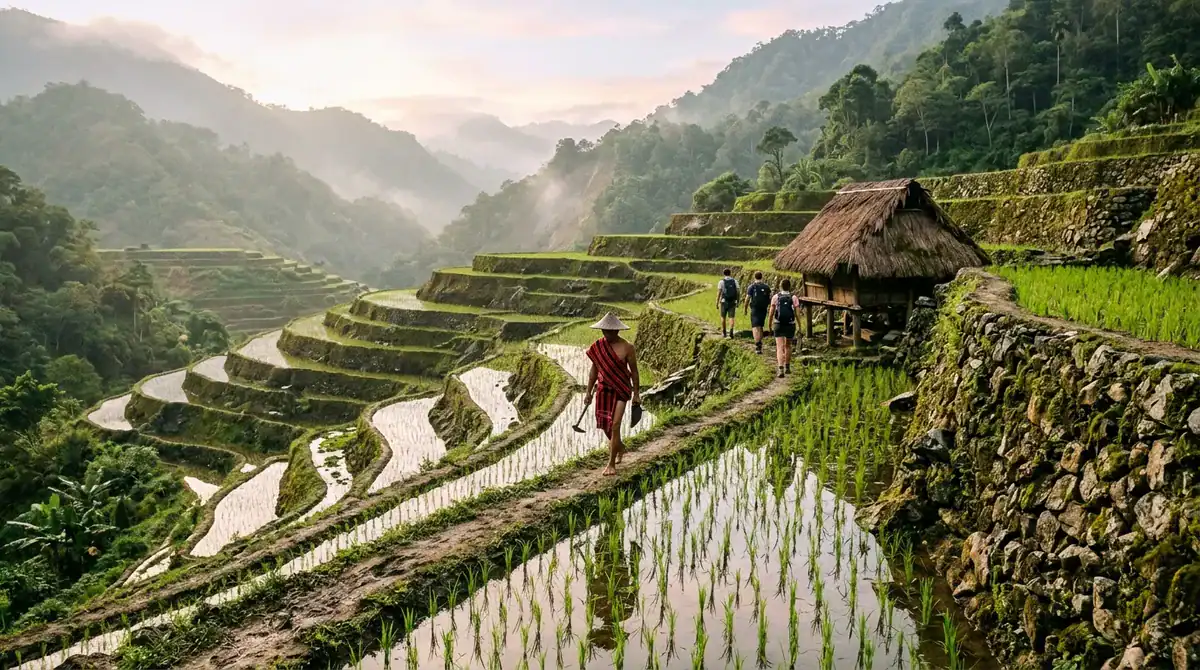
The Banaue rice terraces are not a single viewpoint. They are part of a larger living landscape: the Rice Terraces of the Philippine Cordilleras, inscribed by UNESCO in 1995 as five clusters across four municipalities. Banaue holds two of those clusters, which most travelers reach first. Batad is an amphitheatre-like bowl of paddies with a village at its base, and Bangaan is a set of terraces backing a traditional Ifugao village. Knowing how these clusters differ will help you choose your base, decide how many days to stay, and plan which walks to take.
Getting there takes planning too. The overnight bus from Manila runs about 9 to 10 hours, and a two-day, one-night trip typically costs roughly ₱2,500 to ₱4,500 per person, according to the Philippines travel guide, though local fees vary. The most important check is access. Executive Order No. 71 took effect on November 21, 2025, suspending outdoor tourism activities in Banaue, including hiking on two named trails, until further notice. Confirm the current status before you book anything. Once you have, the terraces can reward you with the quiet, layered views they are known for.
Key Takeaways
- Each Ifugao household’s forest on the slope above its paddies counts as part of the farm.
- Plan for two days, since a single day leaves little room once travel time to the village is counted.
- Travelers should plan other lodging, since the state-owned Banaue Hotel & Youth Hostel closed in April 2024.
- Presidential Decree No. 1501 penalizes altering the terraces, so visitors should always keep to the marked paths.
- Start community consent conversations early if you plan to fly a drone, because permission takes time to arrange.
Where Are the Banaue Rice Terraces Located?
The Banaue rice terraces sit in Ifugao, a mountain province in northern Luzon, but the UNESCO listing covers far more ground than the town itself. The 1995 inscription is a network of clusters, not one continuous site, so it helps to think of Banaue as a gateway to two of those clusters rather than the terraces themselves.
The protected listing does not include every terrace in Ifugao. Paddies you pass on the road into town may be beautiful, but they sit outside the clusters UNESCO recognizes. That is why the famous viewpoints near Banaue feel different from a walk into the protected clusters.
The viewpoints suit a short stop. You stand at a lookout, take in the sweep of stepped paddies below, photograph the valley, and move on. If you have only a morning or a single day, this is the most efficient way to see the terraces from above.
Batad is a different experience. Its terraces curve around a bowl-shaped amphitheatre, with the village at the bottom, so you are inside the scenery rather than looking down on it. The walk is the first part of the visit. From the Saddle, it takes about 20 minutes downhill on foot into the village, and every step gives you a new angle on the paddies.
Bangaan works well for a quieter pace. Here the terraces rise behind a traditional Ifugao village, so farming and daily life happen in the same view. Spend time wandering the paths, and you will see how the paddies and houses share the same slope.
For a short trip, base yourself in Banaue town, take in one or two viewpoints, and pick one cluster for a half-day walk. For a slower visit, choose Batad or Bangaan as your base and stay overnight in the cluster itself. Trying to cover both clusters in one rushed stay usually leaves you with less time to enjoy either.
How Do the Terraces Keep Working?
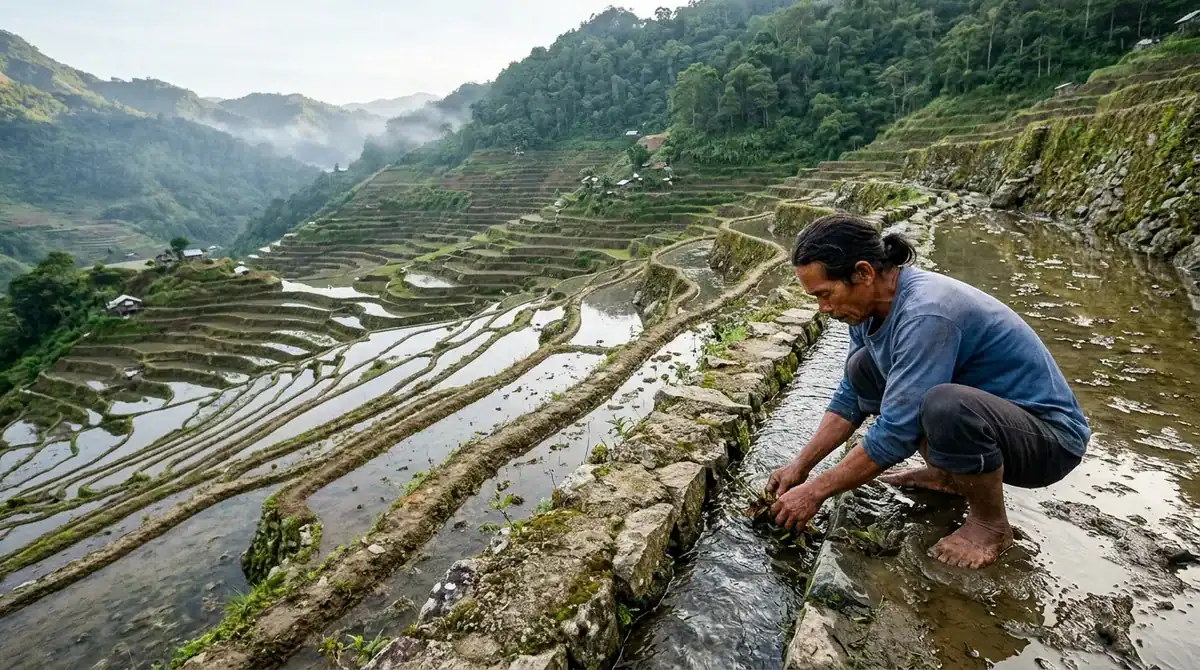
The terraces keep working because of a system of water, forest and farming that communities have tended for around 2,000 years. Rice grows on the stepped paddies, but those paddies depend on people who manage the water, the land above them, and the labor of planting and harvesting together.
A Department of Environment and Natural Resources account of the Ifugao terrace system describes it as covering approximately 20,000 hectares, and it breaks the system into three connected parts that Ifugao farmers have long used. The first is the payoh, the terraces themselves, the carved steps where rice is planted and grown.
The second is the muyong, family forests on the slopes above the paddies. Each household looks after its own wooded land, so the trees and soil higher up are part of the farm, not separate from it.
The third is the ala, the irrigation canals. They carry water from the upper slopes down through the system, so each paddy receives water only after the one above it has been filled. Follow a canal with your eye and the logic becomes clear: the forest feeds the canal, the canal feeds the top step, and the water keeps moving down until it reaches the valley floor.
That network needs constant attention. Walls have to be repaired, channels cleared, and water shared fairly among families. Much of that work is done by neighbors rather than a single owner. Cooperation is what keeps the paddies green year after year.
Ritual sits alongside the physical work. Communities mark planting and harvest with ceremonies that tie the farming calendar to shared beliefs and turn a season of labor into a community event. Harvest time tends to bring villages together, with work in the fields followed by celebration. The specific rites vary between villages, so if you visit during planting or harvest, keep your eyes open and follow the lead of the people around you.
When you stand at a viewpoint, the terraces look like a sculpture. Knowing that every step depends on the forest above and the canal beside it turns a pretty picture into a working system of farmland.
How Do You Get to Banaue from Manila?
You reach Batad from Manila in three stages: an overnight bus to Banaue, a ride up to the Saddle, and a downhill walk into the village. The bus covers the long distance in an estimated 9 to 10 hours, so most travelers board in the evening and wake up in the mountains. Give yourself a slow morning before the next leg rather than rushing straight on.
The rest of the route is short, but it involves a few decisions along the way. Work through these steps in order.
- Board the overnight bus from Manila and settle in for roughly 9 to 10 hours on the road.
- Arrive in Banaue and arrange your ride up to the Saddle, the point where vehicle travel ends and the walk begins.
- Choose a tricycle, which typically costs ₱800 to ₱1,000 for the Banaue-to-Saddle leg, or a public jeepney, which costs around ₱150 and is the budget option.
- Step off at the Saddle, shoulder your bag, and start walking downhill.
- Walk for about 20 minutes into Batad village, where the paddies begin to close in around the path.
Schedules and fares change, so confirm bus departure times, tricycle rates and jeepney fares with local operators before you travel. Ask at your bus company and at your accommodation in Banaue, since they usually hear the latest updates first. Keep small peso notes handy, because drivers may not have change for larger bills.
Pack light for the walk. Every step into the village is downhill, but you will carry your bag back up the same path when you leave, so a small daypack with water and a light layer makes the journey far easier. Take your time on the first stretch, because the first glimpse of the bowl of terraces is worth pausing for.
What Does a Visit Cost, and Where Should You Stay?
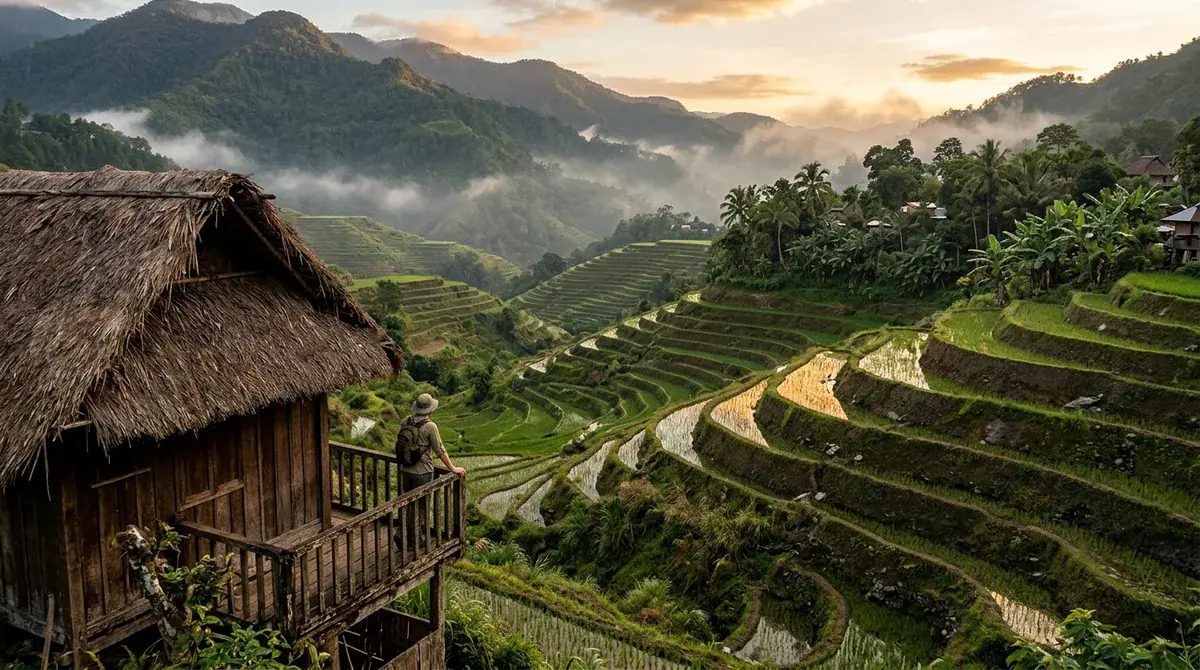
A two-day, one-night visit to the Batad terraces typically costs about ₱2,500 to ₱4,500 per person when you arrange it yourself. Your choice of where to sleep is the main factor that moves the total up or down. Budget-minded travelers can stay in a village homestay, while luxury travelers will need to look beyond Banaue’s state-owned hotel for now.
Start with the small fixed costs. Registration at the Banaue Tourism Office runs ₱20 to ₱50, a minor line item next to lodging and transport. Local fees and guide rates vary, so confirm current amounts with local offices before you finalize your budget.
- Banaue Tourism Office registration: ₱20 to ₱50
- Basic Batad homestay: ₱600 to ₱1,200 per night
- Two-day, one-night do-it-yourself trip: about ₱2,500 to ₱4,500 per person
Basic homestays in Batad are the most affordable way to sleep inside the amphitheatre of terraces. Expect a simple room rather than resort-style comfort, and remember that everything you need for the night has to be carried down the path from the Saddle. Pack a light bag and a clear plan for what you need. That keeps the stay comfortable and your costs predictable.
Banaue’s largest option has been out of service for some time. The state-owned, 81-room Banaue Hotel & Youth Hostel closed in April 2024 for renovation, and reopening is expected in June 2027. Do not plan your trip around it. Instead, look for other lodging in Banaue town or in the villages, and compare the options against the transport and walking time they require.
For budget travelers, the homestay route keeps the trip affordable and puts you closer to village life. For luxury travelers, the honest advice is to set expectations early, choose lodging with comfort in mind, and accept that the experience here is built around the landscape rather than polished service. Either way, keep a buffer in your budget, since fees and rates can change before you go.
Which Hiking Routes Should You Check Before You Go?
Two named hiking trails are currently suspended. Executive Order No. 71, issued by Banaue Mayor Donald Mongolnon, took effect on November 21, 2025, and suspends outdoor tourism activities in Banaue until further notice. The order specifically covers hiking on the Banaue View Point–Bocos trail and the Banaue Pula–Cambulo–Batad trail, so neither should appear in your itinerary until the status changes.
The order is broader than those two trail names. It covers outdoor tourism activities, and the trails are listed as examples of what is included. That means your plans for the viewpoints above Banaue need checking too. A lookout stop may feel like the simplest part of a trip, but it is still an outdoor activity under the order, so confirm it along with any walk.
Batad remains the walk that shapes most visits to the cluster. Once you reach the village, the terrace-level paths wind between the paddies and around the bowl’s curves, giving you a close view of the walls, the water channels and the houses at the base. Walking these paths slowly is what makes the cluster feel like a place you move through, not one you simply look at.
Because the status can change, treat the suspension as the first thing to check, not the last. Contact the Banaue Local Government Unit before you book anything. Ask which trails and viewpoints are open, and whether the route from the Saddle into Batad is affected. Those answers should shape your route, your number of days and your base.
Once you have confirmed the status, ask the people you plan to meet for details as well. Lodging hosts and local guides usually know which paths are in use and which are quiet, and their advice can help you adjust a plan on short notice. Keep a backup itinerary that uses open ground, so a closed trail does not turn your trip into a scramble.
If you want the details, the Philippine Information Agency report on the suspension sets out what was halted and when. Check it alongside the local office, since the local office has the latest word.
How Are the Terraces Recovering from Typhoon Uwan?
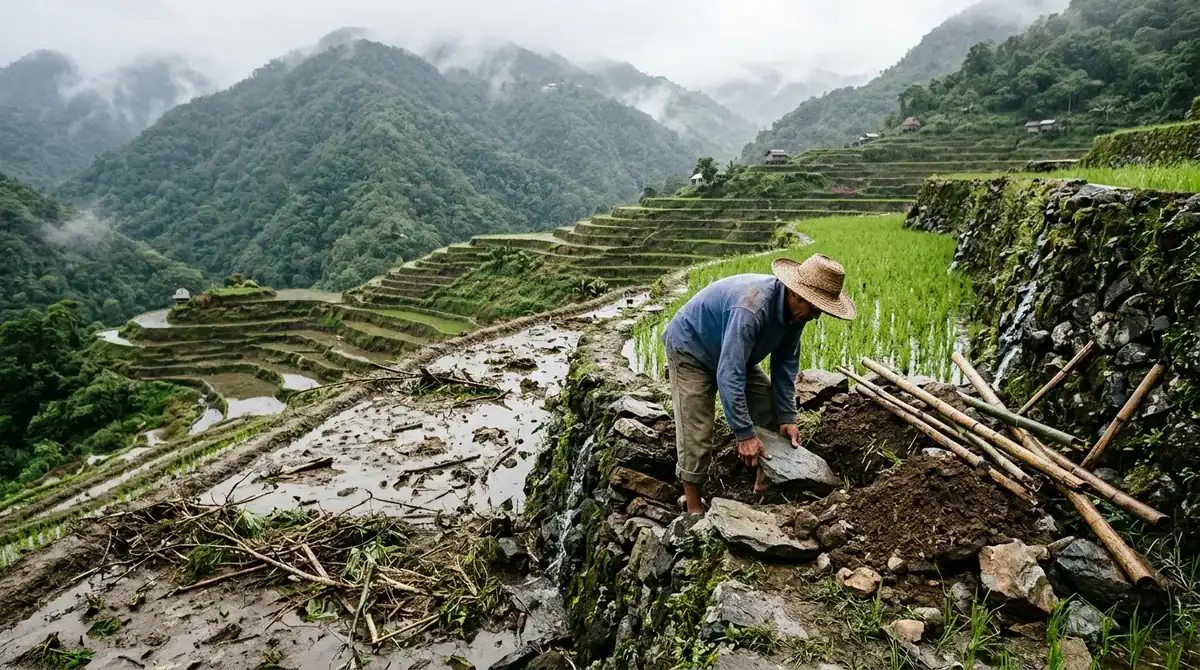
Typhoon Uwan, which struck in November 2025, caused landslides and soil erosion that affected more than 80 rice paddies in Batad. Repairs since then have drawn on local labor, as described below.
Heavy rain loosens soil on steep slopes. When the earth above a paddy gives way, stone walls, earth banks and canals can be buried or washed out. Because water moves from one step to the next, a break in one place can starve the paddies below it.
Repair work has been organized through the Department of Labor and Employment’s TUPAD program. A July 2026 report on the community-led restoration documents that 128 Batad residents were hired for 20 days of irrigation-system clearing and terrace repair. Their work is practical: clearing blocked channels and rebuilding walls so water can reach each paddy again.
The terraces have been legally protected for decades. Presidential Decree No. 260 identified them as a national landmark in 1973. Presidential Decree No. 1501 amended that in 1978 to penalize modification, alteration, repair or destruction of the original features of a national landmark. The walls and channels that have been in place for generations are protected as part of the landscape.
That is why visitors should never alter the terraces or walk on them. A footstep on a wall can start a slump, a stone moved out of place can change how water flows to the family below, and a shortcut across a paddy can wash away soil that took seasons to build. The simple rule is to keep to the marked paths and never step onto a paddy.
Small habits make a real difference. Sit on the path rather than on a wall, carry out every piece of trash you bring in, and photograph the paddies from the edge rather than leaning over them. If a channel looks blocked or a wall looks cracked, leave it alone and tell your host, who can pass the word to the people already doing the repairs.
How Do You Visit the Villages Respectfully?
Respecting the villages means following the lead of the people who farm and live there. Stay on the paths, keep off the paddies, carry out everything you bring in, and ask before you photograph anyone or any private home.
The village footpaths are also the working edges of the fields, so the same habits apply on every slope. Walk single file where the walls are narrow, and keep children within arm’s reach, since a small slip on a bank can flatten young seedlings or send soil sliding off a wall. Families with toddlers may find a baby carrier easier than a stroller on these steps.
The main courtesies come down to four habits:
- Stay on the paths and never step onto a paddy.
- Pack out all trash, including wrappers, bottles and tissues.
- Follow the household rules and ask about any area that seems off limits.
- Ask for community consent before you fly a drone.
Rules can differ from one village to the next, so do not assume that what was fine in one place will be fine in another. Your host or local guide is the best source for current expectations, especially during planting or harvest, when work in the fields can take priority over visitors.
Photographers have a few extra steps. Ask residents before you photograph people, and ask before you frame a private home, even when the view is irresistible. A friendly greeting and a clear explanation of what you want to shoot usually make the answer easy, and if the answer is no, accept it gracefully.
Drones need the most care. Community consent comes first, so raise your plans with your host well before the day of the flight, and let them help you find the right people to ask. If permission is not given, leave the drone in your bag and use the height of a viewpoint instead.
Planning Your Own Trip to the Rice Terraces
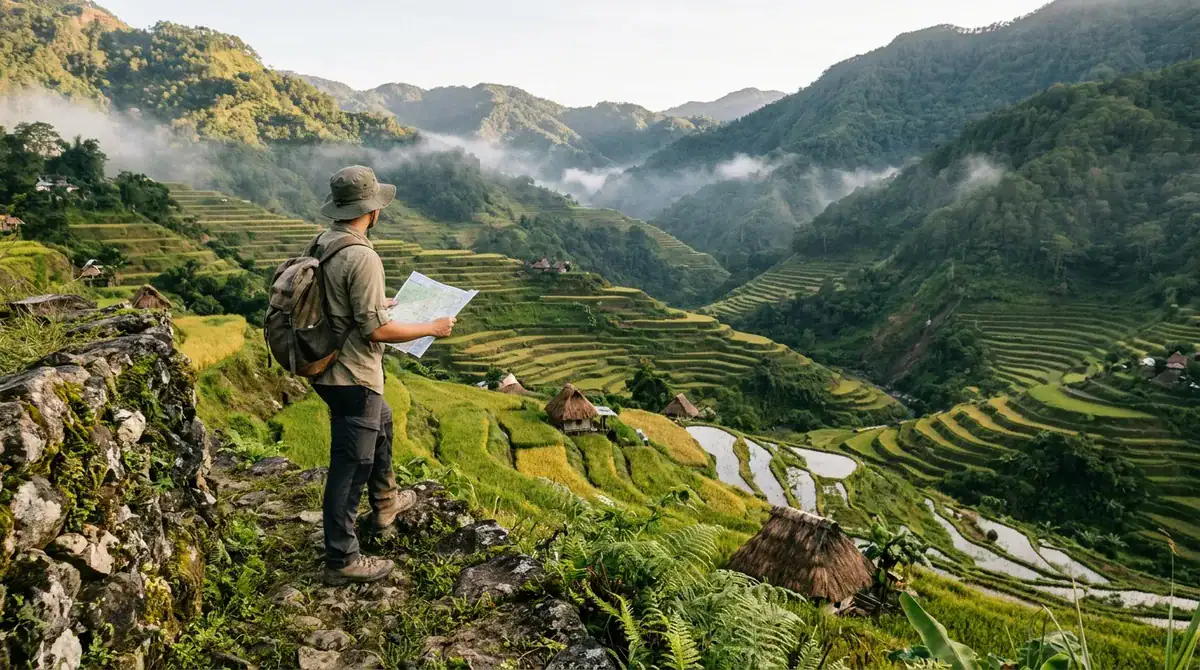
Planning works best in a clear order. Start by choosing your cluster: Batad for the bowl of terraces with a village at its base, Bangaan for paddies rising behind a traditional village, or the viewpoints if you only have a few hours. Next, check whether Executive Order No. 71 still suspends the trails and lookouts you have in mind, since that decides which routes you can walk. Then confirm your lodging and fares, and only after that arrange transport from Manila, so your bus seat matches the plan you have built.
Give yourself two days and one night. A single day leaves little room once the overnight bus, the ride to the Saddle and the walk down into the village are counted, and every stop turns into a rush. With two days, you can arrive in the morning, wander the paths at an unhurried pace, watch the light move across the paddies, and rest before the climb back out.
The terraces have held their shape for generations. With a little planning, your own journey through the mountains can begin to take form.
Your Next Steps Before You Go
Your next step is a single message to the Banaue Local Government Unit, sent before you book a bus seat. Ask three things: whether outdoor tourism is still suspended, which trails and lookouts are open, and whether the path from the Saddle into Batad is clear. Write the answers in your notes with the date, so you have a record if a guide or checkpoint asks.
Then match the cluster to your time. With two full days and an appetite for slow walking, book a Batad homestay and plan to reach the Saddle in the morning, so the downhill walk happens in daylight. If you prefer a quieter pace, make Bangaan your daytime walk and keep your route to the paths you have confirmed.
Next, send your host a short list of questions. Ask which paths residents are using this week, whether any fields are being harvested, and where photography is welcome. Raise drone plans early, because community consent takes time to arrange and should never be rushed on the morning of a flight.
Finally, prepare a backup day. Pack a small daypack, keep plenty of small peso notes, and plan an alternative: a morning at an open viewpoint if one is allowed, or an unhurried afternoon resting at your lodging while you wait for the latest update from the local office.